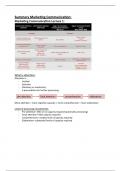
Summary Marketing Communication:
Marketing Communication Lecture 1:
What is attention:
Attention is …
- Limited
- Selective
- Voluntary or involuntary
- A precondition for further processing
More attention = more cognitive capacity = more comprehension = more elaboration
Levels of processing /involvement:
- Pre-attention= little or no capacity required (automatic processing)
- Focal attention= little capacity required
- Comprehension= modest level of capacity required
- Elaboration= substantial levels of capacity required
,How campaigns can stand out: Attracting Attention
Increasing – Involuntary attention:
- Various communication cues can increase an automatic orienting response
o Salient, original, and novel stimuli (1. Saliency)
o Centrally located stimuli (2. Horizontal Centrality)
o Stimuli presented first (3. Primacy)
o Pictures (4. Picture Superiority)
- Oftentimes unconscious and unintended
- “Attractors”
- Associated with bottom-up processing= when a consumer tries to process info, he
starts from the simple concrete steps what he sees, smells, hears, feels. Goes from
the pure objective facts to form an opinion.
- Top-down processing= use what we already know to form opinions, your knowledge
scheme is already quite elaborate.
1. Saliency:
Salient stimuli:
- Perceptually prominent (size, colour, contrast, …)
- Novel, unexpected, and original stimuli
- Stimuli related to life and death
These stimuli:
- Stick out and are hard to ignore
- Lead to mild psychological arousal
- Result in focal attention to the source of stimulation
,2. Horizontal Centrality:
Stimuli in the centre receive more attention (and are more likely to be chosen)
3. Primacy:
Consumers are more attentive to items that are presented first in a list
4. Picture Superiority:
Pictorial information receives more information than textual information
To what elements do consumers pay most attention?
- Pictures: attract attention, regardless of size
- Text: the bigger the text, the more attention
- Brand: the biggen the brand name, the more attention
, Increasing – Voluntary attention:
- How to increase voluntary attention?
o Increase self-relevance
▪ Personal interest avoids inattentional blindness
▪ Self-referencing
▪ Proximity
▪ …
o Curiosity
▪ Unfinished ads
▪ Mysterious ads
▪ …
- Oftentimes conscious and intended
- “Magnetizers”
- Associated with top-down processing= use what we already know to form opinions,
your knowledge scheme is already quite elaborate. Asses the info based on what I
already know with knowledge schemas.
1. Personal Interest and Inattentional Blindness:
- Consumers allocate more attention to information that is consistent with their goals
- Information that is not relevant, is often ignored, and will lead to inattentional
blindness
- Implications for SEA and SEO
o Organic results generate more attention and traffic because they are
immediately relevant
o Sponsored results often suffer from inattentional blindness
Marketing Communication Lecture 1:
What is attention:
Attention is …
- Limited
- Selective
- Voluntary or involuntary
- A precondition for further processing
More attention = more cognitive capacity = more comprehension = more elaboration
Levels of processing /involvement:
- Pre-attention= little or no capacity required (automatic processing)
- Focal attention= little capacity required
- Comprehension= modest level of capacity required
- Elaboration= substantial levels of capacity required
,How campaigns can stand out: Attracting Attention
Increasing – Involuntary attention:
- Various communication cues can increase an automatic orienting response
o Salient, original, and novel stimuli (1. Saliency)
o Centrally located stimuli (2. Horizontal Centrality)
o Stimuli presented first (3. Primacy)
o Pictures (4. Picture Superiority)
- Oftentimes unconscious and unintended
- “Attractors”
- Associated with bottom-up processing= when a consumer tries to process info, he
starts from the simple concrete steps what he sees, smells, hears, feels. Goes from
the pure objective facts to form an opinion.
- Top-down processing= use what we already know to form opinions, your knowledge
scheme is already quite elaborate.
1. Saliency:
Salient stimuli:
- Perceptually prominent (size, colour, contrast, …)
- Novel, unexpected, and original stimuli
- Stimuli related to life and death
These stimuli:
- Stick out and are hard to ignore
- Lead to mild psychological arousal
- Result in focal attention to the source of stimulation
,2. Horizontal Centrality:
Stimuli in the centre receive more attention (and are more likely to be chosen)
3. Primacy:
Consumers are more attentive to items that are presented first in a list
4. Picture Superiority:
Pictorial information receives more information than textual information
To what elements do consumers pay most attention?
- Pictures: attract attention, regardless of size
- Text: the bigger the text, the more attention
- Brand: the biggen the brand name, the more attention
, Increasing – Voluntary attention:
- How to increase voluntary attention?
o Increase self-relevance
▪ Personal interest avoids inattentional blindness
▪ Self-referencing
▪ Proximity
▪ …
o Curiosity
▪ Unfinished ads
▪ Mysterious ads
▪ …
- Oftentimes conscious and intended
- “Magnetizers”
- Associated with top-down processing= use what we already know to form opinions,
your knowledge scheme is already quite elaborate. Asses the info based on what I
already know with knowledge schemas.
1. Personal Interest and Inattentional Blindness:
- Consumers allocate more attention to information that is consistent with their goals
- Information that is not relevant, is often ignored, and will lead to inattentional
blindness
- Implications for SEA and SEO
o Organic results generate more attention and traffic because they are
immediately relevant
o Sponsored results often suffer from inattentional blindness