

Pentose Phosphate Pathway
11 August 2020 13:59
Regulation, Purpose and Importance in Human Health
• It is also known as Hexose Monophosphate Shunt
• Occurs in virtually all cell types and tissues
○ Liver - 30% glucose metabolised by pentose phosphate pathway
• Occurs in the cytoplasm
• Produces NADPH
○ NADPH necessary for several pathways:
> Fatty acid synthesis (50%)
> Oxidative Stress Homeostasis
> Cytochrome P450 Enzymes
• Produces Trioses, Hexoses, and Pentoses
○ Pentoses necessary for nucleotide synthesis
It generates NADPH and pentoses (5-carbon sugars) as well as ribose 5-phosphate, a
precursor for the synthesis of Nucleotides.
Pentose phosphate pathway (PPP) plays a critical role in regulating cancer cell growth by
supplying cells with not only ribose-5-phosphate but also NADPH for detoxification of
intracellular ROS (Reactive Oxidative Species), reductive biosynthesis, and ribose biogenesis.
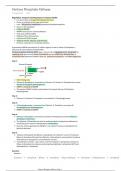
Step 1:
• Rate limiting step
• Glucose-6-Phosphate is converted into Glucono-1,5-lactone-6- Phosphate by enzyme
Glucose-6-Phosphate Dehydrogenase.
• NADP+ is reduced to NADPH
• The product NADPH inhibits and activates the enzyme Glucose-6-Phosphate
Dehydrogenase
Step 2:
• Glucono-1,5-lactone-6- Phosphate is converted to 6- Phosphogluconate
Step 3:
• 6-Phosphogluconate is converted into Ribulose -5- Phosphate by enzyme 6-
Phosphogluconate Dehydrogenase.
• NADP+ is reduced to NADPH
Step 4:
• Ribulose-5-Phosphate is converted to Xylulose-5-Phosphate by enzyme Ribulose-
phosphate-3-epimerase.
• The Xylulose-5-Phopshate can then be redirected back into glycolysis pathway by
converting into Fructose-6-phosphate by transketolase.
• Once the cell has generated its NADPH, it can redirect Fructose-6-phosphate into
glycolysis pathway.
Step 5:
• Xylulose-5-phosphate and Ribose-5-phosphate are involved in a series of reactions.
Ribose-5-phosphate (formed from Ribulose-5-phosphate by isomerization) combines
with Xylulose-5-phosphate in a transketolase reaction.
• Transketolase transfers a two-carbon unit from Xylulose-5-phosphate (a ketose) to
Ribose-5-phosphate (an aldose), producing Glyceraldehyde-3-phosphate (G3P) and
Sedoheptulose-7-phosphate.
Reaction:
Step 6:
Pentose Phosphate Pathway Page 1
11 August 2020 13:59
Regulation, Purpose and Importance in Human Health
• It is also known as Hexose Monophosphate Shunt
• Occurs in virtually all cell types and tissues
○ Liver - 30% glucose metabolised by pentose phosphate pathway
• Occurs in the cytoplasm
• Produces NADPH
○ NADPH necessary for several pathways:
> Fatty acid synthesis (50%)
> Oxidative Stress Homeostasis
> Cytochrome P450 Enzymes
• Produces Trioses, Hexoses, and Pentoses
○ Pentoses necessary for nucleotide synthesis
It generates NADPH and pentoses (5-carbon sugars) as well as ribose 5-phosphate, a
precursor for the synthesis of Nucleotides.
Pentose phosphate pathway (PPP) plays a critical role in regulating cancer cell growth by
supplying cells with not only ribose-5-phosphate but also NADPH for detoxification of
intracellular ROS (Reactive Oxidative Species), reductive biosynthesis, and ribose biogenesis.
Step 1:
• Rate limiting step
• Glucose-6-Phosphate is converted into Glucono-1,5-lactone-6- Phosphate by enzyme
Glucose-6-Phosphate Dehydrogenase.
• NADP+ is reduced to NADPH
• The product NADPH inhibits and activates the enzyme Glucose-6-Phosphate
Dehydrogenase
Step 2:
• Glucono-1,5-lactone-6- Phosphate is converted to 6- Phosphogluconate
Step 3:
• 6-Phosphogluconate is converted into Ribulose -5- Phosphate by enzyme 6-
Phosphogluconate Dehydrogenase.
• NADP+ is reduced to NADPH
Step 4:
• Ribulose-5-Phosphate is converted to Xylulose-5-Phosphate by enzyme Ribulose-
phosphate-3-epimerase.
• The Xylulose-5-Phopshate can then be redirected back into glycolysis pathway by
converting into Fructose-6-phosphate by transketolase.
• Once the cell has generated its NADPH, it can redirect Fructose-6-phosphate into
glycolysis pathway.
Step 5:
• Xylulose-5-phosphate and Ribose-5-phosphate are involved in a series of reactions.
Ribose-5-phosphate (formed from Ribulose-5-phosphate by isomerization) combines
with Xylulose-5-phosphate in a transketolase reaction.
• Transketolase transfers a two-carbon unit from Xylulose-5-phosphate (a ketose) to
Ribose-5-phosphate (an aldose), producing Glyceraldehyde-3-phosphate (G3P) and
Sedoheptulose-7-phosphate.
Reaction:
Step 6:
Pentose Phosphate Pathway Page 1


