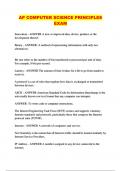
AP COMPUTER SCIENCE PRINCIPLES
EXAM
Innovation - ANSWER A new or improved idea, device, product, or the
development thereof.
Binary - ANSWER: A method of representing information with only two
alternatives.
Bit rate refers to the number of bits transferred or processed per unit of time.
For example, 8 bits per second.
Latency - ANSWER The amount of time it takes for a bit to go from sender to
receiver.
A protocol is a set of rules that regulate how data is exchanged or transmitted
between devices.
ASCII - ANSWER American Standard Code for Information Interchange is the
universally known raw text format that any computer can interpret.
ANSWER: To write code or computer instructions.
The Internet Engineering Task Force (IETF) creates and supports voluntary
Internet standards and protocols, particularly those that compose the Internet
protocol suite (TCP/IP).
Internet - ANSWER A network of computers and servers.
Net Neutrality is the notion that all Internet traffic should be treated similarly by
Internet Service Providers.
IP Address - ANSWER A number assigned to any device connected to the
internet.
, Packets - ANSWER Small pieces of information deliberately crafted from
larger amounts of data.
Network redundancy is having numerous backups to provide resilience in the
event of high usage or breakdown.
A router is a machine that relays data over a network.
TCP - ANSWER Transmission Control Protocol - delivers a stream of packets
on the internet in a reliable, organized, and error-free manner. TCP is
inextricably tied with IP and is commonly referred to as TCP/IP in writing.
DNS - ANSWER A service that converts URLs into IP addresses.
HTTP (HyperText Transfer Protocol) is the protocol used to transfer web pages
over the internet.
IP Address - ANSWER A number assigned to any device connected to the
internet.
URL - ANSWER A simple address for accessing a webpage.
A heuristic is a problem-solving strategy (algorithm) used to obtain a
satisfactory answer when an optimal or exact solution is impractical or
unachievable.
Lossless compression is a data compression technology that allows the original
data to be precisely rebuilt from the compressed data.
Image - ANSWER A form of data used to create graphics or visuals.
Metadata - ANSWER is information that describes other data. A digital image,
for example, may have information about its size, number of colors, or
resolution.
Pixel (short for "picture element") is the fundamental unit of a digital image,
generally a tiny square or dot containing a single point of color from a larger
image.
EXAM
Innovation - ANSWER A new or improved idea, device, product, or the
development thereof.
Binary - ANSWER: A method of representing information with only two
alternatives.
Bit rate refers to the number of bits transferred or processed per unit of time.
For example, 8 bits per second.
Latency - ANSWER The amount of time it takes for a bit to go from sender to
receiver.
A protocol is a set of rules that regulate how data is exchanged or transmitted
between devices.
ASCII - ANSWER American Standard Code for Information Interchange is the
universally known raw text format that any computer can interpret.
ANSWER: To write code or computer instructions.
The Internet Engineering Task Force (IETF) creates and supports voluntary
Internet standards and protocols, particularly those that compose the Internet
protocol suite (TCP/IP).
Internet - ANSWER A network of computers and servers.
Net Neutrality is the notion that all Internet traffic should be treated similarly by
Internet Service Providers.
IP Address - ANSWER A number assigned to any device connected to the
internet.
, Packets - ANSWER Small pieces of information deliberately crafted from
larger amounts of data.
Network redundancy is having numerous backups to provide resilience in the
event of high usage or breakdown.
A router is a machine that relays data over a network.
TCP - ANSWER Transmission Control Protocol - delivers a stream of packets
on the internet in a reliable, organized, and error-free manner. TCP is
inextricably tied with IP and is commonly referred to as TCP/IP in writing.
DNS - ANSWER A service that converts URLs into IP addresses.
HTTP (HyperText Transfer Protocol) is the protocol used to transfer web pages
over the internet.
IP Address - ANSWER A number assigned to any device connected to the
internet.
URL - ANSWER A simple address for accessing a webpage.
A heuristic is a problem-solving strategy (algorithm) used to obtain a
satisfactory answer when an optimal or exact solution is impractical or
unachievable.
Lossless compression is a data compression technology that allows the original
data to be precisely rebuilt from the compressed data.
Image - ANSWER A form of data used to create graphics or visuals.
Metadata - ANSWER is information that describes other data. A digital image,
for example, may have information about its size, number of colors, or
resolution.
Pixel (short for "picture element") is the fundamental unit of a digital image,
generally a tiny square or dot containing a single point of color from a larger
image.