LIFE SCIENCE-GRADE 11 Lesson 3
--------------------------------------------------------------------------------------------------------------------------------------------------------------------------------------
Support Systems in Animal Skeletons
--------------------------------------------------------------------------------------------------------------------------------------------------------------------------------------
All animals have skeletons to provide support, enable movement in their bodies and for
muscle attachment.
Different Types of Skeletons
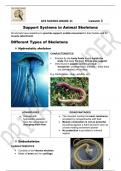
v Hydrostatic skeleton
CHARACTERISTICS
§ Formed by the body fluids found inside the
body that keep the body firm & give support
§ Only found in aquatic (water) and sub
terrestrial (‘underground’) animals – body dries
out (dehydrates) on surface.
E.g. Earthworms, slugs, jellyfish, etc.
ADVANTAGES DISADVANTAGES
• Animals with • The muscles contract & reach resistance
hydrostatic skeleton provided by compartments with fluid
have the advantage of • Muscle contraction is not as powerful
changing their form as pulling against a hard structure such as
a bone making movement slower
• No protection is provided to internal
organs
v Endoskeleton
CHARACTERISTICS
• Consists of an internal skeleton
• Made of bone and /or cartilage
1
, LIFE SCIENCE-GRADE 11 Lesson 3
• Is an adaptation to mostly terrestrial life (land)
E.g. reptiles, mammals, birds, fish & sharks
FUNCTIONS:
• Protect sensitive body parts & organs
• Gives body firmness & shape
• Muscle attachment help with efficient movement
• Produces red blood cells in red marrow found in long bone shafts
• Stores minerals such as calcium, magnesium and phosphorous
ADVANTAGES DISADVANTAGES
• Very strong providing good support to large • No protection from injury
bodies like an exoskeleton
• Muscle attachment to it allows fast and • Cannot change form/shape
efficient movement like a hydrostatic skeleton
• Protects soft internal organs e.g. Lungs,
heart & brain
• Provides storage area for mineral salts
• Endoskeletons produce red blood
cells/erythrocytes
v Exoskeleton
CHARACTERISTICS
§ Consists of an outward skeleton
§ Consists of a shell made of chitin
§ Muscles attach to the inside of the
skeleton
§ Is an adaptation to mostly
terrestrial life (on land/surface)
E.g. Insects, spiders, scorpions, crabs & lobsters
ADVANTAGES DISADVANTAGES
• Animal’s body is very well protected • The animal’s size is limited :
from injury • -A large animal will require a much
• Exoskeleton prevents water-loss thicker exoskeleton for sufficient
(desiccation). muscle movement
• Some animals (e.g. ants) can lift 10 • Animal’s movement will be
times their own body weight because hindered because skeleton will
of their exoskeleton become too heavy
• Internal organs are not protected
as effectively as with an
endoskeleton
2
, LIFE SCIENCE-GRADE 11 Lesson 3
--------------------------------------------------------------------------------------------------------------------------------------------------------------------------------------
--------------------------------------------------------------------------------------------------------------------------------------------------------------------------------------
Human Skeleton
Consists of 206 bones and can be divided into 2 parts:
AXIAL
APPENDICULAR SKELETON
SKELETON
Protects the CNS (brain
& spinal cord) & all the PECTORAL GIRDLE PELVIC GIRDLE
internal organs
Consists of: Consists of: Consists of :
Ø Skull Ø Scapulae (shoulder Ø 2 Pelvic bones
Ø Vertebral column blades) Ø Legs (lower
Ø Ribcage & Ø Clavicles (collar limbs)
Sternum bones)
Ø Arms (upper limbs)
1. The Axial Skeleton
Protects the Central Nervous System (CNS: brain & spinal cord) & internal organs.
Consists of:
§ Skull
§ Vertebral column
§ Ribcage & Sternum
] Skull
3
--------------------------------------------------------------------------------------------------------------------------------------------------------------------------------------
Support Systems in Animal Skeletons
--------------------------------------------------------------------------------------------------------------------------------------------------------------------------------------
All animals have skeletons to provide support, enable movement in their bodies and for
muscle attachment.
Different Types of Skeletons
v Hydrostatic skeleton
CHARACTERISTICS
§ Formed by the body fluids found inside the
body that keep the body firm & give support
§ Only found in aquatic (water) and sub
terrestrial (‘underground’) animals – body dries
out (dehydrates) on surface.
E.g. Earthworms, slugs, jellyfish, etc.
ADVANTAGES DISADVANTAGES
• Animals with • The muscles contract & reach resistance
hydrostatic skeleton provided by compartments with fluid
have the advantage of • Muscle contraction is not as powerful
changing their form as pulling against a hard structure such as
a bone making movement slower
• No protection is provided to internal
organs
v Endoskeleton
CHARACTERISTICS
• Consists of an internal skeleton
• Made of bone and /or cartilage
1
, LIFE SCIENCE-GRADE 11 Lesson 3
• Is an adaptation to mostly terrestrial life (land)
E.g. reptiles, mammals, birds, fish & sharks
FUNCTIONS:
• Protect sensitive body parts & organs
• Gives body firmness & shape
• Muscle attachment help with efficient movement
• Produces red blood cells in red marrow found in long bone shafts
• Stores minerals such as calcium, magnesium and phosphorous
ADVANTAGES DISADVANTAGES
• Very strong providing good support to large • No protection from injury
bodies like an exoskeleton
• Muscle attachment to it allows fast and • Cannot change form/shape
efficient movement like a hydrostatic skeleton
• Protects soft internal organs e.g. Lungs,
heart & brain
• Provides storage area for mineral salts
• Endoskeletons produce red blood
cells/erythrocytes
v Exoskeleton
CHARACTERISTICS
§ Consists of an outward skeleton
§ Consists of a shell made of chitin
§ Muscles attach to the inside of the
skeleton
§ Is an adaptation to mostly
terrestrial life (on land/surface)
E.g. Insects, spiders, scorpions, crabs & lobsters
ADVANTAGES DISADVANTAGES
• Animal’s body is very well protected • The animal’s size is limited :
from injury • -A large animal will require a much
• Exoskeleton prevents water-loss thicker exoskeleton for sufficient
(desiccation). muscle movement
• Some animals (e.g. ants) can lift 10 • Animal’s movement will be
times their own body weight because hindered because skeleton will
of their exoskeleton become too heavy
• Internal organs are not protected
as effectively as with an
endoskeleton
2
, LIFE SCIENCE-GRADE 11 Lesson 3
--------------------------------------------------------------------------------------------------------------------------------------------------------------------------------------
--------------------------------------------------------------------------------------------------------------------------------------------------------------------------------------
Human Skeleton
Consists of 206 bones and can be divided into 2 parts:
AXIAL
APPENDICULAR SKELETON
SKELETON
Protects the CNS (brain
& spinal cord) & all the PECTORAL GIRDLE PELVIC GIRDLE
internal organs
Consists of: Consists of: Consists of :
Ø Skull Ø Scapulae (shoulder Ø 2 Pelvic bones
Ø Vertebral column blades) Ø Legs (lower
Ø Ribcage & Ø Clavicles (collar limbs)
Sternum bones)
Ø Arms (upper limbs)
1. The Axial Skeleton
Protects the Central Nervous System (CNS: brain & spinal cord) & internal organs.
Consists of:
§ Skull
§ Vertebral column
§ Ribcage & Sternum
] Skull
3