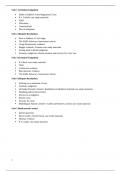
Unit 1 (Criminal Litigation)
Mode of Address in the Magistrates Court
R v. Carlisle case study materials
ABH
Allocation
Contested bail
Plea in mitigation
Unit 2 (Dispute Resolution)
How to Address a Civil Judge
The SQE2 Advocacy Assessment criteria
Using documentary evidence
Badger Limited v Gorman case study materials
Setting aside a default judgment
Summary judgment, interim payment and security for costs: law
Unit 3 (Criminal Litigation)
R v Buck case study materials
Theft
Confession evidence
Bad character evidence
The SQE2 Advocacy Assessment criteria
Unit 4 (Dispute Resolution)
Striking out a statement of case
Summary judgment
Orchadia (Dorset) Limited v Bestboilers (Guildshire) Limited case study materials
Handling judicial intervention
Interest on a judgment
Interim costs
Security for costs
Multilingual Tuition Limited v Cadell and Partners (a firm) case study materials
Unit 5 (both practice areas)
Interim payment
Barry Gould v Rachel Arbor case study materials
Hearsay evidence
R v Cooper case study materials
1
, Advocacy – Course Summary:
UNIT 1: ORAL COMMUNICATION SKILLS AND ADVOCACY
Vocal communication:
Not just what you say, but how you say it.
The term ‘vocal communication’ refers to the way in which you use your voice.
The appropriate use of the voice (for example, in terms of tone of voice and pace) is specifically highlighted
in the SRA Performance Indicators as one element demonstrating competence.
Pitch and Pitch: highness or lowness of voice.
volume:
If someone is nervous the pitch of their voice often becomes higher = lack of confidence
Variations in vocal pitch are useful because they help to bring what is being said to life.
Volume: loudness of voice.
In most situations a natural speaking voice will suffice.
However, in a large courtroom, for example, it may be necessary to increase volume.
Pace: Most people have a natural tendency to speed up their speaking pace when they are nervous. It is
important to fight that tendency.
You should aim to speak calmly but steadily.
Not too quickly, not too slowly.
Tone: Tone allows the speaker to communicate any number of messages: confidence, empathy, contrition,
respect, the seriousness of the situation etc.
It may be necessary to vary the tone when speaking as the subject matter changes.
Verbal Most people pick up verbal mannerisms which become part of their everyday speech. The mannerisms
mannerisms: may be so automatic that the speaker is not even aware of them.
However, in a formal context such mannerisms should be avoided as they can detract from what is being
said and/or distract the listener.
Examples: ‘ok’, ‘good’, ‘like’, ‘yes?’ or filling pauses with a prolonged ‘erm’.
The listener:
The language must cater for the recipient’s level of knowledge and understanding.
Lay person: jargon and technical terms are generally to be avoided or, if there is genuinely no alternative,
they can be used but must be explained.
When speaking to another lawyer, using technical language is more acceptable.
In Interviewing you will be dealing with a client who is likely to have little or no legal knowledge.
In Advocacy your ‘audience’ could not be more legally sophisticated, and this will require you to display
the skill of presenting legal arguments effectively and persuasively whilst maintaining the formalities of
the courtroom.
Listening:
Listening is an underrated skill which requires considerable concentration.
Listening as a solicitor: need to pick up every nuance or recall precisely what was said.
Most authorities on oral communication skills make a distinction between ‘passive listening’ and ‘active
listening’.
Passive listening:
2
, o using silences and other unobtrusive signals to encourage the speaker to continue.
o silence is one of the most powerful techniques available to a solicitor. It may require a conscious
effort to remain silent for longer than normal in the hope that the speaker will fill the void with
more information.
Active listening:
o more obtrusive techniques which demonstrate to the other person that the solicitor has both
heard and understood.
o Most common example: summarising —> giving a short, clear precise summary of what the
speaker has just said.
Questioning:
Open questions:
o Give maximum freedom to the person being questioned, they encourage expansion and they do
not seek to influence the content of the reply:
o ‘So, what happened next?’
o ‘What were your reactions to that?’
o ‘How did you respond to the offer?’
o ‘Why did you do that?’
o ‘Tell me about your relationship with the managing director.’
o ‘Tell me more about ...’
Closed questions:
o Invite a narrow answer, from a few words or a sentence to a ‘yes’/‘no’ reply (sometimes called
‘yes/no questions’):
o ‘Were you also carrying a knife?’
o ‘Did you accept the offer?’
o One particular form of closed question is the leading question. For example, the questioner
might deliberately seek to influence the content of the reply by asking a question which
encourages a particular answer: ‘So you must have been drunk, mustn’t you?’
Non-verbal communication:
Appearance: looking professional inspires confidence in the client. Dress code for SQE2 oral
assessment: clothing suitable for a business environment.
Body language: importance of body language is highlighted in the SRA Performance Indicators for the
SQE2 Client Interviewing Assessment.
o To begin by smiling and making eye contact makes for a confident start and enables you to
establish the all-important connection with the observer from the outset.
o Sitting or standing in a physically relaxed manner can help you feel more relaxed and convey the
impression of confidence to an observer.
ADVOCACY – PREPARING FOR A HEARING:
Advocacy: the art of influencing outcomes, the art of persuasion.
In its legal context, advocacy is the skill of presenting legal argument to a court or tribunal.
Person practicing the skill: advocate.
3
, In the SQE2 Advocacy assessments candidates will be given a case study on which they will conduct a piece
of courtroom advocacy. An email will ask you to conduct the advocacy and tells you in which court you are
appearing. You are likely to be given a file of documents to study.
Two advocacy assessments, questions mat drawn from FLK:
One in Dispute Resolution (Contract Law and Tort); and
One in Criminal Litigation (Criminal Liability).
Questions on ethics and professional conduct will be pervasive.
45 mins to prepare and 15 mins to make submissions to a judge who is present in the room.
The judge will assess you both on skills and application of the law.
NB. You may be asked questions during your advocacy.
You will be assessed on how well you present your case. This may seem obvious, but you must always
remember not to repeat what the court already knows unless it is to emphasise or persuade the court of
something. Simply repeating what the court is already aware of is not advocacy.
Should be concise: do not repeat what you have said unless you want to stress something.
Persuasion: you use the facts that assist you. If the facts do not assist, you try to minimise their impact.
However, you must never lie or knowingly mislead the court.
Skills:
(1) Use appropriate language and behaviour.
(2) Adopt a clear and logical structure.
(3) Present a persuasive argument.
(4) Interact with/engage the court appropriately.
(5) Include all key relevant facts.
Application of law:
(1) Apply the law correctly to the client’s situation.
(2) Apply the law comprehensively to the client’s situation, identifying any ethical and professional
conduct issues and exercising judgment to resolve them honestly and with integrity.
NB. the level of knowledge required for the assessments is that of a Day One solicitor. If the piece of
advocacy requires knowledge of an aspect of the law which a Day One solicitor would have to look up, this
will be given to you in the assessments.
Analysis:
The law
The facts
Identify any gaps and inconsistencies in the facts
Link the facts to the law
Identify any strengths and weaknesses
Structure submissions
4
Mode of Address in the Magistrates Court
R v. Carlisle case study materials
ABH
Allocation
Contested bail
Plea in mitigation
Unit 2 (Dispute Resolution)
How to Address a Civil Judge
The SQE2 Advocacy Assessment criteria
Using documentary evidence
Badger Limited v Gorman case study materials
Setting aside a default judgment
Summary judgment, interim payment and security for costs: law
Unit 3 (Criminal Litigation)
R v Buck case study materials
Theft
Confession evidence
Bad character evidence
The SQE2 Advocacy Assessment criteria
Unit 4 (Dispute Resolution)
Striking out a statement of case
Summary judgment
Orchadia (Dorset) Limited v Bestboilers (Guildshire) Limited case study materials
Handling judicial intervention
Interest on a judgment
Interim costs
Security for costs
Multilingual Tuition Limited v Cadell and Partners (a firm) case study materials
Unit 5 (both practice areas)
Interim payment
Barry Gould v Rachel Arbor case study materials
Hearsay evidence
R v Cooper case study materials
1
, Advocacy – Course Summary:
UNIT 1: ORAL COMMUNICATION SKILLS AND ADVOCACY
Vocal communication:
Not just what you say, but how you say it.
The term ‘vocal communication’ refers to the way in which you use your voice.
The appropriate use of the voice (for example, in terms of tone of voice and pace) is specifically highlighted
in the SRA Performance Indicators as one element demonstrating competence.
Pitch and Pitch: highness or lowness of voice.
volume:
If someone is nervous the pitch of their voice often becomes higher = lack of confidence
Variations in vocal pitch are useful because they help to bring what is being said to life.
Volume: loudness of voice.
In most situations a natural speaking voice will suffice.
However, in a large courtroom, for example, it may be necessary to increase volume.
Pace: Most people have a natural tendency to speed up their speaking pace when they are nervous. It is
important to fight that tendency.
You should aim to speak calmly but steadily.
Not too quickly, not too slowly.
Tone: Tone allows the speaker to communicate any number of messages: confidence, empathy, contrition,
respect, the seriousness of the situation etc.
It may be necessary to vary the tone when speaking as the subject matter changes.
Verbal Most people pick up verbal mannerisms which become part of their everyday speech. The mannerisms
mannerisms: may be so automatic that the speaker is not even aware of them.
However, in a formal context such mannerisms should be avoided as they can detract from what is being
said and/or distract the listener.
Examples: ‘ok’, ‘good’, ‘like’, ‘yes?’ or filling pauses with a prolonged ‘erm’.
The listener:
The language must cater for the recipient’s level of knowledge and understanding.
Lay person: jargon and technical terms are generally to be avoided or, if there is genuinely no alternative,
they can be used but must be explained.
When speaking to another lawyer, using technical language is more acceptable.
In Interviewing you will be dealing with a client who is likely to have little or no legal knowledge.
In Advocacy your ‘audience’ could not be more legally sophisticated, and this will require you to display
the skill of presenting legal arguments effectively and persuasively whilst maintaining the formalities of
the courtroom.
Listening:
Listening is an underrated skill which requires considerable concentration.
Listening as a solicitor: need to pick up every nuance or recall precisely what was said.
Most authorities on oral communication skills make a distinction between ‘passive listening’ and ‘active
listening’.
Passive listening:
2
, o using silences and other unobtrusive signals to encourage the speaker to continue.
o silence is one of the most powerful techniques available to a solicitor. It may require a conscious
effort to remain silent for longer than normal in the hope that the speaker will fill the void with
more information.
Active listening:
o more obtrusive techniques which demonstrate to the other person that the solicitor has both
heard and understood.
o Most common example: summarising —> giving a short, clear precise summary of what the
speaker has just said.
Questioning:
Open questions:
o Give maximum freedom to the person being questioned, they encourage expansion and they do
not seek to influence the content of the reply:
o ‘So, what happened next?’
o ‘What were your reactions to that?’
o ‘How did you respond to the offer?’
o ‘Why did you do that?’
o ‘Tell me about your relationship with the managing director.’
o ‘Tell me more about ...’
Closed questions:
o Invite a narrow answer, from a few words or a sentence to a ‘yes’/‘no’ reply (sometimes called
‘yes/no questions’):
o ‘Were you also carrying a knife?’
o ‘Did you accept the offer?’
o One particular form of closed question is the leading question. For example, the questioner
might deliberately seek to influence the content of the reply by asking a question which
encourages a particular answer: ‘So you must have been drunk, mustn’t you?’
Non-verbal communication:
Appearance: looking professional inspires confidence in the client. Dress code for SQE2 oral
assessment: clothing suitable for a business environment.
Body language: importance of body language is highlighted in the SRA Performance Indicators for the
SQE2 Client Interviewing Assessment.
o To begin by smiling and making eye contact makes for a confident start and enables you to
establish the all-important connection with the observer from the outset.
o Sitting or standing in a physically relaxed manner can help you feel more relaxed and convey the
impression of confidence to an observer.
ADVOCACY – PREPARING FOR A HEARING:
Advocacy: the art of influencing outcomes, the art of persuasion.
In its legal context, advocacy is the skill of presenting legal argument to a court or tribunal.
Person practicing the skill: advocate.
3
, In the SQE2 Advocacy assessments candidates will be given a case study on which they will conduct a piece
of courtroom advocacy. An email will ask you to conduct the advocacy and tells you in which court you are
appearing. You are likely to be given a file of documents to study.
Two advocacy assessments, questions mat drawn from FLK:
One in Dispute Resolution (Contract Law and Tort); and
One in Criminal Litigation (Criminal Liability).
Questions on ethics and professional conduct will be pervasive.
45 mins to prepare and 15 mins to make submissions to a judge who is present in the room.
The judge will assess you both on skills and application of the law.
NB. You may be asked questions during your advocacy.
You will be assessed on how well you present your case. This may seem obvious, but you must always
remember not to repeat what the court already knows unless it is to emphasise or persuade the court of
something. Simply repeating what the court is already aware of is not advocacy.
Should be concise: do not repeat what you have said unless you want to stress something.
Persuasion: you use the facts that assist you. If the facts do not assist, you try to minimise their impact.
However, you must never lie or knowingly mislead the court.
Skills:
(1) Use appropriate language and behaviour.
(2) Adopt a clear and logical structure.
(3) Present a persuasive argument.
(4) Interact with/engage the court appropriately.
(5) Include all key relevant facts.
Application of law:
(1) Apply the law correctly to the client’s situation.
(2) Apply the law comprehensively to the client’s situation, identifying any ethical and professional
conduct issues and exercising judgment to resolve them honestly and with integrity.
NB. the level of knowledge required for the assessments is that of a Day One solicitor. If the piece of
advocacy requires knowledge of an aspect of the law which a Day One solicitor would have to look up, this
will be given to you in the assessments.
Analysis:
The law
The facts
Identify any gaps and inconsistencies in the facts
Link the facts to the law
Identify any strengths and weaknesses
Structure submissions
4