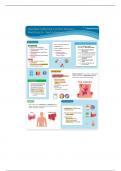
Ulcerative Colitis (UC) & Crohn’s Disease II
Med Surg: GI - Gastrointestinal
Pain - administer analgesics
Common NCLEX Question
Fluid & E+ AVOID Alcohol Client with ulcerative colitis ...
• Strict I & O monitoring interventions? Select all that apply.
Reduce Caffeine (coffee, tea)
• 2 Liters of water daily + more 1. Discuss plans to decrease
with diarrhea PsychoSocial client’s stress
• Hypokalemia low potassium: • Stress reduction
2. Give analgesics as prescribed
3.5 or less • Encourage clients to
discuss feelings 3. Limit fluids to 500 ml per day
• Daily multivitamins containing
Calcium 4. Increase protein foods
with meals
Diet 5. Monitor Input & Output
• High: Protein & Calories ANALGESICS closely
• Low: Fiber 6. Recommend high fiber and
• Keep food journal NCLEX TIP low calorie diet
• Small frequent meals
2 Liters 3.5 or less
K Bowel rupture from a toxic megacolon,
Peritonitis NCLEX TIP which can lead to peritonitis (deadly
Report to HCP! infection in the peritoneal cavity).
• Fever (over 100.3F)
Saunders • Rebound tenderness
• “Rigid” or “board-like Toxic megacolon
The nurse is providing discharge abdomen”
teaching for a client with newly
diagnosed Crohn's disease
• Increasing Pain, tenderness
about dietary measures to • Restless
implement during exacerbation • Fast HR & RR
episodes. Which statement (tachycardia / tachypnea)
made by the client indicates a
need for further instruction?
• “I should increase the fiber 1
in my diet”
Pharmacology
Most clients get a colostomy or ileostomy after a
bowel resection, where we cut out the part of the
bowel causing the problem. SULFASALAZINE
Sulfasalazine “STOPS body
attacking itself”
Colon Small Intestine Steroids “Sooth the Swelling”
• PredniSONE STE
Antidiarrheal:
• Loperamide “Low
bowel movements”
• Dicyclomine “Dry Cycle” Loperamide
Imodium
Med Surg: GI - Gastrointestinal
Pain - administer analgesics
Common NCLEX Question
Fluid & E+ AVOID Alcohol Client with ulcerative colitis ...
• Strict I & O monitoring interventions? Select all that apply.
Reduce Caffeine (coffee, tea)
• 2 Liters of water daily + more 1. Discuss plans to decrease
with diarrhea PsychoSocial client’s stress
• Hypokalemia low potassium: • Stress reduction
2. Give analgesics as prescribed
3.5 or less • Encourage clients to
discuss feelings 3. Limit fluids to 500 ml per day
• Daily multivitamins containing
Calcium 4. Increase protein foods
with meals
Diet 5. Monitor Input & Output
• High: Protein & Calories ANALGESICS closely
• Low: Fiber 6. Recommend high fiber and
• Keep food journal NCLEX TIP low calorie diet
• Small frequent meals
2 Liters 3.5 or less
K Bowel rupture from a toxic megacolon,
Peritonitis NCLEX TIP which can lead to peritonitis (deadly
Report to HCP! infection in the peritoneal cavity).
• Fever (over 100.3F)
Saunders • Rebound tenderness
• “Rigid” or “board-like Toxic megacolon
The nurse is providing discharge abdomen”
teaching for a client with newly
diagnosed Crohn's disease
• Increasing Pain, tenderness
about dietary measures to • Restless
implement during exacerbation • Fast HR & RR
episodes. Which statement (tachycardia / tachypnea)
made by the client indicates a
need for further instruction?
• “I should increase the fiber 1
in my diet”
Pharmacology
Most clients get a colostomy or ileostomy after a
bowel resection, where we cut out the part of the
bowel causing the problem. SULFASALAZINE
Sulfasalazine “STOPS body
attacking itself”
Colon Small Intestine Steroids “Sooth the Swelling”
• PredniSONE STE
Antidiarrheal:
• Loperamide “Low
bowel movements”
• Dicyclomine “Dry Cycle” Loperamide
Imodium