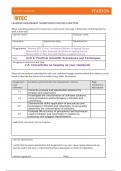
LEARNER ASSESSMENT SUBMISSION AND DECLARATION
When submitting evidence for assessment, each learner must sign a declaration confirming that the
work is their own.
Learner name: Assessor name:
Issue date: Submission date: Submitted on:
Programme: Pearson BTEC L3 Nat. Foundation Diploma in Applied Science
Pearson BTEC L3 Nat. Extended Certifi cate in Applied Science
Pearson BTEC L3 Nat. Extended Diploma in Applied Science
Unit: Unit 2: Practical Scientific Procedures and Techniques
Assignment reference and title:
2.A: Concentrate on keeping up your standards
Please list the evidence submitted for each task. Indicate the page numbers where the evidence can be
found or describe the nature of the evidence (e.g. video, illustration).
Assignment Evidence submitted (for the Assessment Criteria) Page
task numbers or
reference description
Correctly prepare and standardise solutions for
P1 titration and colorimetry.
Investigate the concentration of unknown solutions,
P2 using procedures and techniques in titration and
colorimetry.
Demonstrate skilful application of procedures and
M1 techniques in titration and colorimetry to accurately
determine the concentration of solutions.
Evaluate the accuracy of procedures and techniques
D1 used in titration and colorimetry in relation to
outcomes and suggest improvements.
Additional comments to the Assessor:
Learner declaration:
I certify that the work submitted for this assignment is my own. I have clearly referenced any
sources used in the work. I understand that false declaration is a form of malpractice.
Learner signature: Date:
,BTEC Assignment Brief (NQF)
Pearson BTEC L3 Nat. Foundation Diploma in Applied Science
Qualification Pearson BTEC L3 Nat. Extended Certificate in Applied Science
Pearson BTEC L3 Nat. Extended Diploma in Applied Science
Unit number and title Unit 2:
Practical Scientific Procedures and Techniques
Learning aim(s) A: Undertake titration and colorimetry to determine
(For NQF only) the concentration of solutions.
Assignment title 2.A: Concentrate on keeping up your standards
Assessor
Issue date
Hand in deadline
You are a newly appointed technical assistant at a large
chemical plant, Chemcalequip. As part of your induction period
and to progress in your role, you have to demonstrate skills in
a range of practical procedures and techniques. Part of your
role is to ensure equipment is calibrated and equipment and
chemicals are safety checked.
Vocational Scenario or A key part of your job will be making and testing standard
Context solutions using titration and colorimetry procedures. You
must demonstrate your ability to carry out these techniques
skilfully and accurately.
Evidence of your practical skills, along with your results,
calculations, evaluation of the techniques and possible
improvements will need to be submitted in a report(s).
Task 1 Evaluate the accuracy and safety of the following
quantitative procedures and techniques in relation to
their outcomes.
Your practical work must be undertaken correctly and safely at
all times.
Your techniques will need to be performed to a high degree of
accuracy and precision in order to obtain reliable and valid
outcomes.
You will be observed performing your preparation of solutions,
calibration of equipment and application of titration and
colorimetry techniques.
Titration:
You will perform different titrations to accurately and
Page-2/9
BTEC Assignment Brief v3.0
BTEC Internal Assessment QDAM December 2017
, skilfully determine the concentration of a solution of
sodium hydroxide.
You will first need to calibrate the equipment that you will
use for these titrations which will include: the pipette, the
weighing balance and the pH meter (using buffer
solutions).
Your practical work will involve three stages:
o Preparation of a primary standard solution of Na2CO3by
weighing the solid, using the calibrated weighing
balance, mixing and dissolving in water, and making
up the solution to an accurate volume
o Accurate standardisation of a given concentration of
hydrochloric acid (HCl) by titration with your primary
standard solution of Na2CO3and using the calibrated
pipette
o Titration of the sodium hydroxide (NaOH) solution of
unknown concentration with the standardised HCl
You must use two different titration techniques in your
determination of the concentration of sodium hydroxide
(NaOH):
o by use of an appropriate indicator to determine the
end point
o by use of the calibrated pH meter to monitor the pH
change before, during and after the end point
You must produce accurate, precise and reliable results
from both techniques
You must calculate the concentration of NaOH solution:
o directly from your recorded results, in the titration
technique using the indicator
o by plotting and using a graph of pH against volume of
HCl, in the titration technique using the pH meter
Colorimetry:
You will use a colorimeter (or visible spectrometer) to
accurately and skilfully determine the concentrations of
Sample A and B, which are two different concentrations of
copper (II) sulfate (CuSO4) solution that you will be
provided with.
Your practical work will involve:
o Preparing your own known concentration of
CuSO4solution by weighing hydrated copper (II) sulfate
solid (CuSO4.5H2O), dissolving in water and making up
to an accurate volume
o Accurately dilute your stock CuSO4solution to produce
a series of CuSO4 standard solutions of different
concentrations
o Select an appropriate filter / wavelength for the
colorimeter or visible spectrometer that you will use to
measure the absorbance (or transmission) of the
CuSO4 solutions
o Calibrate the colorimeter / visible spectrometer
according to the manufacturer’s instructions or
practical instructions provided
o Measure and record the absorbance (or transmission)
Page-3/9
BTEC Assignment Brief v3.0
BTEC Internal Assessment QDAM December 2017
When submitting evidence for assessment, each learner must sign a declaration confirming that the
work is their own.
Learner name: Assessor name:
Issue date: Submission date: Submitted on:
Programme: Pearson BTEC L3 Nat. Foundation Diploma in Applied Science
Pearson BTEC L3 Nat. Extended Certifi cate in Applied Science
Pearson BTEC L3 Nat. Extended Diploma in Applied Science
Unit: Unit 2: Practical Scientific Procedures and Techniques
Assignment reference and title:
2.A: Concentrate on keeping up your standards
Please list the evidence submitted for each task. Indicate the page numbers where the evidence can be
found or describe the nature of the evidence (e.g. video, illustration).
Assignment Evidence submitted (for the Assessment Criteria) Page
task numbers or
reference description
Correctly prepare and standardise solutions for
P1 titration and colorimetry.
Investigate the concentration of unknown solutions,
P2 using procedures and techniques in titration and
colorimetry.
Demonstrate skilful application of procedures and
M1 techniques in titration and colorimetry to accurately
determine the concentration of solutions.
Evaluate the accuracy of procedures and techniques
D1 used in titration and colorimetry in relation to
outcomes and suggest improvements.
Additional comments to the Assessor:
Learner declaration:
I certify that the work submitted for this assignment is my own. I have clearly referenced any
sources used in the work. I understand that false declaration is a form of malpractice.
Learner signature: Date:
,BTEC Assignment Brief (NQF)
Pearson BTEC L3 Nat. Foundation Diploma in Applied Science
Qualification Pearson BTEC L3 Nat. Extended Certificate in Applied Science
Pearson BTEC L3 Nat. Extended Diploma in Applied Science
Unit number and title Unit 2:
Practical Scientific Procedures and Techniques
Learning aim(s) A: Undertake titration and colorimetry to determine
(For NQF only) the concentration of solutions.
Assignment title 2.A: Concentrate on keeping up your standards
Assessor
Issue date
Hand in deadline
You are a newly appointed technical assistant at a large
chemical plant, Chemcalequip. As part of your induction period
and to progress in your role, you have to demonstrate skills in
a range of practical procedures and techniques. Part of your
role is to ensure equipment is calibrated and equipment and
chemicals are safety checked.
Vocational Scenario or A key part of your job will be making and testing standard
Context solutions using titration and colorimetry procedures. You
must demonstrate your ability to carry out these techniques
skilfully and accurately.
Evidence of your practical skills, along with your results,
calculations, evaluation of the techniques and possible
improvements will need to be submitted in a report(s).
Task 1 Evaluate the accuracy and safety of the following
quantitative procedures and techniques in relation to
their outcomes.
Your practical work must be undertaken correctly and safely at
all times.
Your techniques will need to be performed to a high degree of
accuracy and precision in order to obtain reliable and valid
outcomes.
You will be observed performing your preparation of solutions,
calibration of equipment and application of titration and
colorimetry techniques.
Titration:
You will perform different titrations to accurately and
Page-2/9
BTEC Assignment Brief v3.0
BTEC Internal Assessment QDAM December 2017
, skilfully determine the concentration of a solution of
sodium hydroxide.
You will first need to calibrate the equipment that you will
use for these titrations which will include: the pipette, the
weighing balance and the pH meter (using buffer
solutions).
Your practical work will involve three stages:
o Preparation of a primary standard solution of Na2CO3by
weighing the solid, using the calibrated weighing
balance, mixing and dissolving in water, and making
up the solution to an accurate volume
o Accurate standardisation of a given concentration of
hydrochloric acid (HCl) by titration with your primary
standard solution of Na2CO3and using the calibrated
pipette
o Titration of the sodium hydroxide (NaOH) solution of
unknown concentration with the standardised HCl
You must use two different titration techniques in your
determination of the concentration of sodium hydroxide
(NaOH):
o by use of an appropriate indicator to determine the
end point
o by use of the calibrated pH meter to monitor the pH
change before, during and after the end point
You must produce accurate, precise and reliable results
from both techniques
You must calculate the concentration of NaOH solution:
o directly from your recorded results, in the titration
technique using the indicator
o by plotting and using a graph of pH against volume of
HCl, in the titration technique using the pH meter
Colorimetry:
You will use a colorimeter (or visible spectrometer) to
accurately and skilfully determine the concentrations of
Sample A and B, which are two different concentrations of
copper (II) sulfate (CuSO4) solution that you will be
provided with.
Your practical work will involve:
o Preparing your own known concentration of
CuSO4solution by weighing hydrated copper (II) sulfate
solid (CuSO4.5H2O), dissolving in water and making up
to an accurate volume
o Accurately dilute your stock CuSO4solution to produce
a series of CuSO4 standard solutions of different
concentrations
o Select an appropriate filter / wavelength for the
colorimeter or visible spectrometer that you will use to
measure the absorbance (or transmission) of the
CuSO4 solutions
o Calibrate the colorimeter / visible spectrometer
according to the manufacturer’s instructions or
practical instructions provided
o Measure and record the absorbance (or transmission)
Page-3/9
BTEC Assignment Brief v3.0
BTEC Internal Assessment QDAM December 2017