Stems - Chapter 6
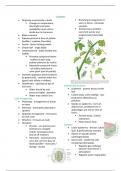
• Intermediate growth - meristems Development of stems
at 5ps increasing their length and • Apical meristem - Increases stem
other meristems increasing their length (dormant before growing
girth season)
Woody twigs § Protected by bud scales
• Alternately arranged- leaves are and leaf primordia (5ny
a<ached to twig alternately or in a embryonic leaves that
spiral around stem develop aOer bud scales
• Oppositely arranged - leaves drop off)
a<ached in pairs • Protoderm - develops into
• Whorled arrangement - leaves in epidermis
whorls • Procambium - to inside of
• Node - area of stem where a leaf is protoderm
a<ached § Produces primary xylem
• Internode - stem region between and primary phloem
nodes • Ground meristem - produces
• Leaf has a fla<ened blade and is parenchyma cells Produced
a<ached to stalk by pe5ole § Pith - parenchyma In centre when
stem is
• Axil - angel between a pe5ole and (large and breakdown increasing
In length
stem shortly aOer leaving a (ie
• Axillary bud - bud located in axil cylindrical hollow hole or primary
7ssue)
• Flowering plants - axillary buds are crushed by other
become branches or develop into meristem 5ssue)
flowers § Cortex - crushed and
• Bud scales - protect buds and fall replaced
when bud starts to grow § Func5on - store food or
• Terminal bud - at end of each twig manufacture it if
(larger than axillary bud) chloroplasts are present
§ Produce 5ssues to let twig • As primary 5ssues develop - leaf
grow longer primordia and bud primordia
• Number of bud scale scars = age develop
• S5pule scars - fine line encircling a • Leaf gaps - leO by xylem and
twig or scars on pe5ole base phloem traces / filled with
• Deciduous trees and shrubs (leaves parenchyma
lost annually) - have dormant
axillary buds with leaf scars below
aOer leaf falls
• Bundle scars - mark loca5on of
water and food conduc5ng 5ssues
(mostly 3)
§ Shape, size, arrangement
and number are
characteris5c for each
species
• Intermediate growth - meristems Development of stems
at 5ps increasing their length and • Apical meristem - Increases stem
other meristems increasing their length (dormant before growing
girth season)
Woody twigs § Protected by bud scales
• Alternately arranged- leaves are and leaf primordia (5ny
a<ached to twig alternately or in a embryonic leaves that
spiral around stem develop aOer bud scales
• Oppositely arranged - leaves drop off)
a<ached in pairs • Protoderm - develops into
• Whorled arrangement - leaves in epidermis
whorls • Procambium - to inside of
• Node - area of stem where a leaf is protoderm
a<ached § Produces primary xylem
• Internode - stem region between and primary phloem
nodes • Ground meristem - produces
• Leaf has a fla<ened blade and is parenchyma cells Produced
a<ached to stalk by pe5ole § Pith - parenchyma In centre when
stem is
• Axil - angel between a pe5ole and (large and breakdown increasing
In length
stem shortly aOer leaving a (ie
• Axillary bud - bud located in axil cylindrical hollow hole or primary
7ssue)
• Flowering plants - axillary buds are crushed by other
become branches or develop into meristem 5ssue)
flowers § Cortex - crushed and
• Bud scales - protect buds and fall replaced
when bud starts to grow § Func5on - store food or
• Terminal bud - at end of each twig manufacture it if
(larger than axillary bud) chloroplasts are present
§ Produce 5ssues to let twig • As primary 5ssues develop - leaf
grow longer primordia and bud primordia
• Number of bud scale scars = age develop
• S5pule scars - fine line encircling a • Leaf gaps - leO by xylem and
twig or scars on pe5ole base phloem traces / filled with
• Deciduous trees and shrubs (leaves parenchyma
lost annually) - have dormant
axillary buds with leaf scars below
aOer leaf falls
• Bundle scars - mark loca5on of
water and food conduc5ng 5ssues
(mostly 3)
§ Shape, size, arrangement
and number are
characteris5c for each
species