

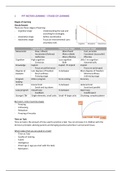
1 PPT MOTOR LEARNING – STAGES OF LEARNING
Stages of learning
Fitss & Passner
There are three stages of learning:
- Cognitive stage Understanding the task and
searching for strategies.
- Associative stage Refine coordination.
- Autonomic stage Focus on environmental cues:
secondary task.
Cognitive stage Associative stage Autonomic stage
Movements - Slow, influent - More fluent - Fast, accurate
- Inconsistent (failures) - More reliable - Consistent (successful)
- Ineffective - More effective - Effective
Cognition High cognition Less cognition Little / no cognition
- Conscious - Both - Automatically
Knowledge Explicit Explicit → implicit Implicit
- Focus on performance - - Focus on action goal
Degrees of Less degrees of freedom In-between More degrees of freedom
freedom - Much stiffness - Minimal stiffness
- Freezing stage - Unfreezing stage
Program Motor program Force scaling Accuracy
loading
Archical Hierarchical In-between Heterarchical
- Serial and top down - Serial and parallel
Loop program Closed loop In-between Open loop
- Feedback - Feedforward
Storage LTM Single elements, small units Small → large units Chunking, complex pattern
Bernstein: motor learning stages
- Freezing
- Unfreezing
- Relaxation
- Freezing of muscles
Time on Task
Time on task is the amount of time used to practice a task. You can increase it in children with the
24-hours principle: advising parents and bringing practical activities in and around house.
What makes that you are good in a task?
- Time on Task
- Quality of training
- Talent
- Intelligence
- Onset age (= age you start with the task)
- Motivation
, Deliberate practice Structured play
Time on task rate Low High
Development of creative solutions Low High
Intrinsic motivation Low High
Type of learning More explicit More implicit
Behaviour Motor, cognitive and social
2 PPT MOTOR LEARNING – IMPLICIT AND EXPLICIT LEARNING
Implicit VS explicit learning
Implicit knowledge (= better) Explicit knowledge
Learning by Doing without explaining how Knowing how to perform a skill
Work memory Low load High load
Speed of learning Fast: no reasoning out what you do Slow: reasoning out what you do
Storage strength High: more durable Low: less durable
Way of movement More natural Less natural
Amount of attention Low: less thinking about the task High: more thinking about the task
There are two forms of long-term memory:
- Explicit (declarative) Cognitive
- Implicit (nondeclarative) Motor
3 PPT MOTOR LEARNING – ANALOGY LEARNING
Ways to improve implicit learning
Analogy learning
Analogy learning is learning by using metaphors (i.e. jump like a frog). The child will use his long term
memory and place it in the work memory. The child does the task nonconscious and without explicit
knowledge about the step-by-step movement. That’s why analogies increase implicit learning.
- Throw as if you’re a catapult: slowly moving backwards and then a fast shoot
- Table tennis backhand: act as if you were throwing a frisbee
Varied practice
You could bring variation in a skill. Mostly, varied practice is better than constant practice.
- Varied practice Repetition without repetition. Manipulation of environmental and
task constraints used to learn the ‘force scaling’ and muscle initiation.
o Altering Veranderen
o Building up Verzwaren
o Combining Verbinden
Most DCD children have problems with those aspects: parameterization and muscle initiation.
Errorless learning
Errorless learning is learning by constraining the environment so that very few errors occur. When
you make mistakes, you will use more explicit learning. In time this will be stored in your long term
memory. So in a final you can use the conscious, explicit knowledge which will result in a less efficient
movement (= choking under pressure). Errorless learning increases implicit learning.
How could I bring it in the therapy? Start relatively easy and make it more difficult in small steps.
Stages of learning
Fitss & Passner
There are three stages of learning:
- Cognitive stage Understanding the task and
searching for strategies.
- Associative stage Refine coordination.
- Autonomic stage Focus on environmental cues:
secondary task.
Cognitive stage Associative stage Autonomic stage
Movements - Slow, influent - More fluent - Fast, accurate
- Inconsistent (failures) - More reliable - Consistent (successful)
- Ineffective - More effective - Effective
Cognition High cognition Less cognition Little / no cognition
- Conscious - Both - Automatically
Knowledge Explicit Explicit → implicit Implicit
- Focus on performance - - Focus on action goal
Degrees of Less degrees of freedom In-between More degrees of freedom
freedom - Much stiffness - Minimal stiffness
- Freezing stage - Unfreezing stage
Program Motor program Force scaling Accuracy
loading
Archical Hierarchical In-between Heterarchical
- Serial and top down - Serial and parallel
Loop program Closed loop In-between Open loop
- Feedback - Feedforward
Storage LTM Single elements, small units Small → large units Chunking, complex pattern
Bernstein: motor learning stages
- Freezing
- Unfreezing
- Relaxation
- Freezing of muscles
Time on Task
Time on task is the amount of time used to practice a task. You can increase it in children with the
24-hours principle: advising parents and bringing practical activities in and around house.
What makes that you are good in a task?
- Time on Task
- Quality of training
- Talent
- Intelligence
- Onset age (= age you start with the task)
- Motivation
, Deliberate practice Structured play
Time on task rate Low High
Development of creative solutions Low High
Intrinsic motivation Low High
Type of learning More explicit More implicit
Behaviour Motor, cognitive and social
2 PPT MOTOR LEARNING – IMPLICIT AND EXPLICIT LEARNING
Implicit VS explicit learning
Implicit knowledge (= better) Explicit knowledge
Learning by Doing without explaining how Knowing how to perform a skill
Work memory Low load High load
Speed of learning Fast: no reasoning out what you do Slow: reasoning out what you do
Storage strength High: more durable Low: less durable
Way of movement More natural Less natural
Amount of attention Low: less thinking about the task High: more thinking about the task
There are two forms of long-term memory:
- Explicit (declarative) Cognitive
- Implicit (nondeclarative) Motor
3 PPT MOTOR LEARNING – ANALOGY LEARNING
Ways to improve implicit learning
Analogy learning
Analogy learning is learning by using metaphors (i.e. jump like a frog). The child will use his long term
memory and place it in the work memory. The child does the task nonconscious and without explicit
knowledge about the step-by-step movement. That’s why analogies increase implicit learning.
- Throw as if you’re a catapult: slowly moving backwards and then a fast shoot
- Table tennis backhand: act as if you were throwing a frisbee
Varied practice
You could bring variation in a skill. Mostly, varied practice is better than constant practice.
- Varied practice Repetition without repetition. Manipulation of environmental and
task constraints used to learn the ‘force scaling’ and muscle initiation.
o Altering Veranderen
o Building up Verzwaren
o Combining Verbinden
Most DCD children have problems with those aspects: parameterization and muscle initiation.
Errorless learning
Errorless learning is learning by constraining the environment so that very few errors occur. When
you make mistakes, you will use more explicit learning. In time this will be stored in your long term
memory. So in a final you can use the conscious, explicit knowledge which will result in a less efficient
movement (= choking under pressure). Errorless learning increases implicit learning.
How could I bring it in the therapy? Start relatively easy and make it more difficult in small steps.


