Finance for Normal People
How Investors and Markets behave
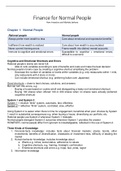
Chapter 1: Normal People
Rational people Normal people
Always prefer more wealth to less Care about emotional and expressive benefits
Indifferent how wealth is realized Care about how wealth is accumulated
Never commit framing errors Frame wealth into distinct mental accounts
Immune to cognitive and emotional errors Susceptible to cognitive + emotional errors;
difficult to overcome
Cognitive and Emotional Shortcuts and Errors
Rational people’s brains are never full:
- Able to rank variables according to sets of benefits and costs and make the best decision
Normal people’s brains cope by creating a cognitive shortcut simplifying the problem:
- Decrease the number of variables or levels within variables (e.g. only restaurants within 1 mile,
only restaurants with 4 stars or more)
- Can include emotional shortcut (e.g. preferring Italian over Japanese)
Good shortcuts = close to best choices, solutions, and answers
But can turn into errors, e.g:
- Buying a house based on cookie smell and disregarding a leaky roof (emotional shortcut)
- Buying 100 shares when offered 100 or 200 shares when no shares were actually preferred
(cognitive shortcut)
System 1 and System 2
System 1 = intuitive “blink” system, automatic, fast, effortless
System 2 = reflective “think” system, controlled, slow, effortful
Using System 2 is easier when there is time for engagement, beneficial when poor choices by System
1 result in substantial consequences e.g. when buying a house, diversifying our portfolio, etc.
Rational people use System 2 whenever System 1 misleads
Normal people disregard System 2 outcomes whenever System 1 provides the answer
HOWEVER, normal people differ from ignorant to knowledgeable, reflected in the use of System 2.
Three Kinds of Knowledge
1. Financial-facts knowledge: includes facts about financial markets; stocks, bonds, other
investments; benefits of diversification, drawbacks of investment fees, difficulty of beating the
market
2. Human-behavior knowledge: includes knowledge about
a. Wants e.g. riches, social status, adherence to values
b. Cognitive shortcuts, e.g. framing, hindsight, confirmation
c. Emotional shortcuts and errors e.g. hope, fear, pride, regret
3. Information knowledge
How Investors and Markets behave
Chapter 1: Normal People
Rational people Normal people
Always prefer more wealth to less Care about emotional and expressive benefits
Indifferent how wealth is realized Care about how wealth is accumulated
Never commit framing errors Frame wealth into distinct mental accounts
Immune to cognitive and emotional errors Susceptible to cognitive + emotional errors;
difficult to overcome
Cognitive and Emotional Shortcuts and Errors
Rational people’s brains are never full:
- Able to rank variables according to sets of benefits and costs and make the best decision
Normal people’s brains cope by creating a cognitive shortcut simplifying the problem:
- Decrease the number of variables or levels within variables (e.g. only restaurants within 1 mile,
only restaurants with 4 stars or more)
- Can include emotional shortcut (e.g. preferring Italian over Japanese)
Good shortcuts = close to best choices, solutions, and answers
But can turn into errors, e.g:
- Buying a house based on cookie smell and disregarding a leaky roof (emotional shortcut)
- Buying 100 shares when offered 100 or 200 shares when no shares were actually preferred
(cognitive shortcut)
System 1 and System 2
System 1 = intuitive “blink” system, automatic, fast, effortless
System 2 = reflective “think” system, controlled, slow, effortful
Using System 2 is easier when there is time for engagement, beneficial when poor choices by System
1 result in substantial consequences e.g. when buying a house, diversifying our portfolio, etc.
Rational people use System 2 whenever System 1 misleads
Normal people disregard System 2 outcomes whenever System 1 provides the answer
HOWEVER, normal people differ from ignorant to knowledgeable, reflected in the use of System 2.
Three Kinds of Knowledge
1. Financial-facts knowledge: includes facts about financial markets; stocks, bonds, other
investments; benefits of diversification, drawbacks of investment fees, difficulty of beating the
market
2. Human-behavior knowledge: includes knowledge about
a. Wants e.g. riches, social status, adherence to values
b. Cognitive shortcuts, e.g. framing, hindsight, confirmation
c. Emotional shortcuts and errors e.g. hope, fear, pride, regret
3. Information knowledge