100% satisfaction guarantee Immediately available after payment Both online and in PDF No strings attached 4.2 TrustPilot
logo-home
Exam (elaborations)

PN MENTAL HEALTH EXAM QUESTIONS AND ANSWERS | LATEST UPDATE

Rating
-
Sold
-
Pages
25
Grade
A+
Uploaded on
09-10-2024
Written in
2024/2025

PN MENTAL HEALTH EXAM QUESTIONS AND ANSWERS | LATEST UPDATE 1. Which term demonstrates a willingness to spend time with a patient? A) Offering self B) Focusing C) Presenting reality D) Giving information Correct Answer: A) Offering self ________________________________________ 2. Responding to stress through the unconscious development of physical manifestations not caused by a physical illness is known as: A) Projection B) Regression C) Displacement D) Conversion Correct Answer: D) Conversion ________________________________________ 3. Performing an act to make up for prior behavior is called: A) Splitting B) Denial C) Undoing D) Regression Correct Answer: C) Undoing ________________________________________ 4. This technique acknowledges the nurse's interest and nonjudgmental attitude: A) Presenting reality B) Paraphrasing and exploring C) Active listening D) Showing acceptance and recognition Correct Answer: C) Active listening ________________________________________ 5. Self-talk, thinking thoughts, and not outwardly verbalizing them refers to: A) Interpersonal communication B) Intrapersonal communication C) Repression D) Conversion Correct Answer: B) Intrapersonal communication ________________________________________ 6. The client who is able to open her eyes and respond but is drowsy and falls asleep readily is described as: A) Lethargic B) Stuporous C) Alert D) Comatose Correct Answer: A) Lethargic ________________________________________ 7. The act of filling in memory gaps is known as: A) Regression B) Projection C) Compensation D) Confabulation Correct Answer: D) Confabulation ________________________________________ 8. This technique helps the client concentrate on what is important: A) Exploring B) Open-ended questions C) Giving information D) Focusing Correct Answer: D) Focusing ________________________________________ 9. Malpractice and negligence fall under which term? A) Nursing Salaries B) Prevention of Liability C) Nursing Liability D) Unintentional Torts Correct Answer: D) Unintentional Torts ________________________________________ 10. The psychoanalytic defense mechanism where an individual retreats to a more infantile psychosexual stage is known as: A) Displacement B) Regression C) Sublimation D) Projection Correct Answer: B) Regression ________________________________________ 11. Neck and elbow extension, with wrists and fingers flexed is called: A) Decerebrate rigidity B) Cogwheel rigidity C) Veracity D) Decorticate posturing Correct Answer: D) Decorticate posturing ________________________________________ 12. Consciously and intentionally pushing unpleasant feelings out of one’s mind is known as: A) Reaction formation B) Sublimation C) Rationalization D) Suppression Correct Answer: D) Suppression ________________________________________ 13. This approach involves orienting the client to the physical setting and ensuring a safe environment: A) Collaborative Care B) Severe anxiety C) Milieu therapy D) Mild anxiety Correct Answer: C) Milieu therapy ________________________________________ 14. The examination used to obtain baseline data of a client’s level of consciousness is: A) Affect B) Rancho Levels of Cognitive Functioning C) Short-term Memory D) Glasgow Coma Scale Correct Answer: D) Glasgow Coma Scale ________________________________________ 15. The level of anxiety precipitated by an imminent loss or change is: A) Mild anxiety B) Acute anxiety C) Severe anxiety D) Chronic anxiety Correct Answer: B) Acute anxiety ________________________________________ 16. Offering assistance with self-care tasks is an example of: A) Panic level of anxiety B) Meaningful verbal communication C) Maintenance of nutrition and hydration D) Promotion of self-care activities Correct Answer: D) Promotion of self-care activities ________________________________________ 17. This technique emphasizes important points and reviews discussions: A) Summarizing B) Splitting C) Open-ended questions D) Focusing Correct Answer: A) Summarizing ________________________________________ 18. If appropriate, therapeutic touch communicates caring and can provide comfort. This is referred to as: A) Taste B) Undoing C) Touch D) Summarizing Correct Answer: C) Touch ________________________________________ 19. When a client admits themselves to an institution for treatment and retains civil rights, this is called: A) Informal admission B) Voluntary admission C) Temporary emergency admission D) Involuntary commitment Correct Answer: B) Voluntary admission ________________________________________ 20. Doing good, described as charity, can be exemplified by: A) Justice B) Beneficence C) Nonmaleficence D) Autonomy Correct Answer: B) Beneficence ________________________________________ 21. The separation of emotions and logical facts when coping with a situation is known as: A) Rationalization B) Projection C) Dissociation D) Intellectualization Correct Answer: D) Intellectualization ________________________________________ 22. The client who is responsive and fully attends to normal conversation is described as: A) Alarm B) Comatose C) Lethargic D) Alert Correct Answer: D) Alert ________________________________________ 23. The client who requires vigorous or painful stimuli to elicit a brief response is: A) Lethargic B) Comatose C) Stuporous D) Alert Correct Answer: C) Stuporous ________________________________________ 24. An appropriate response to an event being faced is known as: A) Altruism B) Chronic anxiety C) Acute anxiety D) Normal anxiety Correct Answer: D) Normal anxiety ________________________________________ 25. Wrongful acts for which an injured party has the right to sue are known as: A) Torts B) Compensation C) Malpractice D) Liability Correct Answer: A) Torts ________________________________________ 26. Using therapeutic communication skills and crisis intervention refers to: A) Intonation B) Displacement C) Counseling D) Timing/relevance Correct Answer: C) Counseling ________________________________________ 27. Overcompensating or demonstrating the opposite behavior of what is felt is called: A) Displacement B) Reaction formation C) Projection D) Sublimation Correct Answer: B) Reaction formation ________________________________________ 28. Communication that addresses an individual's spiritual needs is referred to as: A) What are projective questions? B) Milieu therapy C) Intellectualization D) Transpersonal communication Correct Answer: D) Transpersonal communication ________________________________________ 29. Assisting the client with cessation of smoking and monitoring health conditions relates to: A) Health education and teaching services B) The whole population C) Health promotion and health maintenance D) Promotion of self-care activities Correct Answer: C) Health promotion and health maintenance ________________________________________ 30. When communicating, participants must share meanings. Words that have more than one meaning are known as: A) Denotative/connotative meaning B) Clarity/brevity C) Intonation D) Interpersonal communication Correct Answer: A) Denotative/connotative meaning ________________________________________ 31. Pretending the truth is not reality to manage anxiety is known as: A) Focusing B) Displacement C) Projection D) Denial Correct Answer: D) Denial ________________________________________ 32. This technique provides details that the client might need for decision-making: A) Giving information B) Presenting reality C) Summarizing D) Focusing Correct Answer: A) Giving information ________________________________________

Show more Read less
Institution
PN MENTAL HEALTH Ngn
Course
PN MENTAL HEALTH ngn


Whoops! We can’t load your doc right now. Try again or contact support.

Written for

Institution
PN MENTAL HEALTH ngn
Course
PN MENTAL HEALTH ngn

Document information

Uploaded on
October 9, 2024
Number of pages
25
Written in
2024/2025
Type
Exam (elaborations)
Contains
Questions & answers

Subjects

Content preview

For more info email me @

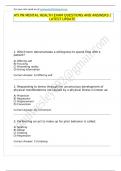
ATI PN MENTAL HEALTH EXAM QUESTIONS AND ANSWERS |
LATEST UPDATE


1. Which term demonstrates a willingness to spend time with a
patient?

A) Offering self
B) Focusing
C) Presenting reality
D) Giving information

Correct Answer: A) Offering self


2. Responding to stress through the unconscious development of
physical manifestations not caused by a physical illness is known as:

A) Projection
B) Regression
C) Displacement
D) Conversion

Correct Answer: D) Conversion


3. Performing an act to make up for prior behavior is called:

A) Splitting
B) Denial
C) Undoing
D) Regression

Correct Answer: C) Undoing

,For more info email me @

4. This technique acknowledges the nurse's interest and
nonjudgmental attitude:

A) Presenting reality
B) Paraphrasing and exploring
C) Active listening
D) Showing acceptance and recognition

Correct Answer: C) Active listening


5. Self-talk, thinking thoughts, and not outwardly verbalizing them
refers to:

A) Interpersonal communication
B) Intrapersonal communication
C) Repression
D) Conversion

Correct Answer: B) Intrapersonal communication


6. The client who is able to open her eyes and respond but is drowsy
and falls asleep readily is described as:

A) Lethargic
B) Stuporous
C) Alert
D) Comatose

Correct Answer: A) Lethargic


7. The act of filling in memory gaps is known as:

A) Regression
B) Projection
C) Compensation
D) Confabulation

Correct Answer: D) Confabulation

, For more info email me @

8. This technique helps the client concentrate on what is important:

A) Exploring
B) Open-ended questions
C) Giving information
D) Focusing

Correct Answer: D) Focusing


9. Malpractice and negligence fall under which term?

A) Nursing Salaries
B) Prevention of Liability
C) Nursing Liability
D) Unintentional Torts

Correct Answer: D) Unintentional Torts


10. The psychoanalytic defense mechanism where an individual
retreats to a more infantile psychosexual stage is known as:

A) Displacement
B) Regression
C) Sublimation
D) Projection

Correct Answer: B) Regression


11. Neck and elbow extension, with wrists and fingers flexed is called:

A) Decerebrate rigidity
B) Cogwheel rigidity
C) Veracity
D) Decorticate posturing

Correct Answer: D) Decorticate posturing


12. Consciously and intentionally pushing unpleasant feelings out of
one’s mind is known as:
Get to know the seller

Seller avatar
Reputation scores are based on the amount of documents a seller has sold for a fee and the reviews they have received for those documents. There are three levels: Bronze, Silver and Gold. The better the reputation, the more your can rely on the quality of the sellers work.
TestGen Walden University
View profile
Follow You need to be logged in order to follow users or courses
Sold
725
Member since
5 year
Number of followers
620
Documents
3379
Last sold
2 weeks ago
QUALITY WORK OF ALL KIND OF QUIZ or EXAM WITH GUARANTEE OF AN A

Im an expert on major courses especially; psychology,Nursing, Human resource Management & Project writting.Assisting students with quality work is my first priority. I ensure scholarly standards in my documents . I assure a GOOD GRADE if you will use my work.

4.2

182 reviews

5
115
4
31
3
12
2
8
1
16

Recently viewed by you

Why students choose Stuvia

Created by fellow students, verified by reviews

Quality you can trust: written by students who passed their exams and reviewed by others who've used these notes.

Didn't get what you expected? Choose another document

No worries! You can immediately select a different document that better matches what you need.

Pay how you prefer, start learning right away

No subscription, no commitments. Pay the way you're used to via credit card or EFT and download your PDF document instantly.

Student with book image

“Bought, downloaded, and aced it. It really can be that simple.”

Alisha Student

Frequently asked questions