Leaves
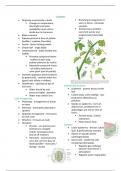
• Originate as primordia in buds § Branching arrangement of
§ Changes in temperature, veins in dicots - re;culate
day length and water vena;on
availability cause cells to § Dichotomous vena;on -
divide due to hormones veins fork evenly and
• Blade ie lamina progressively from blade
• S;pules present at base of pe;ole base
(leaflike / scalelike /thornlike)
• Sessile - leaves lacking pe;ole
• Simple leaf - single blade
• Compound leaf - blade divided into
leaflets
§ Pinnately compound leaves
- leaflets in pairs long
pe;ole extension (ie rachis)
§ Palmately compound leaves
- all leaflets aEached at
same point (end of pe;ole)
• Stomatal apparatus (pore bordered
by guard cells) - controls water loss
(guard cells inflate or deflate)
• Hydathodes - openings at ;ps of
leaf veins Internal leaf structure
§ Water forced by root • Epidermis - protect ;ssues inside
pressure (night) - guEa;on leaf
§ Water may contain ions • Cu;cle (waxy cu;n coa;ng) - wax
Leaf arrangement produc;on affected by air
• Phyllotaxy - arrangement of leaves pollu;on
on stem • Glands on epidermis - form of
• Alternate - alternately aEached or depressions, pro;berances or
spiraled appendages (on leaf or ends of
• Opposite arrangement - two leaves hairs)
at each node § Secrete s;cky / smelly
• Whorled - 3+ leaves at node substances
§ Keep insects away
• Veina;on
Stomata
§ Pinnate - one primary vein
(midvein) in enlarged • Lower epidermis - thinner cu;cle
midrib (secondary veins layer & perforated by stomata
branch off midvein) • Absent on aqua;c plants’
§ Palmately - several primary submerged leaves
veins fan out from base of • Guard cells - epidermal cells
blade (parallel - monocots / containing chloroplasts
diverge - dicots) § Regulate gas exchange
between leaf interior /
atmosphere
§ Regulate water evapora;on
• Originate as primordia in buds § Branching arrangement of
§ Changes in temperature, veins in dicots - re;culate
day length and water vena;on
availability cause cells to § Dichotomous vena;on -
divide due to hormones veins fork evenly and
• Blade ie lamina progressively from blade
• S;pules present at base of pe;ole base
(leaflike / scalelike /thornlike)
• Sessile - leaves lacking pe;ole
• Simple leaf - single blade
• Compound leaf - blade divided into
leaflets
§ Pinnately compound leaves
- leaflets in pairs long
pe;ole extension (ie rachis)
§ Palmately compound leaves
- all leaflets aEached at
same point (end of pe;ole)
• Stomatal apparatus (pore bordered
by guard cells) - controls water loss
(guard cells inflate or deflate)
• Hydathodes - openings at ;ps of
leaf veins Internal leaf structure
§ Water forced by root • Epidermis - protect ;ssues inside
pressure (night) - guEa;on leaf
§ Water may contain ions • Cu;cle (waxy cu;n coa;ng) - wax
Leaf arrangement produc;on affected by air
• Phyllotaxy - arrangement of leaves pollu;on
on stem • Glands on epidermis - form of
• Alternate - alternately aEached or depressions, pro;berances or
spiraled appendages (on leaf or ends of
• Opposite arrangement - two leaves hairs)
at each node § Secrete s;cky / smelly
• Whorled - 3+ leaves at node substances
§ Keep insects away
• Veina;on
Stomata
§ Pinnate - one primary vein
(midvein) in enlarged • Lower epidermis - thinner cu;cle
midrib (secondary veins layer & perforated by stomata
branch off midvein) • Absent on aqua;c plants’
§ Palmately - several primary submerged leaves
veins fan out from base of • Guard cells - epidermal cells
blade (parallel - monocots / containing chloroplasts
diverge - dicots) § Regulate gas exchange
between leaf interior /
atmosphere
§ Regulate water evapora;on