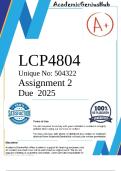
STA1610 EXAM
PACK 2024
QUESTIONS AND
ANSWERS
FOR ASSISTANCE CONTACT
EMAIL:
, lOMoARcPSD|31863004
Contents
1 Data and Statistics 1
1.1 Variables . . . . . . . . . . . . . . . . . . . . . . . . . . . . . . . . . . . . . . . . . . . . 1
1.2 Population and Sample . . . . . . . . . . . . . . . . . . . . . . . . . . . . . . . . . . . . . 18
2 Descriptive statistics: Tabular and Graphical Presentations 23
2.1 Visualizing Numerical data . . . . . . . . . . . . . . . . . . . . . . . . . . . . . . . . . . . 23
3 Descriptive Statistics: Numerical Measures 33
3.1 The Central Tendency or Location . . . . . . . . . . . . . . . . . . . . . . . . . . . . . . . 33
3.2 The Dispersion or Variability . . . . . . . . . . . . . . . . . . . . . . . . . . . . . . . . . . 34
3.3 Quartile and Coefficient of Variation . . . . . . . . . . . . . . . . . . . . . . . . . . . . . . 53
4 Introduction to Probability 61
5 Discrete Probability Distribution: Binomial and Poisson 81
5.1 General Information . . . . . . . . . . . . . . . . . . . . . . . . . . . . . . . . . . . . . . . 81
5.2 Discrete Probability Distribution . . . . . . . . . . . . . . . . . . . . . . . . . . . . . . . . 92
5.2.1 Binomial Probability Distribution . . . . . . . . . . . . . . . . . . . . . . . . . . . 92
5.2.2 Poisson Probability Distribution . . . . . . . . . . . . . . . . . . . . . . . . . . . . 101
iii STA1610/1
, lOMoARcPSD|31863004
6 Continuous Probability Distribution 113
6.1 Normal Probability Distribution . . . . . . . . . . . . . . . . . . . . . . . . . . . . . . . . 113
7 Sampling Distribution of the Mean and Proportions 137
7.1 Sampling Distribution of the Mean . . . . . . . . . . . . . . . . . . . . . . . . . . . . . . . 138
7.2 Sampling Distribution of the Proportion . . . . . . . . . . . . . . . . . . . . . . . . . . . . 151
8 Point Estimations and Confidence Intervals 161
8.1 Point Estimations . . . . . . . . . . . . . . . . . . . . . . . . . . . . . . . . . . . . . . . . 161
8.2 Confidence Interval . . . . . . . . . . . . . . . . . . . . . . . . . . . . . . . . . . . . . . . 161
8.2.1 Confidence Interval of the Mean . . . . . . . . . . . . . . . . . . . . . . . . . . . . 162
8.2.2 Confidence Interval of the Proportion . . . . . . . . . . . . . . . . . . . . . . . . . 180
9 Hypothesis Testing of the Mean and Proportions 187
9.1 Hypothesis Testing of the Mean . . . . . . . . . . . . . . . . . . . . . . . . . . . . . . . . 189
9.2 Hypothesis Testing of the Proportion . . . . . . . . . . . . . . . . . . . . . . . . . . . . . . 201
10 Chi–squared Test 209
11 Simple linear regression 229
iv
Downloaded by Gabriel Musyoka ()
, lOMoARcPSD|31863004
Preface
Welcome to the exciting workbook of Statistics.
I have written this workbook to make Statistics accessible to everyone, including those with a limited math-
ematics background. Statistics affects all aspects of our lives and its applications are so numerous that, in a
sense, we are limited only by our own imagination in discovering new uses for Statistics. The workbook of
statistics continues to emphasize some important concepts of Statistics.
The applied nature of the Statistics discipline is reinforced by showing and teaching students how to choose a
correct statistical procedure or formulae with a clear understanding of a such particular concept. Fulfilling this
objective requires several features built into this workbook that include a driven-scope of Statistical concepts
and a large number of activities.
In the workbook, calculators are very good at providing numerical results of statistical processes. One reason
for using calculator is for students to be able to understand the technique and concepts by doing calculations
by hand. Students have to be aware that all assignments and examinations in this module will be done by
hand with the support of formulaes and statistics tables. The approach adopted in the workbook is to divide
the solution of statistical problems into two stages and include them in every appropriate activity:
1. Identify a technique and
2. Calculate the Statistics. The calculation stage is completed in a manual way.
It is important that you do the exercises on your own before looking at my solutions. Even if you cannot
do an exercise, you should at least read through it and try to do it. Each exercise is designed to test your
understanding of the work immediately preceding it.
The scope helps students determine whether or not a statistical method or a particular formulae is appropriate.
To enrich students’ learning experience, each topic was chosen for its relatively straightforward presentations
and useful applications. Some of the other topics in expanding students knowledge for a quick overviews
include steam-and-leaf plots, statistical tables and graphs.
I hope that you enjoy studying this module as much as I have enjoyed compiling the workbook. In closing
I invite you to help me improve my presentation of this module. You can do this by bringing any errors,
obscurities, comments, suggestions or misprints to the attention of your lecturer.
Your Lecturer
Mr B J Kanyama
v STA1610/1
Downloaded by Gabriel Musyoka ()
PACK 2024
QUESTIONS AND
ANSWERS
FOR ASSISTANCE CONTACT
EMAIL:
, lOMoARcPSD|31863004
Contents
1 Data and Statistics 1
1.1 Variables . . . . . . . . . . . . . . . . . . . . . . . . . . . . . . . . . . . . . . . . . . . . 1
1.2 Population and Sample . . . . . . . . . . . . . . . . . . . . . . . . . . . . . . . . . . . . . 18
2 Descriptive statistics: Tabular and Graphical Presentations 23
2.1 Visualizing Numerical data . . . . . . . . . . . . . . . . . . . . . . . . . . . . . . . . . . . 23
3 Descriptive Statistics: Numerical Measures 33
3.1 The Central Tendency or Location . . . . . . . . . . . . . . . . . . . . . . . . . . . . . . . 33
3.2 The Dispersion or Variability . . . . . . . . . . . . . . . . . . . . . . . . . . . . . . . . . . 34
3.3 Quartile and Coefficient of Variation . . . . . . . . . . . . . . . . . . . . . . . . . . . . . . 53
4 Introduction to Probability 61
5 Discrete Probability Distribution: Binomial and Poisson 81
5.1 General Information . . . . . . . . . . . . . . . . . . . . . . . . . . . . . . . . . . . . . . . 81
5.2 Discrete Probability Distribution . . . . . . . . . . . . . . . . . . . . . . . . . . . . . . . . 92
5.2.1 Binomial Probability Distribution . . . . . . . . . . . . . . . . . . . . . . . . . . . 92
5.2.2 Poisson Probability Distribution . . . . . . . . . . . . . . . . . . . . . . . . . . . . 101
iii STA1610/1
, lOMoARcPSD|31863004
6 Continuous Probability Distribution 113
6.1 Normal Probability Distribution . . . . . . . . . . . . . . . . . . . . . . . . . . . . . . . . 113
7 Sampling Distribution of the Mean and Proportions 137
7.1 Sampling Distribution of the Mean . . . . . . . . . . . . . . . . . . . . . . . . . . . . . . . 138
7.2 Sampling Distribution of the Proportion . . . . . . . . . . . . . . . . . . . . . . . . . . . . 151
8 Point Estimations and Confidence Intervals 161
8.1 Point Estimations . . . . . . . . . . . . . . . . . . . . . . . . . . . . . . . . . . . . . . . . 161
8.2 Confidence Interval . . . . . . . . . . . . . . . . . . . . . . . . . . . . . . . . . . . . . . . 161
8.2.1 Confidence Interval of the Mean . . . . . . . . . . . . . . . . . . . . . . . . . . . . 162
8.2.2 Confidence Interval of the Proportion . . . . . . . . . . . . . . . . . . . . . . . . . 180
9 Hypothesis Testing of the Mean and Proportions 187
9.1 Hypothesis Testing of the Mean . . . . . . . . . . . . . . . . . . . . . . . . . . . . . . . . 189
9.2 Hypothesis Testing of the Proportion . . . . . . . . . . . . . . . . . . . . . . . . . . . . . . 201
10 Chi–squared Test 209
11 Simple linear regression 229
iv
Downloaded by Gabriel Musyoka ()
, lOMoARcPSD|31863004
Preface
Welcome to the exciting workbook of Statistics.
I have written this workbook to make Statistics accessible to everyone, including those with a limited math-
ematics background. Statistics affects all aspects of our lives and its applications are so numerous that, in a
sense, we are limited only by our own imagination in discovering new uses for Statistics. The workbook of
statistics continues to emphasize some important concepts of Statistics.
The applied nature of the Statistics discipline is reinforced by showing and teaching students how to choose a
correct statistical procedure or formulae with a clear understanding of a such particular concept. Fulfilling this
objective requires several features built into this workbook that include a driven-scope of Statistical concepts
and a large number of activities.
In the workbook, calculators are very good at providing numerical results of statistical processes. One reason
for using calculator is for students to be able to understand the technique and concepts by doing calculations
by hand. Students have to be aware that all assignments and examinations in this module will be done by
hand with the support of formulaes and statistics tables. The approach adopted in the workbook is to divide
the solution of statistical problems into two stages and include them in every appropriate activity:
1. Identify a technique and
2. Calculate the Statistics. The calculation stage is completed in a manual way.
It is important that you do the exercises on your own before looking at my solutions. Even if you cannot
do an exercise, you should at least read through it and try to do it. Each exercise is designed to test your
understanding of the work immediately preceding it.
The scope helps students determine whether or not a statistical method or a particular formulae is appropriate.
To enrich students’ learning experience, each topic was chosen for its relatively straightforward presentations
and useful applications. Some of the other topics in expanding students knowledge for a quick overviews
include steam-and-leaf plots, statistical tables and graphs.
I hope that you enjoy studying this module as much as I have enjoyed compiling the workbook. In closing
I invite you to help me improve my presentation of this module. You can do this by bringing any errors,
obscurities, comments, suggestions or misprints to the attention of your lecturer.
Your Lecturer
Mr B J Kanyama
v STA1610/1
Downloaded by Gabriel Musyoka ()