CASE STUDY DETAILS
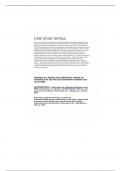
Gary is a 19-year-old who withdrew from college after experiencing a manic episode during
which he was brought to the attention of the Campus Police (“I took the responsibility to pull
multiple fire alarms in my dorm to ensure that they worked, given the life or death nature of
fires”). He had changed his major from engineering to philosophy and increasingly had reduced
his sleep, spending long hours engaging his friends in conversations about the nature of reality.
He had been convinced about the importance of his ideas, stating frequently that he was more
learned and advanced than all his professors. He told others that he was on the verge of
revolutionizing his new field, and he grew increasingly irritable and intolerant of any who
disagreed with him. He also increased a number of high-risk behaviors – drinking and engaging
in sexual relations in a way that was unlike his previous history. At the present time, he has
returned home and his been placed on a mood stabilizer (after a period of time on an
antipsychotic), and his psychiatrist is requesting adjunctive psychotherapy for his bipolar
disorder. The patient’s parents are somewhat shocked by the diagnosis, but they acknowledge
that Gary had early problems with anxiety during pre-adolescence, followed by some periods of
withdrawal and depression during his adolescence. His parents are eager to be involved in
treatment, if appropriate.
NURSING DX: INEFFECTIVE INDIVIDUAL COPING AS
EVIDENCED BY DESTRUCTIVE BEHAVIOR TOWARD SELF
OR OTHERS.
INTERVENTION 1: Administer an antimanic medication and
PRN tranquilizers, as ordered, and evaluate for efficacy, and
side and toxic effects. (Townsend, M.C., Morgan,K.I., 2021 p.
530)
Rationale 1: Bipolar disorder is caused by
biochemical/neurologic imbalances in the brain. Appropriate
antimanic medications allow psychosocial and nursing
interventions to be effective. (Townsend, M.C., Morgan,K.I.,
2021 p. 530)
Gary is a 19-year-old who withdrew from college after experiencing a manic episode during
which he was brought to the attention of the Campus Police (“I took the responsibility to pull
multiple fire alarms in my dorm to ensure that they worked, given the life or death nature of
fires”). He had changed his major from engineering to philosophy and increasingly had reduced
his sleep, spending long hours engaging his friends in conversations about the nature of reality.
He had been convinced about the importance of his ideas, stating frequently that he was more
learned and advanced than all his professors. He told others that he was on the verge of
revolutionizing his new field, and he grew increasingly irritable and intolerant of any who
disagreed with him. He also increased a number of high-risk behaviors – drinking and engaging
in sexual relations in a way that was unlike his previous history. At the present time, he has
returned home and his been placed on a mood stabilizer (after a period of time on an
antipsychotic), and his psychiatrist is requesting adjunctive psychotherapy for his bipolar
disorder. The patient’s parents are somewhat shocked by the diagnosis, but they acknowledge
that Gary had early problems with anxiety during pre-adolescence, followed by some periods of
withdrawal and depression during his adolescence. His parents are eager to be involved in
treatment, if appropriate.
NURSING DX: INEFFECTIVE INDIVIDUAL COPING AS
EVIDENCED BY DESTRUCTIVE BEHAVIOR TOWARD SELF
OR OTHERS.
INTERVENTION 1: Administer an antimanic medication and
PRN tranquilizers, as ordered, and evaluate for efficacy, and
side and toxic effects. (Townsend, M.C., Morgan,K.I., 2021 p.
530)
Rationale 1: Bipolar disorder is caused by
biochemical/neurologic imbalances in the brain. Appropriate
antimanic medications allow psychosocial and nursing
interventions to be effective. (Townsend, M.C., Morgan,K.I.,
2021 p. 530)