
Basic Concepts
Created @September 19, 2023 9:21 PM
Updated @September 19, 2023 10:44 PM
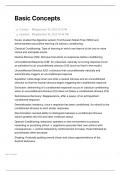
Pavlov studied the digestive system; first Russian Nobel Prize (1904) and
demonstrated associative learning via salivary conditioning.
Classical Conditioning: Type of learning in which one llearns to link two or more
stimuli and anticipate events
Neutral Stimulus (NS): Stimulus that elicits no respoonse before conditioning
Unconditioned Response (UR): An unlearned, naturally occurring response (such
as salivation) to an unconditioned stimulus (US) (such as food in the mouth)
Unconditioned Stimulus (US): a stimulus that unconditionally–naturally and
automatically–triggers an unconditioned response
Aquisition: Initial stage when one links a neutral stimulus and an uncondiitoned
stimulus so that the neutral stimulus begins triggering the conditioned response
Extinction: diminishing of a conditioned responsel occurs in classical conditioning
when an unconditioned stimulus (US) does not follow a coniditoined stimulus (CS)
Spontaneous Recovery: Reappearance, after a pause, of an extinguished
conditioned response
Generalisation: tendency, once a response has been conditioned, for stimuli to the
coniditioned stimulus to elicit similar responses
Discrimination: learned ability to distinguish between a conidtioned stimulus
(which predicts the US) and other irrelevant stimuli
Operant Conditioning: behaviour operates on the environment to produce
rewarding or punishing stimuli → organisms associate their own actions with
consequences → actions followed by reinforcement increase, those followed by
punishments often decrease
Shaping: Gradually guiding toward closer and closer approximations of the
desired behaviour
Basic Concepts 1
, Reinforcement: Any event that strgthens a preceding response
Primary Reinforcer: Unlearned & innately reinforcing stimuli
Conditioned (Secondary) Reinforcer: Gains power through association with
primary reinforcer
Immediate: Occurs immediately after a behaviour
Delayed: Involves time delay between desired response and delivery of reward
Reinforcement Schedule: Includes pattern that defines how often a desired
response will be reinforced
Continuous Reinforcement Schedule: Involves reinforcing the desired response
every time it occurs
Partial (intermittent) reinforcement: includes schedule reinfrocing a response only
part of the time; results in slower acquisition of a response but much greater
resistance to extinction than continuous reinforcement
Types of Reinforcement: Fixed ratio, Fixed interval, Variable Ratio, Variable
Interval. Most powerful for getting continued interaction is variable ratio (slot
machines)
Punishment: administers an undesirable consequence or withdraws something
desirable in an attempt to decrease the frequency of a behaviour
Positive Punishment: presenting a negative consequence after an undesired
behaviour is exhibited, making the behaviour less likely to occur
Negative Punishment: removing a desired stimulus after a particular undesired
behaviour is exhibited, resulting in reducing behaviour in the future
Classical Conditioning Operant Conditioning
organism associates behaviour
Basic Idea organism associates events
and resulting events
voluntary, operates on
Response involuntary, automatic
environment
associating repsonse with a
associating events; NS is paired
Acquisition consequence (reinforcer or
with US and becomes CS
punisher)
Basic Concepts 2
Created @September 19, 2023 9:21 PM
Updated @September 19, 2023 10:44 PM
Pavlov studied the digestive system; first Russian Nobel Prize (1904) and
demonstrated associative learning via salivary conditioning.
Classical Conditioning: Type of learning in which one llearns to link two or more
stimuli and anticipate events
Neutral Stimulus (NS): Stimulus that elicits no respoonse before conditioning
Unconditioned Response (UR): An unlearned, naturally occurring response (such
as salivation) to an unconditioned stimulus (US) (such as food in the mouth)
Unconditioned Stimulus (US): a stimulus that unconditionally–naturally and
automatically–triggers an unconditioned response
Aquisition: Initial stage when one links a neutral stimulus and an uncondiitoned
stimulus so that the neutral stimulus begins triggering the conditioned response
Extinction: diminishing of a conditioned responsel occurs in classical conditioning
when an unconditioned stimulus (US) does not follow a coniditoined stimulus (CS)
Spontaneous Recovery: Reappearance, after a pause, of an extinguished
conditioned response
Generalisation: tendency, once a response has been conditioned, for stimuli to the
coniditioned stimulus to elicit similar responses
Discrimination: learned ability to distinguish between a conidtioned stimulus
(which predicts the US) and other irrelevant stimuli
Operant Conditioning: behaviour operates on the environment to produce
rewarding or punishing stimuli → organisms associate their own actions with
consequences → actions followed by reinforcement increase, those followed by
punishments often decrease
Shaping: Gradually guiding toward closer and closer approximations of the
desired behaviour
Basic Concepts 1
, Reinforcement: Any event that strgthens a preceding response
Primary Reinforcer: Unlearned & innately reinforcing stimuli
Conditioned (Secondary) Reinforcer: Gains power through association with
primary reinforcer
Immediate: Occurs immediately after a behaviour
Delayed: Involves time delay between desired response and delivery of reward
Reinforcement Schedule: Includes pattern that defines how often a desired
response will be reinforced
Continuous Reinforcement Schedule: Involves reinforcing the desired response
every time it occurs
Partial (intermittent) reinforcement: includes schedule reinfrocing a response only
part of the time; results in slower acquisition of a response but much greater
resistance to extinction than continuous reinforcement
Types of Reinforcement: Fixed ratio, Fixed interval, Variable Ratio, Variable
Interval. Most powerful for getting continued interaction is variable ratio (slot
machines)
Punishment: administers an undesirable consequence or withdraws something
desirable in an attempt to decrease the frequency of a behaviour
Positive Punishment: presenting a negative consequence after an undesired
behaviour is exhibited, making the behaviour less likely to occur
Negative Punishment: removing a desired stimulus after a particular undesired
behaviour is exhibited, resulting in reducing behaviour in the future
Classical Conditioning Operant Conditioning
organism associates behaviour
Basic Idea organism associates events
and resulting events
voluntary, operates on
Response involuntary, automatic
environment
associating repsonse with a
associating events; NS is paired
Acquisition consequence (reinforcer or
with US and becomes CS
punisher)
Basic Concepts 2


