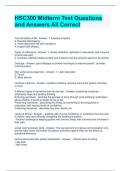
HSC300 Midterm Test Questions
and Answers All Correct
Four principles of MI - Answer- 1. Express empathy
2. Develop Discrepancy
3. Avoid argument/ roll with resistance
4. support self efficacy
Types of reflections - Answer- 1. simple reflection: rephrase in new words, add meaning
to what was said
2. Complex reflection:states content and emotions that the persons seems to be feeling
Dialouge - Answer- good dialogue is another technique to improve patient - provider
communication
Non verbal encouragement - Answer- 1. Look interested
2. Touch
3. Allow silence
narrative medicine - Answer- narrative medicine revolves around the patient narrative,
or story
3 different types of narratives that can be had. - Answer- sustaining narratives -
emphasize hope and positive thinking
Enduring narratives - describe the process of living through ones suffering; ambivalent
about whether it would be better to live or die
Preserving narratives - describing the illness as something to be conquered or
overcame; with varying levels of confidence
Fracturing narratives - describes fea, loss, denial, etc
nature of illness - Answer- - patients with chronic conditions, or conditions that are hard
to define, may have difficulty navigating the healthcare system
- Another challenge is keeping patient with chronic illness well informed and involved in
their care
actual communication skills - Answer- The key element to improve communication is to
provide take home information for patient and allow opportunities for the follow up
questions whenever
factors associated with patient satisfaction - Answer- - doctors level of caring
-rude stuff
- wait times
, the 4 processes people go through when faced with illness - Answer- - Supernormal
identities- determined to not let the illness stop them from being better than ever
-Restored self- people are not quite as optimistic, but still deny that illness has changed
them
-Contingent personal identity- people admit that they can't do every thing they did before
their illness and confront the consequences
- Salvaged self- the development of a transformed identity that includes previous self,
but with current limitations
Communication training for caregivers - Answer- •Communication is key to making good
health care decisions, reducing costs, improving health outcomes, raising patient
satisfaction and minimizing mistakes and misunderstanding
r=
socialization and how it related to becoming a health care professional - Answer- •It
involves socialization- or learning behave appropriately within a specific community
define the voice of medicine - Answer- •The Voice of Medicine is also the expected
communication style in the U.S. for caregivers
communication - Answer- •Isolation: from long study hours to witnessing death and
trauma, it can isolate students
•Identity in limbo: not a layperson, not yet a full-fledged professions
•Privileges: as you learn and experience more you gain the privilege of feeling more like
a health care professional
•Resentment: mainly towards patients- lacking empathy and learning to depersonalize
patients causes this
•Compassion rebound: luckily, as students move into their careers, they tend to regain
their empathy and compassion
idi-theme-
Systems level influences on caregivers - Answer- •Isolation: from long study hours to
witnessing death and trauma, it can isolate students
•Identity in limbo: not a layperson, not yet a full-fledged professions
•Privileges: as you learn and experience more you gain the privilege of feeling more like
a health care professional
•Resentment: mainly towards patients- lacking empathy and learning to depersonalize
patients causes this
•Compassion rebound: luckily, as students move into their careers, they tend to regain
their empathy and compassion
ﱟ앗ꬶퟷ璌䛛怸喰禁
- Answer- •Time constraints: a real and very critical limitation that both patients and
caregivers dislike
and Answers All Correct
Four principles of MI - Answer- 1. Express empathy
2. Develop Discrepancy
3. Avoid argument/ roll with resistance
4. support self efficacy
Types of reflections - Answer- 1. simple reflection: rephrase in new words, add meaning
to what was said
2. Complex reflection:states content and emotions that the persons seems to be feeling
Dialouge - Answer- good dialogue is another technique to improve patient - provider
communication
Non verbal encouragement - Answer- 1. Look interested
2. Touch
3. Allow silence
narrative medicine - Answer- narrative medicine revolves around the patient narrative,
or story
3 different types of narratives that can be had. - Answer- sustaining narratives -
emphasize hope and positive thinking
Enduring narratives - describe the process of living through ones suffering; ambivalent
about whether it would be better to live or die
Preserving narratives - describing the illness as something to be conquered or
overcame; with varying levels of confidence
Fracturing narratives - describes fea, loss, denial, etc
nature of illness - Answer- - patients with chronic conditions, or conditions that are hard
to define, may have difficulty navigating the healthcare system
- Another challenge is keeping patient with chronic illness well informed and involved in
their care
actual communication skills - Answer- The key element to improve communication is to
provide take home information for patient and allow opportunities for the follow up
questions whenever
factors associated with patient satisfaction - Answer- - doctors level of caring
-rude stuff
- wait times
, the 4 processes people go through when faced with illness - Answer- - Supernormal
identities- determined to not let the illness stop them from being better than ever
-Restored self- people are not quite as optimistic, but still deny that illness has changed
them
-Contingent personal identity- people admit that they can't do every thing they did before
their illness and confront the consequences
- Salvaged self- the development of a transformed identity that includes previous self,
but with current limitations
Communication training for caregivers - Answer- •Communication is key to making good
health care decisions, reducing costs, improving health outcomes, raising patient
satisfaction and minimizing mistakes and misunderstanding
r=
socialization and how it related to becoming a health care professional - Answer- •It
involves socialization- or learning behave appropriately within a specific community
define the voice of medicine - Answer- •The Voice of Medicine is also the expected
communication style in the U.S. for caregivers
communication - Answer- •Isolation: from long study hours to witnessing death and
trauma, it can isolate students
•Identity in limbo: not a layperson, not yet a full-fledged professions
•Privileges: as you learn and experience more you gain the privilege of feeling more like
a health care professional
•Resentment: mainly towards patients- lacking empathy and learning to depersonalize
patients causes this
•Compassion rebound: luckily, as students move into their careers, they tend to regain
their empathy and compassion
idi-theme-
Systems level influences on caregivers - Answer- •Isolation: from long study hours to
witnessing death and trauma, it can isolate students
•Identity in limbo: not a layperson, not yet a full-fledged professions
•Privileges: as you learn and experience more you gain the privilege of feeling more like
a health care professional
•Resentment: mainly towards patients- lacking empathy and learning to depersonalize
patients causes this
•Compassion rebound: luckily, as students move into their careers, they tend to regain
their empathy and compassion
ﱟ앗ꬶퟷ璌䛛怸喰禁
- Answer- •Time constraints: a real and very critical limitation that both patients and
caregivers dislike