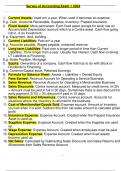
Survey of Accounting Exam 1 2024
1. Current Assets: Used w/n a year. When used it becomes an expense.
E.g. Cash, Accounts Recievable, Supplies, Inventory, Prepaid Insurance
2. Fixed Assets: More permanent. Each fixed asset (except for land) has an
Accumulated Depreciation account which is a Contra-asset. Cash flow going
into it, is an Investment.
E.g. Equipment, land, building
3. Current Liabilities: Paid w/n a year
E.g. Accounts payable, Wages payable, unearned revenue.
4. Long-term Liabilities: Paid over a longer period of time than Current
Liabilities. Think longer than a year. Usually has interest. Cash flow involving
LT Liabilities is Financing.
E.g. Notes Payable, Mortgage
5. Equity: Ownership of a company. Cash flow that has to do with Stock or
Dividends is Financing.
E.g. Common/Capital stock, Retained Earnings
6. Formula for Balance Sheet: Assets = Liabilities + Owned Equity
7. Fees Earned: Revenue Account for Operating a Service Business
8. Sales Revenue: Revenue Account for Operating a Merchandise Business
9. Sales Discounts: Contra revenue account. Measured by credit terms. (n/30)
= Amount must be paid in full in 30 days. Sometimes there is also discount for
early payment (3/10) = 3% discount if paid in 10 days.
10. Sales Returns and Allowances: Contra revenue account. Accounts for
situations where the inventory is returned to the business.
11. Cost of Merchandise/Goods Sold: Expense account. Amount of inventory
you lost when it is sold. Subtract this from net sales amount to calculate gross
profit.
12. Insurance Expense: Expense Account. Created when the Prepaid Insurance
Asset is used up.
13. Supplies Expense: Expense Account. Created when the Supplies are used
up.
14. Wage Expense: Expense Account. Created when employees must be paid.
15. Depreciation Expense: Expense Account. Created when fixed assets
become used up.
16. Net Sales: Calculated by Subtracting Sales Discounts and Sales Returns and
Allowances from Sales Revenue Account.
1/3
1. Current Assets: Used w/n a year. When used it becomes an expense.
E.g. Cash, Accounts Recievable, Supplies, Inventory, Prepaid Insurance
2. Fixed Assets: More permanent. Each fixed asset (except for land) has an
Accumulated Depreciation account which is a Contra-asset. Cash flow going
into it, is an Investment.
E.g. Equipment, land, building
3. Current Liabilities: Paid w/n a year
E.g. Accounts payable, Wages payable, unearned revenue.
4. Long-term Liabilities: Paid over a longer period of time than Current
Liabilities. Think longer than a year. Usually has interest. Cash flow involving
LT Liabilities is Financing.
E.g. Notes Payable, Mortgage
5. Equity: Ownership of a company. Cash flow that has to do with Stock or
Dividends is Financing.
E.g. Common/Capital stock, Retained Earnings
6. Formula for Balance Sheet: Assets = Liabilities + Owned Equity
7. Fees Earned: Revenue Account for Operating a Service Business
8. Sales Revenue: Revenue Account for Operating a Merchandise Business
9. Sales Discounts: Contra revenue account. Measured by credit terms. (n/30)
= Amount must be paid in full in 30 days. Sometimes there is also discount for
early payment (3/10) = 3% discount if paid in 10 days.
10. Sales Returns and Allowances: Contra revenue account. Accounts for
situations where the inventory is returned to the business.
11. Cost of Merchandise/Goods Sold: Expense account. Amount of inventory
you lost when it is sold. Subtract this from net sales amount to calculate gross
profit.
12. Insurance Expense: Expense Account. Created when the Prepaid Insurance
Asset is used up.
13. Supplies Expense: Expense Account. Created when the Supplies are used
up.
14. Wage Expense: Expense Account. Created when employees must be paid.
15. Depreciation Expense: Expense Account. Created when fixed assets
become used up.
16. Net Sales: Calculated by Subtracting Sales Discounts and Sales Returns and
Allowances from Sales Revenue Account.
1/3