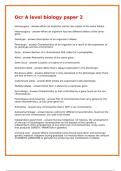
Ocr A level biology paper 2
Homozygous - answer-When an organism carries two copies of the same alleles.
Heterozygous - answer-When an organism has two different alleles of the same
gene.
Genotype - answer-Description of an organism's alleles.
Phenotype - answer-Characteristics of an organism as a result of the expression of
its genotype and the environment.
Gene - answer-Section of a chromosome that codes for a polypeptide.
Allele - answer-Alternative version of the same gene.
Gene locus - answer-Location of a gene on a chromosome.
Dominant allele - answer-Allele that is always expressed in the phenotype.
Recessive allele - answer-Allele that is only expressed in the phenotype when there
are two of them i.e. in a homozygote.
Codominant allele - answer-Both alleles are expressed in the phenotype.
Multiple alleles - answer-More than 2 alleles for a particular gene.
Sex linkage - answer-Characteristic or trait controlled by a gene found on the sex
chromosomes.
Homologous chromosomes - answer-Pair of chromosomes that carry genes for the
same characteristics, at the same gene loci.
Autosome - answer-Any chromosome that is NOT a sex chromosome.
Autosomal linkage - answer-Genes coding for different characteristics, found on the
same non-sex chromosome, are said to be linked.
Independent assortment - answer-During metaphase I of meiosis, the arrangement
of one pair of homologous chromosomes on the equator of the spindle is
independent of the arrangement of any other pair of chromosomes. A key event
that produces GENETIC VARIATION in gametes.
Crossing over - answer-Where chromatids twist around each other and exchange
genetic material. Happens during prophase I of meiosis which increases the amount
of GENETIC VARIATION in gametes by producing new combination of alleles.
,Carrier - answer-Individual who has an allele, often for a disease, which is not
expressed in the phenotype i.e. they are heterozygous.
True breeding - answer-Individuals that are true breeding are homozygous for a
particular characteristic or trait.
Epistasis - answer-A type of gene interaction, where the allele of one gene masks
the effect of the allele of a different gene.
Hemizygous - answer-Having a single copy of a gene instead of the normal two. For
example, if there is heterozygous inheritance of the sex chromosomes, XY.
Variation - answer-The range of differences in characteristics between organisms
Phencopy - answer-When environmental conditions alter the phenotype to resemble
the effects of genotypic change
Discontinuous variation - answer-Variation where there are 2 or more distinct
categories with no intermediates. Determined by a small number of genes with little
or no environmental influence.
Continuous variation - answer-Variation where there are two extremes and all
possible intermediate forms. Determined by many genes (polygenic) and influenced
by the environment.
Etiolation - answer-When plants grow abnormally long and spindly because they are
not getting enough light.
Chlorosis - answer-When plants don't produce enough chlorophyll and turn yellow
eg due to lack of magnesium in the soil.
Artificial selection - answer-When humans select which individuals in a population to
breed together in order to get desirable traits.
Stabilising selection pressure - answer-Factor that reduces the range of phenotypes
by selecting against individuals with the extreme phenotype.
Selection pressure - answer-A factor that gives a greater chance of surviving to
some members of the population than others e.g. moth camouflage
Stabilising selection - answer-Types of selection that operates against the extremes
of the range of phenotypes so the population remains the same over time.
Directional selection - answer-Factor that selects individuals with an extreme
phenotype of a range of phenotypes so the population changes over time.
Genetic drift - answer-The increase or decrease in the frequency of alleles as a
result of chance events.
, Carrying capacity - answer-The maximum population size of a species that a
particular habitat can support over time.
Gene pool - answer-The sum of all the alleles in a population at a given time.
Genetic bottleneck - answer-An event, such as a natural disaster, that causes a
large reduction in the size of a population.
Founder effect - answer-What happens when a small number of individuals start a
new population and there is only a small number of alleles.
Species - answer-A group of similar organisms that can reproduce to give fertile
offspring.
Allopatric speciation - answer-Populations become geographically isolated and, as a
result of natural selection, form new species.
Sympatric speciation - answer-Formation of a new species without geographical
isolation.
Reproductive isolation - answer-Populations cannot breed successfully together
because of mechanical changes or behavioral changes.
Geographical isolation - answer-A physical barrier such as a mountain range or a
desert that prevents gene flow between populations.
Natural selection - answer-The mechanism of evolution.It is the survival of
individuals in a population to reproduce and pass on their alleles to the next
generation.
Restriction endonuclease - answer-Enzyme that cuts DNA molecules at a specific
sequence of bases.
Palindromic recognition site - answer-The specific sequence of bases where a
restriction enzyme will cut. The sequence of bases reads the same in opposite
directions.
DNA ligase - answer-Enzyme which joins sections of DNA together, catalysing
condensation reaction.
Sticky ends - answer-When a restriction endonuclease cuts DNA and leaves
unpaired bases.
Vector DNA - answer-Used to transfer DNA into a cell eg a plasmid or bacteriophage.
Plasmid - answer-Small, circular molecule of DNA used to transfer DNA into cells.
Bacteriophage - answer-A virus that infects a bacterium and can be used as a DNA
vector.
Homozygous - answer-When an organism carries two copies of the same alleles.
Heterozygous - answer-When an organism has two different alleles of the same
gene.
Genotype - answer-Description of an organism's alleles.
Phenotype - answer-Characteristics of an organism as a result of the expression of
its genotype and the environment.
Gene - answer-Section of a chromosome that codes for a polypeptide.
Allele - answer-Alternative version of the same gene.
Gene locus - answer-Location of a gene on a chromosome.
Dominant allele - answer-Allele that is always expressed in the phenotype.
Recessive allele - answer-Allele that is only expressed in the phenotype when there
are two of them i.e. in a homozygote.
Codominant allele - answer-Both alleles are expressed in the phenotype.
Multiple alleles - answer-More than 2 alleles for a particular gene.
Sex linkage - answer-Characteristic or trait controlled by a gene found on the sex
chromosomes.
Homologous chromosomes - answer-Pair of chromosomes that carry genes for the
same characteristics, at the same gene loci.
Autosome - answer-Any chromosome that is NOT a sex chromosome.
Autosomal linkage - answer-Genes coding for different characteristics, found on the
same non-sex chromosome, are said to be linked.
Independent assortment - answer-During metaphase I of meiosis, the arrangement
of one pair of homologous chromosomes on the equator of the spindle is
independent of the arrangement of any other pair of chromosomes. A key event
that produces GENETIC VARIATION in gametes.
Crossing over - answer-Where chromatids twist around each other and exchange
genetic material. Happens during prophase I of meiosis which increases the amount
of GENETIC VARIATION in gametes by producing new combination of alleles.
,Carrier - answer-Individual who has an allele, often for a disease, which is not
expressed in the phenotype i.e. they are heterozygous.
True breeding - answer-Individuals that are true breeding are homozygous for a
particular characteristic or trait.
Epistasis - answer-A type of gene interaction, where the allele of one gene masks
the effect of the allele of a different gene.
Hemizygous - answer-Having a single copy of a gene instead of the normal two. For
example, if there is heterozygous inheritance of the sex chromosomes, XY.
Variation - answer-The range of differences in characteristics between organisms
Phencopy - answer-When environmental conditions alter the phenotype to resemble
the effects of genotypic change
Discontinuous variation - answer-Variation where there are 2 or more distinct
categories with no intermediates. Determined by a small number of genes with little
or no environmental influence.
Continuous variation - answer-Variation where there are two extremes and all
possible intermediate forms. Determined by many genes (polygenic) and influenced
by the environment.
Etiolation - answer-When plants grow abnormally long and spindly because they are
not getting enough light.
Chlorosis - answer-When plants don't produce enough chlorophyll and turn yellow
eg due to lack of magnesium in the soil.
Artificial selection - answer-When humans select which individuals in a population to
breed together in order to get desirable traits.
Stabilising selection pressure - answer-Factor that reduces the range of phenotypes
by selecting against individuals with the extreme phenotype.
Selection pressure - answer-A factor that gives a greater chance of surviving to
some members of the population than others e.g. moth camouflage
Stabilising selection - answer-Types of selection that operates against the extremes
of the range of phenotypes so the population remains the same over time.
Directional selection - answer-Factor that selects individuals with an extreme
phenotype of a range of phenotypes so the population changes over time.
Genetic drift - answer-The increase or decrease in the frequency of alleles as a
result of chance events.
, Carrying capacity - answer-The maximum population size of a species that a
particular habitat can support over time.
Gene pool - answer-The sum of all the alleles in a population at a given time.
Genetic bottleneck - answer-An event, such as a natural disaster, that causes a
large reduction in the size of a population.
Founder effect - answer-What happens when a small number of individuals start a
new population and there is only a small number of alleles.
Species - answer-A group of similar organisms that can reproduce to give fertile
offspring.
Allopatric speciation - answer-Populations become geographically isolated and, as a
result of natural selection, form new species.
Sympatric speciation - answer-Formation of a new species without geographical
isolation.
Reproductive isolation - answer-Populations cannot breed successfully together
because of mechanical changes or behavioral changes.
Geographical isolation - answer-A physical barrier such as a mountain range or a
desert that prevents gene flow between populations.
Natural selection - answer-The mechanism of evolution.It is the survival of
individuals in a population to reproduce and pass on their alleles to the next
generation.
Restriction endonuclease - answer-Enzyme that cuts DNA molecules at a specific
sequence of bases.
Palindromic recognition site - answer-The specific sequence of bases where a
restriction enzyme will cut. The sequence of bases reads the same in opposite
directions.
DNA ligase - answer-Enzyme which joins sections of DNA together, catalysing
condensation reaction.
Sticky ends - answer-When a restriction endonuclease cuts DNA and leaves
unpaired bases.
Vector DNA - answer-Used to transfer DNA into a cell eg a plasmid or bacteriophage.
Plasmid - answer-Small, circular molecule of DNA used to transfer DNA into cells.
Bacteriophage - answer-A virus that infects a bacterium and can be used as a DNA
vector.