Virologie
Les 1
Structuur van virussen
• Virussen zijn kleine infectieuze partikels die bestaan uit een nucleïnezuur in een eiwitmantel
en in sommige gevallen een membraanenvelop.
• Virussen zijn geen cellen:
– Virussen hebben maar 1 type nucleïnezuur (enkel- of dubbelstrengs DNA of RNA).
– Virussen hebben geen metabolisme en maken dus geen ATP.
– Virussen hebben geen enzymen die nodig zijn voor het produceren van
macromoleculen, m.n. eiwitten.
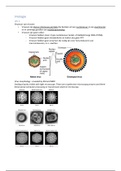
Virus morphology : revealed by EM and NMR
Smallpox barely visible with light microscope. These are cryoelectron microscopy pictures and three-
dimensional computer processing or transmission electron microscopy.
,Taxonomy based on genetic content and structural elements
Viraal Genoom
• Virale genomen zijn 5 – 670 kb
• Circulair of lineair
• Meestal 1 molecuul, soms meerdere fragmenten
Capside
• Het capside is een eiwitmantel die het genoom omvat.
• Een capside wordt gevormd door 1 of meerdere eiwitten (structurele eenheden) die heel
precies zijn gerangschikt in een repeterend patroon (capsomeren).
• Een capside ontstaat door self-assembly, evt. bijgestaan door chaperone-eiwitten.
,Membraanenvelop
• Speelt een rol bij infectie van gastheercel (eerste contact).
• Combinatie van lipiden en eiwitten van de gastheer en virale eiwitten.
• Het complete viruspartikel heet virion
• Virionen kunnen ook enzymen bevatten, bijv.
– lysozym (bacteriofaag)
– nucleïnezuurpolymerases
– enzymen nodig voor de productie van nieuwe virionen
Replicatie
- Viruses replicate by assembly of preformed components into
many Particles
- Not binary fission like bacteria ("division in half")
• cytopathic effect: Syncytia
• Normale cellen vs ‘samengeklonterde’ cellen
, Formation of syncytia
Due to the expression of a fusion protein
1. Attachment
Viruses attach to host cells by binding to receptors expressed on the host cell surface
Very specific interactions with one or more cell surface proteins (receptors and co-receptors)
HIV: CD4 as receptor and gp120 and gp41 as coreceptors
→the virus makes use of receptors that have specific functions for the normal activities of the cell!
For example chemokine receptors, growth factor receptors, adhesion molecules
→blocking antibodies!
→transfection of the receptor into cell lines generates a susceptible cell line to use as a tool
On virus-side: naked viruses bind with capsid surface, with depressions or on ridges, fibres and knobs
(adenovirus) or spikes (rotavirus). Enveloped viruses interact with receptors on cellular membrane
through surface glycoproteins. In influenza this is the haemagglutinin protein which as a result of its
receptor binding capacities can induce red blood cells to clump
Attachment may induce major structural changes in the virion
Virus attachment: Influenza
Waarom infecteert het griepvirus alleen de luchtwegen? Vanwege de aanwezigheid van de juiste
receptoren!
Hoe kunnen we dit bevestigen?
- Door een techniek van virus histochemistry
Groot verschil tussen vogelgriep virus en seizoensgriepvirus → deze binden aan andere receptoren
Vogelgriepvirus aan een aviaire receptor (lagere luchtwegen), en een seizoensgreipvirus aan een
human receptor (bovenste luchtwegen).
Les 1
Structuur van virussen
• Virussen zijn kleine infectieuze partikels die bestaan uit een nucleïnezuur in een eiwitmantel
en in sommige gevallen een membraanenvelop.
• Virussen zijn geen cellen:
– Virussen hebben maar 1 type nucleïnezuur (enkel- of dubbelstrengs DNA of RNA).
– Virussen hebben geen metabolisme en maken dus geen ATP.
– Virussen hebben geen enzymen die nodig zijn voor het produceren van
macromoleculen, m.n. eiwitten.
Virus morphology : revealed by EM and NMR
Smallpox barely visible with light microscope. These are cryoelectron microscopy pictures and three-
dimensional computer processing or transmission electron microscopy.
,Taxonomy based on genetic content and structural elements
Viraal Genoom
• Virale genomen zijn 5 – 670 kb
• Circulair of lineair
• Meestal 1 molecuul, soms meerdere fragmenten
Capside
• Het capside is een eiwitmantel die het genoom omvat.
• Een capside wordt gevormd door 1 of meerdere eiwitten (structurele eenheden) die heel
precies zijn gerangschikt in een repeterend patroon (capsomeren).
• Een capside ontstaat door self-assembly, evt. bijgestaan door chaperone-eiwitten.
,Membraanenvelop
• Speelt een rol bij infectie van gastheercel (eerste contact).
• Combinatie van lipiden en eiwitten van de gastheer en virale eiwitten.
• Het complete viruspartikel heet virion
• Virionen kunnen ook enzymen bevatten, bijv.
– lysozym (bacteriofaag)
– nucleïnezuurpolymerases
– enzymen nodig voor de productie van nieuwe virionen
Replicatie
- Viruses replicate by assembly of preformed components into
many Particles
- Not binary fission like bacteria ("division in half")
• cytopathic effect: Syncytia
• Normale cellen vs ‘samengeklonterde’ cellen
, Formation of syncytia
Due to the expression of a fusion protein
1. Attachment
Viruses attach to host cells by binding to receptors expressed on the host cell surface
Very specific interactions with one or more cell surface proteins (receptors and co-receptors)
HIV: CD4 as receptor and gp120 and gp41 as coreceptors
→the virus makes use of receptors that have specific functions for the normal activities of the cell!
For example chemokine receptors, growth factor receptors, adhesion molecules
→blocking antibodies!
→transfection of the receptor into cell lines generates a susceptible cell line to use as a tool
On virus-side: naked viruses bind with capsid surface, with depressions or on ridges, fibres and knobs
(adenovirus) or spikes (rotavirus). Enveloped viruses interact with receptors on cellular membrane
through surface glycoproteins. In influenza this is the haemagglutinin protein which as a result of its
receptor binding capacities can induce red blood cells to clump
Attachment may induce major structural changes in the virion
Virus attachment: Influenza
Waarom infecteert het griepvirus alleen de luchtwegen? Vanwege de aanwezigheid van de juiste
receptoren!
Hoe kunnen we dit bevestigen?
- Door een techniek van virus histochemistry
Groot verschil tussen vogelgriep virus en seizoensgriepvirus → deze binden aan andere receptoren
Vogelgriepvirus aan een aviaire receptor (lagere luchtwegen), en een seizoensgreipvirus aan een
human receptor (bovenste luchtwegen).