JavaScript Programming Language Overview
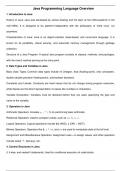
1. Introduction to JavaScript
History of JavaScript: JavaScript was created by Brendan Eich in 1995 as a client-side scripting
language for web development.
Characteristics of JavaScript: JavaScript is a lightweight, interpreted, and just-in-time compiled
programming language, primarily used for creating interactive web pages.
Structure of a JavaScript Program: A typical JavaScript program consists of functions, variables, and
objects, and is often embedded in HTML to manipulate web content.
2. Data Types and Variables in JavaScript
Basic Data Types: JavaScript supports primitive data types like number, string, boolean, null,
undefined, and symbol.
Variables: Variables can be declared using var, let, and const. Variables can store data types
dynamically.
Constants and Literals: Constants are declared using const and their values cannot be changed
after initialization. Literals are fixed values used directly in the code.
3. Operators in JavaScript
Arithmetic Operators: Includes +, -, *, /, % for performing basic arithmetic.
Relational Operators: Used to compare values, such as ==, !=, >, <.
Logical Operators: Logical operations include && (AND), || (OR), ! (NOT).
Assignment and Miscellaneous Operators: Assignment uses = to assign values, and other operators
include typeof, instanceof, etc.
4. Control Structures in JavaScript
if, if-else, and nested if statements: Used for conditional execution of code blocks.
switch-case statement: Provides a way to select one of many blocks of code based on the value of a
variable.
Loops: for, while, and do-while loops allow repetitive execution of code blocks.
1. Introduction to JavaScript
History of JavaScript: JavaScript was created by Brendan Eich in 1995 as a client-side scripting
language for web development.
Characteristics of JavaScript: JavaScript is a lightweight, interpreted, and just-in-time compiled
programming language, primarily used for creating interactive web pages.
Structure of a JavaScript Program: A typical JavaScript program consists of functions, variables, and
objects, and is often embedded in HTML to manipulate web content.
2. Data Types and Variables in JavaScript
Basic Data Types: JavaScript supports primitive data types like number, string, boolean, null,
undefined, and symbol.
Variables: Variables can be declared using var, let, and const. Variables can store data types
dynamically.
Constants and Literals: Constants are declared using const and their values cannot be changed
after initialization. Literals are fixed values used directly in the code.
3. Operators in JavaScript
Arithmetic Operators: Includes +, -, *, /, % for performing basic arithmetic.
Relational Operators: Used to compare values, such as ==, !=, >, <.
Logical Operators: Logical operations include && (AND), || (OR), ! (NOT).
Assignment and Miscellaneous Operators: Assignment uses = to assign values, and other operators
include typeof, instanceof, etc.
4. Control Structures in JavaScript
if, if-else, and nested if statements: Used for conditional execution of code blocks.
switch-case statement: Provides a way to select one of many blocks of code based on the value of a
variable.
Loops: for, while, and do-while loops allow repetitive execution of code blocks.