

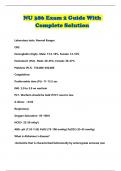
NU 386 Exam 2 Guide With
Complete Solution
Laboratory tests: Normal Ranges
CBC:
Hemoglobin (Hgb)- Male: 13.5-18%, Female: 12-16%
Hematocrit (Hct)- Male: 40-45%, Female: 38-47%
Platelets (PLT)- 150,000-450,000
Coagulation:
Prothrombin time (Pt)- 11-13.5 sec
INR- 2.0 to 3.0 on warfarin
PLT- Warfarin should be held if PLT count is low
d-dimer- <0.50
Respiratory:
Oxygen Saturation- 95-100%
HCO3- 22-28 mEq/L
ABG- pH (7.35-7.45) PaO2 (75-100 mmHg) PaCO2 (35-45 mmHg)
What is Alzheimer's disease?
-Dementia that is characterized behaviorally by anterograde amnesia (can
,remember the past but cannot form new memories).
-Visual memory is also impaired, leading to confusion with regard to
orientation
Pathophysiology/Etiology: Alzheimer's Disease
Changes in brain structure and function
-Amyloid plaques: abnormal clusters of beta amyloid fragments that build up
between nerve cells
-Neurofibrillary tangles: destroy the transport system for nutrients that is
made up of proteins
-Loss of connections between neurons
-Neuron death
S/S of Alzheimer's Disease
-Memory loss that affects job skills
-Problems with abstract thinking
-Difficulty doing familiar tasks
-Poor or decreased judgement
-Problems with language
-Misplacing things
-Changes in mood
-Changes in personality
-Loss of initiative
,Assessment for Alzheimer's
loss in mini-mental scale, clock drawing, 3-word recall test
Diagnosis of Alzheimer's
-Thorough history & physical
-Rule out other possibilities
-Labs: vitamin B12 or B1 deficiency, electrolyte imbalance, thyroid disorders,
infections (UTI)
-Biomarkers: research only
-MRI, CT, PET
-Lumbar puncture: sBPP in CSF (soluble beta protein precursor)
-MMSE or Mini-cog
Nursing Interventions: Alzheimer's Disease
-No cure
-Minimizing undesirable behaviors/providing support for family
-Assess cognitive status
-Bowel/Bladder program
-Safe environment
-Frequent walks
-Verbal/nonverbal communication
-Assess skin regularly
, -Cognitive stimulation
-Memory training exercises
-Avoid overstimulation
-Promotion of self-care
-Provide routines
Medication Interventions: Alzheimer's & Dementia
Acetylcholinesterase Inhibitors (AChEIs)- Donepezil (Aricept), Galantamine
HBr (Razadyne): Slows breakdown of ACh
Glutamine Pathway Modifiers- Memantine (Nemenda): Regulates abnormal
glutamine
Antipsychotics-haloperidol (Haldol): FDA has warned that antipsychotics are
not indicated for treatment of dementia related psychosis. There is an
increased risk of CVA and death in older adult with dementia
Antidepressants- citalopram (Celexa), fluoxetine (Prozac): may improve
cognitive ability and problems related to sleep
Anxiolytics- lorazepam (Ativan), oxazepam (Serax)
-AD meds may slow the course of the disease, but do not work for everyone
What is Dementia?
A chronic or persistent disorder of the mental processes caused by brain
disease or injury and marked by memory disorders, personality changes, and
impaired reasoning
What are the causes of Dementia?
Complete Solution
Laboratory tests: Normal Ranges
CBC:
Hemoglobin (Hgb)- Male: 13.5-18%, Female: 12-16%
Hematocrit (Hct)- Male: 40-45%, Female: 38-47%
Platelets (PLT)- 150,000-450,000
Coagulation:
Prothrombin time (Pt)- 11-13.5 sec
INR- 2.0 to 3.0 on warfarin
PLT- Warfarin should be held if PLT count is low
d-dimer- <0.50
Respiratory:
Oxygen Saturation- 95-100%
HCO3- 22-28 mEq/L
ABG- pH (7.35-7.45) PaO2 (75-100 mmHg) PaCO2 (35-45 mmHg)
What is Alzheimer's disease?
-Dementia that is characterized behaviorally by anterograde amnesia (can
,remember the past but cannot form new memories).
-Visual memory is also impaired, leading to confusion with regard to
orientation
Pathophysiology/Etiology: Alzheimer's Disease
Changes in brain structure and function
-Amyloid plaques: abnormal clusters of beta amyloid fragments that build up
between nerve cells
-Neurofibrillary tangles: destroy the transport system for nutrients that is
made up of proteins
-Loss of connections between neurons
-Neuron death
S/S of Alzheimer's Disease
-Memory loss that affects job skills
-Problems with abstract thinking
-Difficulty doing familiar tasks
-Poor or decreased judgement
-Problems with language
-Misplacing things
-Changes in mood
-Changes in personality
-Loss of initiative
,Assessment for Alzheimer's
loss in mini-mental scale, clock drawing, 3-word recall test
Diagnosis of Alzheimer's
-Thorough history & physical
-Rule out other possibilities
-Labs: vitamin B12 or B1 deficiency, electrolyte imbalance, thyroid disorders,
infections (UTI)
-Biomarkers: research only
-MRI, CT, PET
-Lumbar puncture: sBPP in CSF (soluble beta protein precursor)
-MMSE or Mini-cog
Nursing Interventions: Alzheimer's Disease
-No cure
-Minimizing undesirable behaviors/providing support for family
-Assess cognitive status
-Bowel/Bladder program
-Safe environment
-Frequent walks
-Verbal/nonverbal communication
-Assess skin regularly
, -Cognitive stimulation
-Memory training exercises
-Avoid overstimulation
-Promotion of self-care
-Provide routines
Medication Interventions: Alzheimer's & Dementia
Acetylcholinesterase Inhibitors (AChEIs)- Donepezil (Aricept), Galantamine
HBr (Razadyne): Slows breakdown of ACh
Glutamine Pathway Modifiers- Memantine (Nemenda): Regulates abnormal
glutamine
Antipsychotics-haloperidol (Haldol): FDA has warned that antipsychotics are
not indicated for treatment of dementia related psychosis. There is an
increased risk of CVA and death in older adult with dementia
Antidepressants- citalopram (Celexa), fluoxetine (Prozac): may improve
cognitive ability and problems related to sleep
Anxiolytics- lorazepam (Ativan), oxazepam (Serax)
-AD meds may slow the course of the disease, but do not work for everyone
What is Dementia?
A chronic or persistent disorder of the mental processes caused by brain
disease or injury and marked by memory disorders, personality changes, and
impaired reasoning
What are the causes of Dementia?


