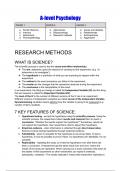
A-level Psychology
PAPER 1 PAPER 2 PAPER 3
a. Social influence a. Approaches a. Issues and debates
b. memory b. Biopsychology b. Relationships
c. Attachment c. Research methods c. Schizophrenia
d. Psychopathology d. Aggression
RESEARCH METHODS
WHAT IS SCIENCE?
The scientific process is used to test the cause-and-effect relationship):
➔ The aim, statement, gives the reasons for carrying out the experiment, (e.g. “to
determine or to investigate”).
➔ The hypothesis is a prediction of what you are expecting to happen within the
experiment.
➔ The method is the exact procedure you follow in the experiment.
➔ The results are the changes that the researcher observes during the experiment.
➔ The conclusion is the interpretation of the result.
In an experiment, the thing we change is called the Independent Variable (IV) and the thing
that we measure is called the Dependent Variable (DV).
The level of the IV is the number of different versions of the IV are in an experiment.
Different versions of independent variables are called Levels of the Independent Variable.
Operationalising variables means defining how the variable is going to be measured (e.g.
number of items recalled).
7 KEY FEATURES OF SCIENCE:
1. Hypothesis testing - we test the hypothesis using the scientific process. Using the
scientific process, the researchers collect results and interpret them to reach a
conclusion. “Whether the results support the hypothesis?” Sometimes, results do
not support the hypothesis, then researchers need to adjust their hypothesis.
2. Empirical evidence - when information is collected through direct observation.
Science involves testing hypothesis through empirical evidence.
3. Falsifiability - when it’s possible for the hypothesis to be proven false. To test a
hypothesis, it must be possible to prove it false. If a hypothesis isn’t falsifiable, it’s not
scientific.
4. Replicability - repeating the study, to re-test the hypothesis even after there has
been a conclusion. If researchers get the same result over and over, means the
results of the study are replicated. When carrying out a study scientists write down all
the details of their experiment so other researchers can repeat it (methods,
participants, variables). “The results replicated” means that researchers replicated a
, study and found the same results. If possible to replicate a study the study is
replicable.
5. Control - … (What is meant by control in the context of scientific research? Control in
an experiment refers to whether the experiment is using a control group, and whether
extraneous variables have been controlled)
Control group: no manipulation (a level of the IV which is not manipulated by the
researcher).
Experimental group: manipulated (a level of the IV which is manipulated by the
researcher). Science involves comparing an experimental group to a control group.
The independent variable is manipulated by the researcher
The dependent variable is measured by the researcher.
An extraneous variable is something other than what we’re studying which affects
the DV, if they are controlled we say that the researcher controlled extraneous
variables.
A confounding variable is an
extraneous variable that varies
according to the level of the
independent variable.
Confounding variables can make it
seem as if a relationship between
the independent and dependent
variable exists, when in fact, the
dependent variable is affected by
another variable that is related to the independent variable.
6. Objectivity - a researcher must not let personal bias affect the way they carry out an
experiment. Personal bias is when researchers have a preference on what result
they want, and when researchers let their personal bias affect how they are carrying
out the experiment - they are not being objective. Researchers are objective when
they don't let their personal bias (how they experiment) affect the experiment.
Researchers might be subconsciously affected by their personal preferences.
7. Theory Construction - in science a theory must be a comprehensive explanation
that has already been backed up by a scientific method. We need the scientific
method to construct theory, which is used to test predictions about the world.
Therefore theories must be falsifiable. A theory is a repeated use of the scientific
method and can be used to test new testable hypotheses.
ISSUES IN PSYCHOLOGICAL RESEARCH
Valid, when a test measures what it claims to measure.
Lacks validity, when a test doesn’t measure what it claims to measure. For the results to be
valid the measurement shouldn’t be affected by any extraneous or confounding variables.
Assessing validity:
➔ Face validity - look at the test to decide if it appears to measure what it claims to be
measuring.
➔ Concurrent validity - comparing results from one test to results from another test
measuring the same behaviour known to be valid.
PAPER 1 PAPER 2 PAPER 3
a. Social influence a. Approaches a. Issues and debates
b. memory b. Biopsychology b. Relationships
c. Attachment c. Research methods c. Schizophrenia
d. Psychopathology d. Aggression
RESEARCH METHODS
WHAT IS SCIENCE?
The scientific process is used to test the cause-and-effect relationship):
➔ The aim, statement, gives the reasons for carrying out the experiment, (e.g. “to
determine or to investigate”).
➔ The hypothesis is a prediction of what you are expecting to happen within the
experiment.
➔ The method is the exact procedure you follow in the experiment.
➔ The results are the changes that the researcher observes during the experiment.
➔ The conclusion is the interpretation of the result.
In an experiment, the thing we change is called the Independent Variable (IV) and the thing
that we measure is called the Dependent Variable (DV).
The level of the IV is the number of different versions of the IV are in an experiment.
Different versions of independent variables are called Levels of the Independent Variable.
Operationalising variables means defining how the variable is going to be measured (e.g.
number of items recalled).
7 KEY FEATURES OF SCIENCE:
1. Hypothesis testing - we test the hypothesis using the scientific process. Using the
scientific process, the researchers collect results and interpret them to reach a
conclusion. “Whether the results support the hypothesis?” Sometimes, results do
not support the hypothesis, then researchers need to adjust their hypothesis.
2. Empirical evidence - when information is collected through direct observation.
Science involves testing hypothesis through empirical evidence.
3. Falsifiability - when it’s possible for the hypothesis to be proven false. To test a
hypothesis, it must be possible to prove it false. If a hypothesis isn’t falsifiable, it’s not
scientific.
4. Replicability - repeating the study, to re-test the hypothesis even after there has
been a conclusion. If researchers get the same result over and over, means the
results of the study are replicated. When carrying out a study scientists write down all
the details of their experiment so other researchers can repeat it (methods,
participants, variables). “The results replicated” means that researchers replicated a
, study and found the same results. If possible to replicate a study the study is
replicable.
5. Control - … (What is meant by control in the context of scientific research? Control in
an experiment refers to whether the experiment is using a control group, and whether
extraneous variables have been controlled)
Control group: no manipulation (a level of the IV which is not manipulated by the
researcher).
Experimental group: manipulated (a level of the IV which is manipulated by the
researcher). Science involves comparing an experimental group to a control group.
The independent variable is manipulated by the researcher
The dependent variable is measured by the researcher.
An extraneous variable is something other than what we’re studying which affects
the DV, if they are controlled we say that the researcher controlled extraneous
variables.
A confounding variable is an
extraneous variable that varies
according to the level of the
independent variable.
Confounding variables can make it
seem as if a relationship between
the independent and dependent
variable exists, when in fact, the
dependent variable is affected by
another variable that is related to the independent variable.
6. Objectivity - a researcher must not let personal bias affect the way they carry out an
experiment. Personal bias is when researchers have a preference on what result
they want, and when researchers let their personal bias affect how they are carrying
out the experiment - they are not being objective. Researchers are objective when
they don't let their personal bias (how they experiment) affect the experiment.
Researchers might be subconsciously affected by their personal preferences.
7. Theory Construction - in science a theory must be a comprehensive explanation
that has already been backed up by a scientific method. We need the scientific
method to construct theory, which is used to test predictions about the world.
Therefore theories must be falsifiable. A theory is a repeated use of the scientific
method and can be used to test new testable hypotheses.
ISSUES IN PSYCHOLOGICAL RESEARCH
Valid, when a test measures what it claims to measure.
Lacks validity, when a test doesn’t measure what it claims to measure. For the results to be
valid the measurement shouldn’t be affected by any extraneous or confounding variables.
Assessing validity:
➔ Face validity - look at the test to decide if it appears to measure what it claims to be
measuring.
➔ Concurrent validity - comparing results from one test to results from another test
measuring the same behaviour known to be valid.