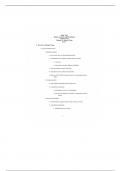
BIOL 1303
Human Anatomy and Physiology I
Lecture Notes
Chapter 10: Muscle Tissue
Part 1
I. Overview of Muscle Tissue
A. Types of muscle tissue
1. Skeletal (striated)
a. move bone, skin, or other skeletal muscles
b. controlled by the voluntary, somatic nervous system
i. conscious
ii. unconscious: posture, balance, breathing
c. some involuntary control: shivering
d. each muscle cell is called a muscle fiber
e. there are 100’s-1000’s of muscle fibers in each skeletal muscle
organ
2. Cardiac (striated)
a. wall of heart and initial portion of the aorta
b. controlled involuntarily
i. autorhythmic: has its own pacemaker
ii. pace can be altered by hormones or autonomic nervous
system
3. Smooth (nonstriated)
a. walls of hollow organs: blood vessels, GI tract, airways
b. controlled involuntarily
i. autonomic nervous system
-1-
, ii. endocrine system
iii. some are autorythmic
B. Functions of muscle tissue
1. Movement of body
a. entire body
b. body parts
2. Stabilize body position
a. posture
b. balance
3. Storing and moving substances within the body
a. sphincters (ring of smooth muscle) contract to store substances
b. contraction and relaxation of smooth muscle in tracts, propels
substances
c. cardiac muscle contracts to move blood
d. skeletal muscle contraction aid in moving blood through the
veins and lymph
4. Heat production: Thermogenesis
C. Properties of muscle tissue
1. Electrical excitability: respond to stimuli with electrical signal
a. the electrical signal is seen in the form of an action potential
b. caused by:
i. autorhythmic electrical signals
ii. neurotransmitters
iii. hormones
-2-
Human Anatomy and Physiology I
Lecture Notes
Chapter 10: Muscle Tissue
Part 1
I. Overview of Muscle Tissue
A. Types of muscle tissue
1. Skeletal (striated)
a. move bone, skin, or other skeletal muscles
b. controlled by the voluntary, somatic nervous system
i. conscious
ii. unconscious: posture, balance, breathing
c. some involuntary control: shivering
d. each muscle cell is called a muscle fiber
e. there are 100’s-1000’s of muscle fibers in each skeletal muscle
organ
2. Cardiac (striated)
a. wall of heart and initial portion of the aorta
b. controlled involuntarily
i. autorhythmic: has its own pacemaker
ii. pace can be altered by hormones or autonomic nervous
system
3. Smooth (nonstriated)
a. walls of hollow organs: blood vessels, GI tract, airways
b. controlled involuntarily
i. autonomic nervous system
-1-
, ii. endocrine system
iii. some are autorythmic
B. Functions of muscle tissue
1. Movement of body
a. entire body
b. body parts
2. Stabilize body position
a. posture
b. balance
3. Storing and moving substances within the body
a. sphincters (ring of smooth muscle) contract to store substances
b. contraction and relaxation of smooth muscle in tracts, propels
substances
c. cardiac muscle contracts to move blood
d. skeletal muscle contraction aid in moving blood through the
veins and lymph
4. Heat production: Thermogenesis
C. Properties of muscle tissue
1. Electrical excitability: respond to stimuli with electrical signal
a. the electrical signal is seen in the form of an action potential
b. caused by:
i. autorhythmic electrical signals
ii. neurotransmitters
iii. hormones
-2-