Prof Dr Jörg Fliege Semester 2, 2022/2023
School of Mathematical Sciences
University of Southampton
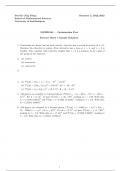
MATH6184 — Optimization Part
Exercise Sheet 1 Sample Solutions
1. Constraints are linear (and as such convex), objective has a second derivative of 4 > 0,
therefore the objective is convex. First derivative has a zero at x = 3, and x = 3 is
feasible. This, together with convexity, implies that x = 3 is a solution. As by a plot of
the graph of the objective.
2. (a) convex.
(b) nonconvex.
(c) nonconvex.
3.
4. (a) ∇f (x) = (2x1 + x2 − 6, x1 − 8)T = (0, 0)T .
(b) ∇f (x) = (20x1 , 12/x2 )T = (20, 6)T . d = (−20, −6)T .
(c) ∇f (x) = (x3 , 3x22 , x1 )T = (0, 3, 1)T . d = (0, −3, 1)T .
5. (All figures are rounded to 4 decimal places.) ∇f (x) = −(x2 − 20(x1 − 2)3 , x1 − 12(x2 −
5)3 )T . For x = (1, 3)T , we have ∇f (x) = (−23, −97)T , leading to t = 1/32. With this,
x = (1.7188, 6.0312)T and ∇f (x) = (−6.4762, 11.4418)T , leading to t = 1/8. With this,
x = (2.5283, 4.6010)T .
6. (All figures are rounded to 4 decimal places.) ∇f (x) = (−1000/(x1 + x2 )2 + 2(x1 −
2), −1000/(x1 + x2 )2 + 2(x2 − 10))T . For x = (3, 7)T , we have ∇f (x) = (−8, −26)T ,
leading to t = 1/2. With this, x = (7, 15)T and ∇f (x) = (7.9339, 7.9339)T , leading to
t = 1/2. With this, x = (3.0331, 11.0331)T .
1
School of Mathematical Sciences
University of Southampton
MATH6184 — Optimization Part
Exercise Sheet 1 Sample Solutions
1. Constraints are linear (and as such convex), objective has a second derivative of 4 > 0,
therefore the objective is convex. First derivative has a zero at x = 3, and x = 3 is
feasible. This, together with convexity, implies that x = 3 is a solution. As by a plot of
the graph of the objective.
2. (a) convex.
(b) nonconvex.
(c) nonconvex.
3.
4. (a) ∇f (x) = (2x1 + x2 − 6, x1 − 8)T = (0, 0)T .
(b) ∇f (x) = (20x1 , 12/x2 )T = (20, 6)T . d = (−20, −6)T .
(c) ∇f (x) = (x3 , 3x22 , x1 )T = (0, 3, 1)T . d = (0, −3, 1)T .
5. (All figures are rounded to 4 decimal places.) ∇f (x) = −(x2 − 20(x1 − 2)3 , x1 − 12(x2 −
5)3 )T . For x = (1, 3)T , we have ∇f (x) = (−23, −97)T , leading to t = 1/32. With this,
x = (1.7188, 6.0312)T and ∇f (x) = (−6.4762, 11.4418)T , leading to t = 1/8. With this,
x = (2.5283, 4.6010)T .
6. (All figures are rounded to 4 decimal places.) ∇f (x) = (−1000/(x1 + x2 )2 + 2(x1 −
2), −1000/(x1 + x2 )2 + 2(x2 − 10))T . For x = (3, 7)T , we have ∇f (x) = (−8, −26)T ,
leading to t = 1/2. With this, x = (7, 15)T and ∇f (x) = (7.9339, 7.9339)T , leading to
t = 1/2. With this, x = (3.0331, 11.0331)T .
1