100% satisfaction guarantee Immediately available after payment Both online and in PDF No strings attached 4.6 TrustPilot
logo-home
Other

Liberty University: EDUC 323- Quiz: Knowing, Doing, and Teaching Mathematics Score for this attempt: 40 out of 40.

Rating
-
Sold
-
Pages
7
Uploaded on
17-09-2024
Written in
2024/2025

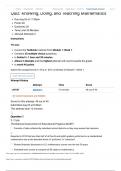
Quiz: Knowing, Doing, and Teaching Mathematics Score for this attempt: 40 out of 40  Question 1 2 / 2 pts Consists of data collected by individual school districts so they may assess their teachers. Reported in 2019 that less than half of all fourth and eighth graders performed on a standardized mathematics test at the desirable levels of "proficient" or "advanced". Showed dramatic decreases in U.S. mathematics scores over the last 30 years. Evaluated tests scores to compare all 50 states in mathematics. The National Assessment of Educational Progress (NAEP)  Q uestion 2 2 / 2 pts Provide ways to promote memorization of facts. Think beyond computation when considering the integration of technology. Develop a long-term plan for building your expertise. Generate ways for students to provide evidence of their thinking through discussion, illustrations, and written responses. Q uestion 3 2 / 2 pts The inclusion of end of chapter tests. End of the year, state assessments. Feedback, on-going observation, and continuous data gathering. Speed tests for basic facts.  Q uestion 4 2 / 2 pts Manipulatives and a document camera. Knowledge of mathematical standards and knowledge of mathematical practices. Internet sites and computer software. Student achievement records and interviews with experienced teachers.  Q uestion 5 2 / 2 pts Look for both horizontal and vertical alignment to build coherence within learning trajectories. Provide instructional opportunities for students to demonstrate their competence in different ways. Which of the following can be said to be true about the Teaching and Learning principle in the Six Guiding Principles from Principles to Action? What are examples of effective assessment techniques from NCTM Principles to Action that will guide your understanding of student knowledge? Which choice reflects two factors that influence the teaching of mathematics effectively? What statement best reflects the Equity and Access principle of the Six Guiding Principles from Principles to Actions? Think beyond computation when considering the integration of technology. Teach students how to check their work.  Q uestion 6 2 / 2 pts What it means to do mathematics Allowing students to use markers and pens to solve problems. The amount of homework to assign each night. Following a curriculum's view about teaching mathematics. Q uestion 7 2 / 2 pts Learning progressions. Pacing guide. Curriculum map. Standards document.  Q uestion 8 2 / 2 pts Model with mathematics. Curriculum. Attending to precision. Use appropriate tools strategically.  Q uestion 9 2 / 2 pts Assessments that include timed tests. Practicing or prospective teachers face the challenge of teaching mathematics from a problemsolving perspective. This often requires some to confront their personal beliefs about What helps teachers know the sequence of what came before a particular concept as well as what to expect next as students reach key points along a pathway to desired learning targets? Which is not one of the eight standards for mathematical practice? Which statement below captures the big idea from one of the Six Guiding Principles outlined in the NCTM Principles to Action? Learning mathematics through teacher directed strategies. Look for both horizontal and vertical alignment to build coherence. Problem solving to be completed after the mastery of basic fact.  Q uestion 10 2 / 2 pts The essential big ideas and mathematics concepts for preschool-aged children. What came before as well as what to expect next. Progressions which are identical for all students. What the vision is for the teachers their role in developing curriculum. Q uestion 11 2 / 2 pts Do you solve problems quickly without checking your work? Do you stay away from manipulatives because that means you can't solve problems with equations? Do you refuse to talk with your partner because you don't want to cheat? Do you consider several possible approaches before diving in to solve a problem?  Q uestion 12 2 / 2 pts Learning theories are teaching strategies. Learning theories are used to write lesson objectives. Learning theories inform teaching. Learning theories help you assess student understanding.  Q uestion 13 2 / 2 pts Identify the statement that best completes this statement, "Learning progressions reflect current research and practice and they guide teachers in understanding…" For which of the following questions might a student with a productive disposition typically say "yes?" Which statement is true about learning theories? Which of the following represents an example of an effective way a teacher might help facilitate students' construction of mathematical relationships? Asking students, "How is Laila's strategy like Marco's strategy?" Prompting a student with a hint as soon as the teacher hears a pause or struggle. Require students to follow the strategy that the teacher models. Only focus on one strategy so that students will not be confused.  Q uestion 14 2 / 2 pts Have the student try again, as they made a computation error. Tell the student that they missed a step, and should practice more problems. Assign more homework on the topic. Treat errors as learning opportunities, and address as a class by unpacking the reasoning. Q uestion 15 2 / 2 pts Class activities and lessons should be designed with students' prior experiences in mind. Students should be guided through a lesson without questions that may cause doubt. New concepts should only be presented to students through teacher-centered presentations, in order to help them build the necessary background knowledge. Most students learn best in a quiet class that consists primarily of direct-instruction, so that they can focus and won't be distracted by others.  Q uestion 16 2 / 2 pts Value student ideas and approaches. Value only one method or approach for all students. Value traditional strategies over inventive strategies. Value the teacher "telling" approach.  How should teachers treat student errors? Identify the statement that reflects an educational implication of the learning theories discussed in this chapter. What statement is an example of how a teacher can honor diversity? Question 17 2 / 2 pts Plan and design instruction based on prior learning. Designate time for student reflection. Plan tasks that reflect the social and cultural makeup of the classroom. Design tasks that will require students to use only the standard algorithm. Q uestion 18 2 / 2 pts Accuracy, efficiency, and flexibility. Memorize, drill, and practice. Following directions, doing all steps, and rechecking. Being confident, leading others, and speaking up in class.  Q uestion 19 2 / 2 pts Teacher requires a single strategy solution. Teachers do not want students to struggle in mathematics. Teacher provides solutions when students make errors. Teacher scaffolds new content through the use of tools and peer assistance.  Q uestion 20 2 / 2 pts Give them work from the grade below. Recommend the students for special education services. Scaffold the content to allow them to engage in the task. Focus on basic skills and wait to give them word problems. The focus of connecting the dots between theory and practice require teachers to focus on opportunities. All of the statements below are true EXCEPT: What are the three components of procedural fluency? Making connections among mathematical relationships improves student conceptual understanding. What statement is a tenet of this belief? When students do not have skills, they need to be successful with a grade-level topic, teachers can:

Show more Read less


Whoops! We can’t load your doc right now. Try again or contact support.

Document information

Uploaded on
September 17, 2024
Number of pages
7
Written in
2024/2025
Type
Other
Person
Unknown

Subjects

  • educ 323

Content preview

Online Residential Athletics Request Info Apply Now Visit Us Create Guest Account Sign In

Quiz: Knowing, Doing, and Teaching Mathematics
Due Aug 26 at 11:59pm
Points 40
Questions 20
Time Limit 90 Minutes
Allowed Attempts 2
Instructions

The quiz:

Covers the Textbook material from Module 1: Week 1.
Contains 20 multiple-choice questions.
Is limited to 1 hour and 30 minutes.
Allows 2 attempts and the highest attempt will count towards the grade.
Is worth 40 points.

Submit this assignment by 11:59 p.m. (ET) on Monday of Module 1: Week 1.

TAKE THE QUIZ AGAIN

Attempt History
Attempt Time Score
LATEST Attempt 1 12 minutes 40 out of 40


 Correct answers are hidden.
Score for this attempt: 40 out of 40
Submitted Aug 23 at 8:49am
This attempt took 12 minutes.

Question 1
pts
The National Assessment of Educational Progress (NAEP)
Consists of data collected by individual school districts so they may assess their teachers.


Reported in 2019 that less than half of all fourth and eighth graders performed on a standardized
mathematics test at the desirable levels of "proficient" or "advanced".

Showed dramatic decreases in U.S. mathematics scores over the last 30 years.

Evaluated tests scores to compare all 50 states in mathematics.
This study source was downloaded by 100000890485048 from CourseHero.com on 09-17-2024 15:14:36 GMT -05:00


https://www.coursehero.com/file/238955569/Quiz-Knowing-Doing-and-Teaching-Mathematicspdf/

, 
Question 2
pts
Which of the following can be said to be true about the Teaching and Learning principle in the
Six Guiding Principles from Principles to Action?
Provide ways to promote memorization of facts.

Think beyond computation when considering the integration of technology.

Develop a long-term plan for building your expertise.


Generate ways for students to provide evidence of their thinking through discussion, illustrations, and written
responses.


Question 3
pts
What are examples of effective assessment techniques from NCTM Principles to Action that
will guide your understanding of student knowledge?
The inclusion of end of chapter tests.

End of the year, state assessments.

Feedback, on-going observation, and continuous data gathering.

Speed tests for basic facts.


Question 4
pts
Which choice reflects two factors that influence the teaching of mathematics effectively?
Manipulatives and a document camera.

Knowledge of mathematical standards and knowledge of mathematical practices.

Internet sites and computer software.

Student achievement records and interviews with experienced teachers.


Question 5
pts
What statement best reflects the Equity and Access principle of the Six Guiding Principles from
Principles to Actions?
Look for both horizontal and vertical alignment to build coherence within learning trajectories.

Provide instructional opportunities for students to demonstrate their competence in different ways.
This study source was downloaded by 100000890485048 from CourseHero.com on 09-17-2024 15:14:36 GMT -05:00


https://www.coursehero.com/file/238955569/Quiz-Knowing-Doing-and-Teaching-Mathematicspdf/
Get to know the seller

Seller avatar
Reputation scores are based on the amount of documents a seller has sold for a fee and the reviews they have received for those documents. There are three levels: Bronze, Silver and Gold. The better the reputation, the more your can rely on the quality of the sellers work.
Topscorer london
View profile
Follow You need to be logged in order to follow users or courses
Sold
114
Member since
5 year
Number of followers
13
Documents
454
Last sold
22 hours ago
Top Scorer

Helping all Students fulfill their educational, career and personal goals.

4.3

24 reviews

5
16
4
3
3
3
2
0
1
2

Recently viewed by you

Why students choose Stuvia

Created by fellow students, verified by reviews

Quality you can trust: written by students who passed their tests and reviewed by others who've used these notes.

Didn't get what you expected? Choose another document

No worries! You can instantly pick a different document that better fits what you're looking for.

Pay as you like, start learning right away

No subscription, no commitments. Pay the way you're used to via credit card and download your PDF document instantly.

Student with book image

“Bought, downloaded, and aced it. It really can be that simple.”

Alisha Student

Frequently asked questions