Minor Paediatric Physiotherapy – Period 1
Week 1
An introduction of the course
A task-oriented approach is better than a process-oriented approach.
Methodical approach: tasks performed in an order from easy to more difficult.
Didactical approach:
- The way the child learns.
- The way you approach the child.
o How can I make the exercises clear to the child?
>> So it’s about learning & teaching.
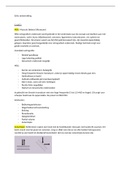
Development
3 different areas:
- Motor domain.
- Cognitive domain.
- Social-emotional domain.
>> Every child develops in a different rate.
Motor domain:
- Gross motor skills.
- Fine motor skills.
- Abilities.
o Coordination, force, flexibility, speed, etc.
o Example: to learn handwriting you need different abilities.
In an early stage of learning new characters you need eye-hand
coordination.
‘Professional’ handwriters don’t need eye-hand coordination anymore
for legible writing.
Cognitive domain:
- How to learn motor skills.
o You have to understand the task.
- Your knowledge.
Social-emotional domain:
- Self-confidence.
- Does the child make friends at school?
- Etc.
, Pyramid of Gallahue
A hierarchic model of motor development which consists of 3 stages:
- Rudimentary stage (de beginselen)
o 0 – 1-2 years.
o Reflexes.
o Development in horizontal and vertical plane.
- Fundamental motor skill stage.
o 1-2 – 7-8 years.
o Consists of 3 phases:
Initial phase
Elementary phase
Mature phase (volgroeid)
- Sport skill stage.
o 7-8 – 14+ years.
o Consists of 3 phases:
Generalized phase (/transitional phase).
An intermediate phase between the fundamental and sport skill
stage.
Specific sport skill phase.
Like a lay-up, volleyball smash, etc.
Specialized phase.
Like a gymnastic can do two backflips and a summersault in a
row.
Pyramid how motor skills are build up during your life.
- Previous steps must be finished first before you can continue (otherwise the child can
develop a delay in developing motor skills).
- Never go back to a previous step to improve that step!
Intentional motor skills:
- First pyramid:
o Person who?
o Environment(al constraints) where?
o Task (constraints) what?
- Second pyramid the person:
o Underlying processes.
o Internal constraints.
o Strategies.
Motor control
- Classification of motor skills
Motor skill – Classificatons
In Schmidt (2008) motor skills are conceptualized in two ways:
- As a task skill classification perspective
o Skills should be distinguishable among a number of dimensions or on the basis
of a variety of prominent characteristics.
- In terms of motor proficiency how skilled is a person when performing a skill?
Week 1
An introduction of the course
A task-oriented approach is better than a process-oriented approach.
Methodical approach: tasks performed in an order from easy to more difficult.
Didactical approach:
- The way the child learns.
- The way you approach the child.
o How can I make the exercises clear to the child?
>> So it’s about learning & teaching.
Development
3 different areas:
- Motor domain.
- Cognitive domain.
- Social-emotional domain.
>> Every child develops in a different rate.
Motor domain:
- Gross motor skills.
- Fine motor skills.
- Abilities.
o Coordination, force, flexibility, speed, etc.
o Example: to learn handwriting you need different abilities.
In an early stage of learning new characters you need eye-hand
coordination.
‘Professional’ handwriters don’t need eye-hand coordination anymore
for legible writing.
Cognitive domain:
- How to learn motor skills.
o You have to understand the task.
- Your knowledge.
Social-emotional domain:
- Self-confidence.
- Does the child make friends at school?
- Etc.
, Pyramid of Gallahue
A hierarchic model of motor development which consists of 3 stages:
- Rudimentary stage (de beginselen)
o 0 – 1-2 years.
o Reflexes.
o Development in horizontal and vertical plane.
- Fundamental motor skill stage.
o 1-2 – 7-8 years.
o Consists of 3 phases:
Initial phase
Elementary phase
Mature phase (volgroeid)
- Sport skill stage.
o 7-8 – 14+ years.
o Consists of 3 phases:
Generalized phase (/transitional phase).
An intermediate phase between the fundamental and sport skill
stage.
Specific sport skill phase.
Like a lay-up, volleyball smash, etc.
Specialized phase.
Like a gymnastic can do two backflips and a summersault in a
row.
Pyramid how motor skills are build up during your life.
- Previous steps must be finished first before you can continue (otherwise the child can
develop a delay in developing motor skills).
- Never go back to a previous step to improve that step!
Intentional motor skills:
- First pyramid:
o Person who?
o Environment(al constraints) where?
o Task (constraints) what?
- Second pyramid the person:
o Underlying processes.
o Internal constraints.
o Strategies.
Motor control
- Classification of motor skills
Motor skill – Classificatons
In Schmidt (2008) motor skills are conceptualized in two ways:
- As a task skill classification perspective
o Skills should be distinguishable among a number of dimensions or on the basis
of a variety of prominent characteristics.
- In terms of motor proficiency how skilled is a person when performing a skill?