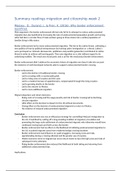
Summary readings migration and citizenship week 2
Massey, D., Durand, J., & Pren, K. (2016). Why border enforcement
backfired.
Main argument: the border enforcement did not only fail in its attempt to reduce undocumented
migration but also backfired by increasing the rate of undocumented population growth and turning
what had been a circular flow of male workers going to three states into a settles population of
families living in fifty states.
Border enforcement led to more undocumented migration. This led to the Latino threat: cultivating a
new politics of fear by political entrepreneurs by framing Latino immigration as a threat. Latino’s
were portrayed as criminals. Bureaucrats, politicians and pundits (geleerden) contributed to Latino
threat in order to achieve self-serving goals. They saw migration as a crisis without regard to its
underlying realities. The result was moral panic and a call for the neoclassical border enforcement.
Border enforcement didn’t address the economic drivers of migration nor does it take into account
the existence of well-developed networks able to support undocumented border crossing.
Border enforcement:
- Led to the decline of traditional border crossing
- Led to crossings with a coyote/paid guide
- Led to rising costs of coyotes and the costs
- Led to a modest increase of apprehension, compensated through the rising coyotes
- Led to growing deaths at the border
- Led to less returns to Mexico
- Led to more additional migration
Migrant departure and return decisions:
- Rising costs of crossing and the wage penalty and risk of border crossing led to declining
circular migration
- Little effect on the decision to depart for the US without documents
- Strong effect on the decision of undocumented migrants to return to Mexico.
- No evidence of reduced undocumented migration
Conclusion
- Border enforcement was not an efficacious strategy for controlling Mexican immigration to
the US. It backfired by cutting off a long-standing tradition of migratory circulation and
promoting the large-scale settlement of undocumented migrants who otherwise would have
continued moving back and forth across the border.
- Border enforcement had no effect on the likelihood of initiating undocumented migration to
the US. It pushed migrants away from relatively benign crossing locations
- Border enforcement had influence on: paid smugglers, increasing costs and risks,
apprehending during a crossing attempt and the greater use of coyotes.
- Makes economic sense to migrate but not to return home to face the high costs and risks of
subsequent entry attempts.
- Rising border enforcement also reduced the likelihood of both taking and returning from
additional undocumented trips.
Implications:
, - The observed trajectory of Mexico-US migration since 1965 cannot be explained by the usual
set of social and economic determinants alone, for its path was powerfully determined by
the consequences of choosing border enforcement as a strategy for immigration control, a
choice that we theorized as a product of self-interested actions by politicians, bureaucrats,
and pundits who deliberately manufactured a moral panic to mobilize constituencies and
acquire resources with little regard for the actual consequences.
- If policy makers had done nothing (never increased the Border Patrol’s funding beyond
keeping pace with inflation) the undocumented population would likely have grown
substantially less.
- Manage migration in ways that benefit both nations while protecting to the degree possible
the rights and interests of both migrants and natives, much as the European Union did with
the creation of its internal labor market. A more open border would have produced less
permanent immigration and slower Mexican population growth in the US.
- Policies could have been implemented to encourage return migration
- Need to shift from a policy of immigration suppression to one of immigration management
- Granting legal status to undocumented migrants already present in the US would probably
increase their rate of return migration
Groenendijk, K. (2011). Pre-departure integration strategies in the
European Union: Integration or immigration policy?
By requiring immigrants to pass a pre-departure language test, states claim to test the willingness
and ability of immigrants to learn the language of the destination country before departure, which
some believe is a good predictor of immigrants’ ability to integrate successfully. But is this indicates
that it is used as a way to control immigration rather than to integrate existing immigrants.
Research questions:
1. Th what extent are pre-departure integration strategies part of EU law and policy?
The policy assumed that ethnic origin determines whether the immigrant was able to integrate in the
country. Language tests are sometimes used to select family migrants and have a filtering effect.
2. In which EU member states have pre-departure integration measures been introduced or
discussed, and why? What is the rationale (motivering) behind the requirements immigrants
have to meet, and how do these relate to integration measures after arrival in the country of
immigration?
Pre-departure integration measures have been discussed in the Netherlands, Germany, France,
Denmark and the UK to legitimize the use of integration policies as an instrument to select and
exclude immigrants from admission or exclude admitted immigrants from acquiring a more secure
residence status.
The Netherlands:
- Rationale it would help counter the marginalization and lack of integration of certain
migrant groups (Turkish and Moroccan origin), reduce the number of family migrants
- Critique: not sufficient facilities for immigrants to learn Dutch, the test was based on
software for a completely different purpose
- Integration measures after arrival works selective; it applies only to non-EU family
migrants
Germany:
- Rationale prevent forced marriages, improve the social integration of immigrants through
better language skills, select immigrants who are motivated to integrate, reduce the number
of family migrants (but less explicit than in the Netherlands and France)
Massey, D., Durand, J., & Pren, K. (2016). Why border enforcement
backfired.
Main argument: the border enforcement did not only fail in its attempt to reduce undocumented
migration but also backfired by increasing the rate of undocumented population growth and turning
what had been a circular flow of male workers going to three states into a settles population of
families living in fifty states.
Border enforcement led to more undocumented migration. This led to the Latino threat: cultivating a
new politics of fear by political entrepreneurs by framing Latino immigration as a threat. Latino’s
were portrayed as criminals. Bureaucrats, politicians and pundits (geleerden) contributed to Latino
threat in order to achieve self-serving goals. They saw migration as a crisis without regard to its
underlying realities. The result was moral panic and a call for the neoclassical border enforcement.
Border enforcement didn’t address the economic drivers of migration nor does it take into account
the existence of well-developed networks able to support undocumented border crossing.
Border enforcement:
- Led to the decline of traditional border crossing
- Led to crossings with a coyote/paid guide
- Led to rising costs of coyotes and the costs
- Led to a modest increase of apprehension, compensated through the rising coyotes
- Led to growing deaths at the border
- Led to less returns to Mexico
- Led to more additional migration
Migrant departure and return decisions:
- Rising costs of crossing and the wage penalty and risk of border crossing led to declining
circular migration
- Little effect on the decision to depart for the US without documents
- Strong effect on the decision of undocumented migrants to return to Mexico.
- No evidence of reduced undocumented migration
Conclusion
- Border enforcement was not an efficacious strategy for controlling Mexican immigration to
the US. It backfired by cutting off a long-standing tradition of migratory circulation and
promoting the large-scale settlement of undocumented migrants who otherwise would have
continued moving back and forth across the border.
- Border enforcement had no effect on the likelihood of initiating undocumented migration to
the US. It pushed migrants away from relatively benign crossing locations
- Border enforcement had influence on: paid smugglers, increasing costs and risks,
apprehending during a crossing attempt and the greater use of coyotes.
- Makes economic sense to migrate but not to return home to face the high costs and risks of
subsequent entry attempts.
- Rising border enforcement also reduced the likelihood of both taking and returning from
additional undocumented trips.
Implications:
, - The observed trajectory of Mexico-US migration since 1965 cannot be explained by the usual
set of social and economic determinants alone, for its path was powerfully determined by
the consequences of choosing border enforcement as a strategy for immigration control, a
choice that we theorized as a product of self-interested actions by politicians, bureaucrats,
and pundits who deliberately manufactured a moral panic to mobilize constituencies and
acquire resources with little regard for the actual consequences.
- If policy makers had done nothing (never increased the Border Patrol’s funding beyond
keeping pace with inflation) the undocumented population would likely have grown
substantially less.
- Manage migration in ways that benefit both nations while protecting to the degree possible
the rights and interests of both migrants and natives, much as the European Union did with
the creation of its internal labor market. A more open border would have produced less
permanent immigration and slower Mexican population growth in the US.
- Policies could have been implemented to encourage return migration
- Need to shift from a policy of immigration suppression to one of immigration management
- Granting legal status to undocumented migrants already present in the US would probably
increase their rate of return migration
Groenendijk, K. (2011). Pre-departure integration strategies in the
European Union: Integration or immigration policy?
By requiring immigrants to pass a pre-departure language test, states claim to test the willingness
and ability of immigrants to learn the language of the destination country before departure, which
some believe is a good predictor of immigrants’ ability to integrate successfully. But is this indicates
that it is used as a way to control immigration rather than to integrate existing immigrants.
Research questions:
1. Th what extent are pre-departure integration strategies part of EU law and policy?
The policy assumed that ethnic origin determines whether the immigrant was able to integrate in the
country. Language tests are sometimes used to select family migrants and have a filtering effect.
2. In which EU member states have pre-departure integration measures been introduced or
discussed, and why? What is the rationale (motivering) behind the requirements immigrants
have to meet, and how do these relate to integration measures after arrival in the country of
immigration?
Pre-departure integration measures have been discussed in the Netherlands, Germany, France,
Denmark and the UK to legitimize the use of integration policies as an instrument to select and
exclude immigrants from admission or exclude admitted immigrants from acquiring a more secure
residence status.
The Netherlands:
- Rationale it would help counter the marginalization and lack of integration of certain
migrant groups (Turkish and Moroccan origin), reduce the number of family migrants
- Critique: not sufficient facilities for immigrants to learn Dutch, the test was based on
software for a completely different purpose
- Integration measures after arrival works selective; it applies only to non-EU family
migrants
Germany:
- Rationale prevent forced marriages, improve the social integration of immigrants through
better language skills, select immigrants who are motivated to integrate, reduce the number
of family migrants (but less explicit than in the Netherlands and France)