Summary readings M&C week 5
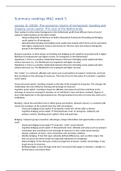
Lancee, B. (2010). The economic returns of immigrants’ bonding and
bridging social capital: The case of the Netherlands.
Goal: analyze to what extent immigrants in the Netherlands profit from different forms of social
capital to make headway on the labor market.
- Using existing body of literature to build a theoretical framework of bonding and bridging
social capital for all immigrants.
- Operationalize bonding and bridging social capital and analyze which forms can be associated
with higher employment chances and income for the four main non-western immigrants
groups in the Netherlands.
Research question: to what extent can bonding and bridging social capital be associated with a higher
likelihood of employment and higher income, for immigrants in the Netherlands?
Hypothesis 1: there is a positive relationship between the level of bridging social capital and labor
market outcomes (i.e., the likelihood to be employed and higher income).
Hypothesis 2: there is a positive relationship between the level of bonding social capital and labor
market outcomes (i.e., the likelihood to be employed and higher income).
The “nodes” in a network; attitudes and values such as perceptions of support, reciprocity, and trust
that contribute to the exchange of resources. The level of trust in the nodes of a network = cognitive
social capital.
Structural social capital = bonding is based on the idea of the strength of strong ties. The stronger the
relationship, the more likely the sharing and exchange of resources.
Cognitive social capital = bonding is based on attitudes and values (trust) that contribute to the
exchange of resources among the members of an individual’s close and dense network. Degree of
trust: thick/particular or thin/generalized trust. Thin/generalized trust refers to loose ties and trust in
institutions.
Bonding = dense ties and thick trust in within-group connections. Network closure: in a network with
closure the members of the network have ties with all members.
- Structural bridging social capital strong ties: family ties, all ties with co-ethnics
- Cognitive bridging social capital Thick/particular trust: to strong ties, solidarity and
primary contacts. Bonding social capital is thick and particular.
Bridging = between-group connection. Advantage: unique information and opportunities come into
reach.
- Structural bridging social capital weak ties: “wide” social network
- Cognitive bridging social capital thin/particular trust, attitudes and values such as outward
orientation that contribute to the exchange of resources in one’s wide social network.
Organic solidarity of looser, more amorphous and secondary relations
- Identity bridging ties that span culturally defined differences, such as ethnic origin. Ties
that cut across the ethnic divide are especially important for immigrants.
- Status bridging ties that span vertical arrangement of power, wealth, and prestige. A way
to get access to resources.
- Building bridges is done through weak ties in structural holes (gaps in networks, a bridge is a
tie that spans a structural hole).
Lancee, B. (2010). The economic returns of immigrants’ bonding and
bridging social capital: The case of the Netherlands.
Goal: analyze to what extent immigrants in the Netherlands profit from different forms of social
capital to make headway on the labor market.
- Using existing body of literature to build a theoretical framework of bonding and bridging
social capital for all immigrants.
- Operationalize bonding and bridging social capital and analyze which forms can be associated
with higher employment chances and income for the four main non-western immigrants
groups in the Netherlands.
Research question: to what extent can bonding and bridging social capital be associated with a higher
likelihood of employment and higher income, for immigrants in the Netherlands?
Hypothesis 1: there is a positive relationship between the level of bridging social capital and labor
market outcomes (i.e., the likelihood to be employed and higher income).
Hypothesis 2: there is a positive relationship between the level of bonding social capital and labor
market outcomes (i.e., the likelihood to be employed and higher income).
The “nodes” in a network; attitudes and values such as perceptions of support, reciprocity, and trust
that contribute to the exchange of resources. The level of trust in the nodes of a network = cognitive
social capital.
Structural social capital = bonding is based on the idea of the strength of strong ties. The stronger the
relationship, the more likely the sharing and exchange of resources.
Cognitive social capital = bonding is based on attitudes and values (trust) that contribute to the
exchange of resources among the members of an individual’s close and dense network. Degree of
trust: thick/particular or thin/generalized trust. Thin/generalized trust refers to loose ties and trust in
institutions.
Bonding = dense ties and thick trust in within-group connections. Network closure: in a network with
closure the members of the network have ties with all members.
- Structural bridging social capital strong ties: family ties, all ties with co-ethnics
- Cognitive bridging social capital Thick/particular trust: to strong ties, solidarity and
primary contacts. Bonding social capital is thick and particular.
Bridging = between-group connection. Advantage: unique information and opportunities come into
reach.
- Structural bridging social capital weak ties: “wide” social network
- Cognitive bridging social capital thin/particular trust, attitudes and values such as outward
orientation that contribute to the exchange of resources in one’s wide social network.
Organic solidarity of looser, more amorphous and secondary relations
- Identity bridging ties that span culturally defined differences, such as ethnic origin. Ties
that cut across the ethnic divide are especially important for immigrants.
- Status bridging ties that span vertical arrangement of power, wealth, and prestige. A way
to get access to resources.
- Building bridges is done through weak ties in structural holes (gaps in networks, a bridge is a
tie that spans a structural hole).