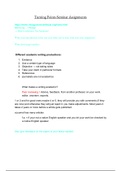
Turning Points Seminar Assignments
https://www.chicagomanualofstyle.org/home.html
bibme.org → chicago
→ How to reference. Use footnotes!
Write your introduction in the very end, when you’re done with your your assignment.
Write down page numbers
Different academic writing productions:
1. Evidence
2. Use a certain type of language
3. Objective → not taking sides
4. Take your claim in particular formats
5. References
6. journalists are not academics
What makes a writing academic?
Peer reviewing = Advice, feedback, from another professor on your work.
editor. anoniem. experts.
1 or 2 and for good ones maybe 4 or 5, they will provide you with comments (if they
are nice) and otherwise they will just reject it. you make adjustments. Most years it
takes 2 years or more before a article gets published.
a journal has many articles
f.a. = if your not a native English speaker and you let your work be checked by
a native English speaker
Also give feedback on the paper of your fellow student.
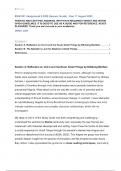
,Seminar 1 Test I + assignment 1
Wim Blockmans: (born: 26 mei 1945)
- Hoogleraar Middeleeuwse geschiedenis aan de Universiteit van
Leiden.
- Blockmans publiceert voornamelijk over de laatmiddeleeuwse en
vroegmoderne tijd. (=early modern age)
Jack Goody: (1919-2015)
- A British social anthropologist. He was a prominent lecturer at Cambridge
University, and was William Wyse Professor of Social
Anthropology from 1973 to 1984.
- Goody left university to fight in World War II.
- He transferred to Archaeology and Anthropology when he
resumed university study in 1946
- Jack Goody explained social structure and social change
primarily in terms of three major factors. The first was the
development of intensive forms of agriculture. Second, he
explained it in terms of urbanisation and growth of bureaucratic
institutions that modified or overrode traditional forms of social
organisation, such as family or tribe, identifying civilisation as "the culture of
cities". And third, he attached great weight to the technologies of
communication as instruments of psychological and social change.
1. Where does the concept ' Middle Ages' come from and why do we still
use it?
The concept of “Middle Ages” or the one thousand years of darkness (dark ages)
comes from the humanists who simplified the European history with the 1000 years
between the Antiquity and the Renaissance where the rebirth of Europe happened.
2. How does Blockmans explain the development of Europe and do you
agree?
Blockmans observes the development of Europe as something necessary to reach
our modern times, in fact during the dark ages the spread of Christianity occurred, as
well as the establishment of areas spreading a common language, the formation of
territorial states with seeds of national consciousness, the reformation of
rational-empirical scientific thought. The development of the continent was way
,behind compared to China, slowly Europe struggled out and imposed his model of
development upon the rest of the world.
3. What is Goody's academic background and how does his background
informs his views on European history?
By studying social anthropology and doing researches out of Europe, in other
continents such as Africa and Asia he had the opportunity to experience a
perspective away from the usual Eurocentric point of view
4. Why does Goody speak about the European 'Theft of History' and do
you agree?
Europeans orchestrated the theft of history by going back to the classical period,
inventing the idea of “antiquity” as if Europe was the only place where history was
made and the civilization was going forward. By doing so they put the continent in
place of superiority upon the world. Even though there was a continuity between the
periods.
5. Compare the approaches (content and style) of Blockmans and Goody.
Blockmans approach is more constructive towards European History, while Goody’s
is more aggressive and critical.
Blockmans: Introduction to Medieval Europe 300-1500 provides a
comprehensive survey of this complex and varied formative period of
European history. Covering themes as diverse as barbarian migrations,
the impact of Christianization, the formation of nations and states, the
emergence of an expansionist commercial economy, the growth of cities,
the Crusades, the effects of plague, and the intellectual and cultural life
of the Middle-Ages, the book explores the driving forces behind the
formation of medieval society and the directions in which it developed
and changed. In doing so, the author covers a wide geographic expanse,
including Western interactions with the Byzantine Empire and the Islamic
world.
Goody: Critical of 18th 19th century Rome which is connected to the
idea of ‘whiteness’ and superiority. The invention of antiquity or adoption
of antiquity- seen as appropriation rather than continuity
. Perhaps the most bare-faced invention of Western philosophers and
historians was to name the collapse of civilization after the fall of Rome
‘feudalism’ and then to suggest that it provided a unique launching pad
for capitalism. Goody, who resisted the the export of the ‘feudal’ label
to African policies, now convincingly undermines any such claim to
, distinctive progress, emphasising rather medieval Europe’s massive loss of
standing when measured against the Asian societies of the period
Assignment: Make a personal list of the five most important turning points in
history
1. August 1945 = An atomic bomb fell on Hiroshima and Nagasaki.
From that moment there came an end to world war two. This is a turning point
because the war had influenced a lot of people’s lives and the world’s politics.
As the war ended, a new era began.
2. 1991 = End of the communist reign in the Soviet Union.
From that moment there came an end to the cold war. The ideologic power blocks
fell down and therefore the world got the possibility to work together instead of
against each other. This is why this is a turning point: all those years this was not the
case.
3. 391 = Christianity becomes the state religion in the Roman Empire.
This is a turning point because for many people this meant a change in their life’s.
Many people believed in the multiple gods and that was a polytheistic form of
religion. From 391 people had to believe in only one god, which was a monotheistic
belief. This is a big change in history and therefore a turning point.
4. 1972 = Salt 1 signed by the Soviet-Union and the United States of America.
This agreement implied that there should be a reduction in the amount of strategic
weapons and not to further increase the power of the nuclear arsenal of both
superpowers. This was a turning point because from this moment a period of
‘detente’ began.
5. 1700 = The scientific revolution.
This was a turning point because this revolution changed the way of thinking. Not
everything was anymore ‘because of god’, but more and more was explained by
mathematical laws and formulas. People began to investigate why the world was the
way it was. This was a turning point because for many many years people weren’t
even thinking about another explanation than the will of god.
https://www.chicagomanualofstyle.org/home.html
bibme.org → chicago
→ How to reference. Use footnotes!
Write your introduction in the very end, when you’re done with your your assignment.
Write down page numbers
Different academic writing productions:
1. Evidence
2. Use a certain type of language
3. Objective → not taking sides
4. Take your claim in particular formats
5. References
6. journalists are not academics
What makes a writing academic?
Peer reviewing = Advice, feedback, from another professor on your work.
editor. anoniem. experts.
1 or 2 and for good ones maybe 4 or 5, they will provide you with comments (if they
are nice) and otherwise they will just reject it. you make adjustments. Most years it
takes 2 years or more before a article gets published.
a journal has many articles
f.a. = if your not a native English speaker and you let your work be checked by
a native English speaker
Also give feedback on the paper of your fellow student.
,Seminar 1 Test I + assignment 1
Wim Blockmans: (born: 26 mei 1945)
- Hoogleraar Middeleeuwse geschiedenis aan de Universiteit van
Leiden.
- Blockmans publiceert voornamelijk over de laatmiddeleeuwse en
vroegmoderne tijd. (=early modern age)
Jack Goody: (1919-2015)
- A British social anthropologist. He was a prominent lecturer at Cambridge
University, and was William Wyse Professor of Social
Anthropology from 1973 to 1984.
- Goody left university to fight in World War II.
- He transferred to Archaeology and Anthropology when he
resumed university study in 1946
- Jack Goody explained social structure and social change
primarily in terms of three major factors. The first was the
development of intensive forms of agriculture. Second, he
explained it in terms of urbanisation and growth of bureaucratic
institutions that modified or overrode traditional forms of social
organisation, such as family or tribe, identifying civilisation as "the culture of
cities". And third, he attached great weight to the technologies of
communication as instruments of psychological and social change.
1. Where does the concept ' Middle Ages' come from and why do we still
use it?
The concept of “Middle Ages” or the one thousand years of darkness (dark ages)
comes from the humanists who simplified the European history with the 1000 years
between the Antiquity and the Renaissance where the rebirth of Europe happened.
2. How does Blockmans explain the development of Europe and do you
agree?
Blockmans observes the development of Europe as something necessary to reach
our modern times, in fact during the dark ages the spread of Christianity occurred, as
well as the establishment of areas spreading a common language, the formation of
territorial states with seeds of national consciousness, the reformation of
rational-empirical scientific thought. The development of the continent was way
,behind compared to China, slowly Europe struggled out and imposed his model of
development upon the rest of the world.
3. What is Goody's academic background and how does his background
informs his views on European history?
By studying social anthropology and doing researches out of Europe, in other
continents such as Africa and Asia he had the opportunity to experience a
perspective away from the usual Eurocentric point of view
4. Why does Goody speak about the European 'Theft of History' and do
you agree?
Europeans orchestrated the theft of history by going back to the classical period,
inventing the idea of “antiquity” as if Europe was the only place where history was
made and the civilization was going forward. By doing so they put the continent in
place of superiority upon the world. Even though there was a continuity between the
periods.
5. Compare the approaches (content and style) of Blockmans and Goody.
Blockmans approach is more constructive towards European History, while Goody’s
is more aggressive and critical.
Blockmans: Introduction to Medieval Europe 300-1500 provides a
comprehensive survey of this complex and varied formative period of
European history. Covering themes as diverse as barbarian migrations,
the impact of Christianization, the formation of nations and states, the
emergence of an expansionist commercial economy, the growth of cities,
the Crusades, the effects of plague, and the intellectual and cultural life
of the Middle-Ages, the book explores the driving forces behind the
formation of medieval society and the directions in which it developed
and changed. In doing so, the author covers a wide geographic expanse,
including Western interactions with the Byzantine Empire and the Islamic
world.
Goody: Critical of 18th 19th century Rome which is connected to the
idea of ‘whiteness’ and superiority. The invention of antiquity or adoption
of antiquity- seen as appropriation rather than continuity
. Perhaps the most bare-faced invention of Western philosophers and
historians was to name the collapse of civilization after the fall of Rome
‘feudalism’ and then to suggest that it provided a unique launching pad
for capitalism. Goody, who resisted the the export of the ‘feudal’ label
to African policies, now convincingly undermines any such claim to
, distinctive progress, emphasising rather medieval Europe’s massive loss of
standing when measured against the Asian societies of the period
Assignment: Make a personal list of the five most important turning points in
history
1. August 1945 = An atomic bomb fell on Hiroshima and Nagasaki.
From that moment there came an end to world war two. This is a turning point
because the war had influenced a lot of people’s lives and the world’s politics.
As the war ended, a new era began.
2. 1991 = End of the communist reign in the Soviet Union.
From that moment there came an end to the cold war. The ideologic power blocks
fell down and therefore the world got the possibility to work together instead of
against each other. This is why this is a turning point: all those years this was not the
case.
3. 391 = Christianity becomes the state religion in the Roman Empire.
This is a turning point because for many people this meant a change in their life’s.
Many people believed in the multiple gods and that was a polytheistic form of
religion. From 391 people had to believe in only one god, which was a monotheistic
belief. This is a big change in history and therefore a turning point.
4. 1972 = Salt 1 signed by the Soviet-Union and the United States of America.
This agreement implied that there should be a reduction in the amount of strategic
weapons and not to further increase the power of the nuclear arsenal of both
superpowers. This was a turning point because from this moment a period of
‘detente’ began.
5. 1700 = The scientific revolution.
This was a turning point because this revolution changed the way of thinking. Not
everything was anymore ‘because of god’, but more and more was explained by
mathematical laws and formulas. People began to investigate why the world was the
way it was. This was a turning point because for many many years people weren’t
even thinking about another explanation than the will of god.