

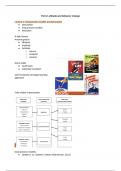
Part 2; attitude and behavior change
Lecture 1: Dual-process models and persuasion
● persuasion
● dual process models
● heuristics
A little history
Ancient greece
● Rhetoric
● Sophists
● Aristotle
○ source
○ recipient
○ content
SInce 1900
● world wars
● industrial revolution
Carl Hovland's:message learning
approach
Yale model of persuasion
Dual process models:
● System 1 vs. System 2 theory (Kahneman, 2011)
, ● reflective - impulsive model (strack & deutch, 2004)
● elaboration likelihood model (Petty & cacioppo, 1986)
● heuristic - systematic model (chaiken, 1987)
System 1 vs. System 2 theory
● “A bat and a ball together cost $1.10. The bat costs $1.00 more than the ball.
How much is the ball?”
Two routes of persuasion
Dual process theories
● Central route vs. peripheral
route
○ More vs. less
elaboration
● Elaboration Likelihood Model
(ELM)
○ Petty & Cacioppo
(1986)
● Heuristic-Systematic Model
(HSM)
○ Chaiken et al. (1989)
Route depends on capacity/motivation
to process information
Two routes to persuasion:
1. ELM (elaboration likelihood
model
Motivation to process message
● personal relevance
○ affecting personal
situation
● importance of choice
, ○ responsibility to others
○ expensive purchases
● need for cognition
○ tendency to engage in analytical thinking
Capacity to process message
Cognitive load
● distraction
● fatigue
Ability
● difficulty of information
● expert vs. novices
Central route
When motivation and ability are high:
● high elaboration
Persuasion depends on elaboration valence
● predominant valence of issue
relevant thoughts
Elaboration valence depends on:
● message being pro-vs. counter
attitudinal
● argument strength (quality)
Persuasion via the peripheral route
ELM peripheral cues
● heuristics: mental shortcuts in the form of if-then rules
● social consensus heuristic: if everybody is saying it, then it
must be true
● more is better: if there re many arguments made for it, then
it must be a good point
other:
● mere exposure effect: liking something after having been
frequently exposed to it
● attractiveness or likability of the source (evaluative
conditioning)
● mood
Elaboration likelihood model
Postulates:
● People are motivated to hold correct attitudes
● However, amount of elaboration depends on situational and individual factors
● Variables that affect the amount of attitude change do so by: (A) serving as
persuasive arguments, (B) serving as peripheral cues, and / or (C) affecting amount
of elaboration
● The more systematic processing, the less influence peripheral cues have, and vice
versa
Lecture 1: Dual-process models and persuasion
● persuasion
● dual process models
● heuristics
A little history
Ancient greece
● Rhetoric
● Sophists
● Aristotle
○ source
○ recipient
○ content
SInce 1900
● world wars
● industrial revolution
Carl Hovland's:message learning
approach
Yale model of persuasion
Dual process models:
● System 1 vs. System 2 theory (Kahneman, 2011)
, ● reflective - impulsive model (strack & deutch, 2004)
● elaboration likelihood model (Petty & cacioppo, 1986)
● heuristic - systematic model (chaiken, 1987)
System 1 vs. System 2 theory
● “A bat and a ball together cost $1.10. The bat costs $1.00 more than the ball.
How much is the ball?”
Two routes of persuasion
Dual process theories
● Central route vs. peripheral
route
○ More vs. less
elaboration
● Elaboration Likelihood Model
(ELM)
○ Petty & Cacioppo
(1986)
● Heuristic-Systematic Model
(HSM)
○ Chaiken et al. (1989)
Route depends on capacity/motivation
to process information
Two routes to persuasion:
1. ELM (elaboration likelihood
model
Motivation to process message
● personal relevance
○ affecting personal
situation
● importance of choice
, ○ responsibility to others
○ expensive purchases
● need for cognition
○ tendency to engage in analytical thinking
Capacity to process message
Cognitive load
● distraction
● fatigue
Ability
● difficulty of information
● expert vs. novices
Central route
When motivation and ability are high:
● high elaboration
Persuasion depends on elaboration valence
● predominant valence of issue
relevant thoughts
Elaboration valence depends on:
● message being pro-vs. counter
attitudinal
● argument strength (quality)
Persuasion via the peripheral route
ELM peripheral cues
● heuristics: mental shortcuts in the form of if-then rules
● social consensus heuristic: if everybody is saying it, then it
must be true
● more is better: if there re many arguments made for it, then
it must be a good point
other:
● mere exposure effect: liking something after having been
frequently exposed to it
● attractiveness or likability of the source (evaluative
conditioning)
● mood
Elaboration likelihood model
Postulates:
● People are motivated to hold correct attitudes
● However, amount of elaboration depends on situational and individual factors
● Variables that affect the amount of attitude change do so by: (A) serving as
persuasive arguments, (B) serving as peripheral cues, and / or (C) affecting amount
of elaboration
● The more systematic processing, the less influence peripheral cues have, and vice
versa


