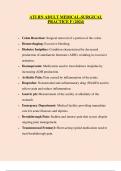
ATI RN ADULT MEDICAL-SURGICAL
PRACTICE F (2024)
• Colon Resection: Surgical removal of a portion of the colon.
• Hemorrhaging: Excessive bleeding.
• Diabetes Insipidus: Condition characterized by decreased
production of antidiuretic hormone (ADH), resulting in excessive
urination.
• Desmopressin: Medication used to treat diabetes insipidus by
increasing ADH production.
• Arthritic Pain: Pain caused by inflammation of the joints.
• Ibuprofen: Nonsteroidal anti-inflammatory drug (NSAID) used to
relieve pain and reduce inflammation.
• Gastric ph: Measurement of the acidity or alkalinity of the
stomach.
• Emergency Department: Medical facility providing immediate
care for acute illnesses and injuries.
• Breakthrough Pain: Sudden and intense pain that occurs despite
ongoing pain management.
• Transmucosal Fentanyl: Short-acting opioid medication used to
treat breakthrough pain.
, • Telemetry Monitor: Device used to monitor and record a patient's
heart activity.
• Myocardial Infarction: Heart attack caused by a blockage in the
blood supply to the heart muscle.
• ST Segment: Portion of an electrocardiogram (ECG) representing
the time between ventricular depolarization and repolarization.
• Ovarian Cancer: Cancer that forms in the ovaries, the female
reproductive organs that produce eggs.
• Radiation Treatment: Therapeutic use of high-energy radiation to
destroy cancer cells.
• Blood Transfusion: Process of transferring blood or blood
components from one person (donor) to another (recipient).
• Furosemide: Diuretic medication used to treat fluid retention and
high blood pressure.
• Magnesium Sulfate: Medication used to treat magnesium
deficiency and prevent seizures in pregnant women with
preeclampsia.
• ABG Results: Arterial blood gas test measuring oxygen, carbon
dioxide, and ph levels in the blood.
• Metabolic Alkalosis: Condition characterized by increased blood
ph and bicarbonate levels.
• Burns: Injuries to the skin caused by heat, chemicals, electricity,
or radiation.
PRACTICE F (2024)
• Colon Resection: Surgical removal of a portion of the colon.
• Hemorrhaging: Excessive bleeding.
• Diabetes Insipidus: Condition characterized by decreased
production of antidiuretic hormone (ADH), resulting in excessive
urination.
• Desmopressin: Medication used to treat diabetes insipidus by
increasing ADH production.
• Arthritic Pain: Pain caused by inflammation of the joints.
• Ibuprofen: Nonsteroidal anti-inflammatory drug (NSAID) used to
relieve pain and reduce inflammation.
• Gastric ph: Measurement of the acidity or alkalinity of the
stomach.
• Emergency Department: Medical facility providing immediate
care for acute illnesses and injuries.
• Breakthrough Pain: Sudden and intense pain that occurs despite
ongoing pain management.
• Transmucosal Fentanyl: Short-acting opioid medication used to
treat breakthrough pain.
, • Telemetry Monitor: Device used to monitor and record a patient's
heart activity.
• Myocardial Infarction: Heart attack caused by a blockage in the
blood supply to the heart muscle.
• ST Segment: Portion of an electrocardiogram (ECG) representing
the time between ventricular depolarization and repolarization.
• Ovarian Cancer: Cancer that forms in the ovaries, the female
reproductive organs that produce eggs.
• Radiation Treatment: Therapeutic use of high-energy radiation to
destroy cancer cells.
• Blood Transfusion: Process of transferring blood or blood
components from one person (donor) to another (recipient).
• Furosemide: Diuretic medication used to treat fluid retention and
high blood pressure.
• Magnesium Sulfate: Medication used to treat magnesium
deficiency and prevent seizures in pregnant women with
preeclampsia.
• ABG Results: Arterial blood gas test measuring oxygen, carbon
dioxide, and ph levels in the blood.
• Metabolic Alkalosis: Condition characterized by increased blood
ph and bicarbonate levels.
• Burns: Injuries to the skin caused by heat, chemicals, electricity,
or radiation.