

SUPPLY CHAIN MANAGEMENT
WEEK 1
Lecture 1
Supply Chain = a set of approaches utilized,
to efficiently integrate suppliers, manufacturers, warehouses, stores,
so that merchandise is produced and distributed at the right quantities, to the right
locations, and at the right time,
in order to minimize system wide costs while satisfying service level requirements.
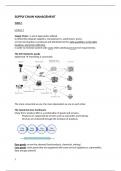
The SCM Network: goods
Spiderweb everything is connected.
The more connected we are, the more dependent we are on each other.
The Goods-Services Continuum
Many firms’ product offer is a combination of goods and services.
- Products are supported by services such as warranties and training.
- Services are enhanced through the inclusion of products.
Pure goods: no service element (food products, chemicals, mining)
Core goods: main goods that are supported with some service (appliances, automobiles,
data storage systems)
1
,Core service: main service that is supported with a good (hotels, airlines, internet service,
providers)
Pure services: no goods element (university, medical, investment)
- Pure goods industries have become low-margin commodity business. To differentiate
often add some services. Examples: helping with stocking items, maintaining
extensive information databases, providing consulting advice.
Key observations
1. Every facility that impacts costs needs to be considered (suppliers’ suppliers,
customers’ customers).
2. Efficiency (use least resources) and effectiveness (get maximum value) throughout
the system is required.
- Increased pressure for sustainability
- Increased risks/disruptions require agility and resilience
Example: Albert Heijn self-scan efficient, because it spares the customer & employee’s
time by using minimum action; effective, because it results in the maximum value, as the
waiting time in line is minimized for customers.
3. Multiple levels of activities based on frequency, time frame of impact and
uncertainty: strategic – tactical – operational
Activities that constitute SCM (The Process)
Planning: processes needed to operate an existing supply chain strategically.
How will the anticipated demand be met with available resources?
Developing set of metrics to monitor the SC so that it is efficient and delivers high quality
and value to customers.
Sourcing: selection of suppliers.
processes include receiving shipments, verifying them, transferring them to
manufacturing facilities, and authorizing supplier payments.
Making: where the major product is produced, or the service is provided.
scheduling processes for workers, coordinating material and other critical resources.
monitor these processes by measuring: speed, quality, worker productivity.
2
,Delivering: a logistics process.
carriers pick and move products, and coordinate and schedule this.
Returning: receiving worn-out, defective, and excess products from customers, and support
for customers.
Henry Ford
- First fully integrated supply chain
- Developed and manufactured the first automobile for middle class Americans.
- Sponsored the development of assembly line technique of mass product.
- Fordism = mass production of inexpensive goods coupled with high wages for
workers.
- Vertical integration = firm boundary was drawn to cover as many activities as
possible.
Early supply chains
- Geographical proximity
- Integrated ownership structures
Why?
- Transportation slow and costly
- Communication and information exchange challenges
Today’s supply chains
- Complex
- Fragmented supply chains
- SKU proliferation
Globally dispersed manufacturing: Example
3
, Network Complexity: Example
Magnitude of SC Costs: Cost Elements of a Typical Trade Book
4
WEEK 1
Lecture 1
Supply Chain = a set of approaches utilized,
to efficiently integrate suppliers, manufacturers, warehouses, stores,
so that merchandise is produced and distributed at the right quantities, to the right
locations, and at the right time,
in order to minimize system wide costs while satisfying service level requirements.
The SCM Network: goods
Spiderweb everything is connected.
The more connected we are, the more dependent we are on each other.
The Goods-Services Continuum
Many firms’ product offer is a combination of goods and services.
- Products are supported by services such as warranties and training.
- Services are enhanced through the inclusion of products.
Pure goods: no service element (food products, chemicals, mining)
Core goods: main goods that are supported with some service (appliances, automobiles,
data storage systems)
1
,Core service: main service that is supported with a good (hotels, airlines, internet service,
providers)
Pure services: no goods element (university, medical, investment)
- Pure goods industries have become low-margin commodity business. To differentiate
often add some services. Examples: helping with stocking items, maintaining
extensive information databases, providing consulting advice.
Key observations
1. Every facility that impacts costs needs to be considered (suppliers’ suppliers,
customers’ customers).
2. Efficiency (use least resources) and effectiveness (get maximum value) throughout
the system is required.
- Increased pressure for sustainability
- Increased risks/disruptions require agility and resilience
Example: Albert Heijn self-scan efficient, because it spares the customer & employee’s
time by using minimum action; effective, because it results in the maximum value, as the
waiting time in line is minimized for customers.
3. Multiple levels of activities based on frequency, time frame of impact and
uncertainty: strategic – tactical – operational
Activities that constitute SCM (The Process)
Planning: processes needed to operate an existing supply chain strategically.
How will the anticipated demand be met with available resources?
Developing set of metrics to monitor the SC so that it is efficient and delivers high quality
and value to customers.
Sourcing: selection of suppliers.
processes include receiving shipments, verifying them, transferring them to
manufacturing facilities, and authorizing supplier payments.
Making: where the major product is produced, or the service is provided.
scheduling processes for workers, coordinating material and other critical resources.
monitor these processes by measuring: speed, quality, worker productivity.
2
,Delivering: a logistics process.
carriers pick and move products, and coordinate and schedule this.
Returning: receiving worn-out, defective, and excess products from customers, and support
for customers.
Henry Ford
- First fully integrated supply chain
- Developed and manufactured the first automobile for middle class Americans.
- Sponsored the development of assembly line technique of mass product.
- Fordism = mass production of inexpensive goods coupled with high wages for
workers.
- Vertical integration = firm boundary was drawn to cover as many activities as
possible.
Early supply chains
- Geographical proximity
- Integrated ownership structures
Why?
- Transportation slow and costly
- Communication and information exchange challenges
Today’s supply chains
- Complex
- Fragmented supply chains
- SKU proliferation
Globally dispersed manufacturing: Example
3
, Network Complexity: Example
Magnitude of SC Costs: Cost Elements of a Typical Trade Book
4



