6
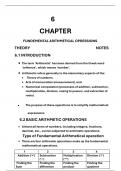
CHAPTER
FUNDEMENTAL ARITHMETICAL OPRESSIONS
THEORY NOTES
6.1 INTRODUCTION
• The term ‘Arithmetic’ has been derived from the Greek word
‘arithmos’, which means ‘number’.
• Arithmetic refers generally to the elementary aspects of the:
• Theory of numbers.
• Arts of mensuration (measurement), and
• Numerical computation (processes of addition, subtraction,
multiplication, division, raising to powers, and extraction of
roots)
. The purpose of these operations is to simplify mathematical
expressions
6.2 BASIC ARITHMETIC OPERATIONS
• Almost all forms of numbers, including integers, fractions,
decimal, etc., can be subjected to arithmetic operations.
Type of Fundamental Arithmetical operation
• There are four arithmetic operations make up the fundamental
mathematical operations.
1 2 3 4
Addition (‘+’) Subtraction Multiplication Division (‘/’)
(‘-’) (‘*’)
Finding the Finding the Finding the Finding the
Sum difference product quotient
, number, then we can find the of the number added by
subtracting the other number from the total.
6.3 ADDITION
Definition
• Addition is the process of finding the sum of two or more items
and is indicated by ‘+’ sign.
• Since it is a commutative process, the sequence is irrelevant
when adding numbers.
• Any type of number, including real and complex numbers,
fractions, and decimals, may be involved.
→ Rules
♦ A positive integer is the result of adding two positive
numbers.
♦ A negative integer is created by adding two negative
integers.
♦ When subtracting positive and negative integers, utilize
the sign of the biggest integer value.
6.4 SUBTRACTION
Definition
• It is the difference between two numbers.
• A ‘-’ symbol is used to indicate subtraction.
• It is addition done in the opposite direction
Subtraction Rules
• Both the numbers are (+), the answer will not also be positive.
• Both the numbers are (-), the answer will also be negative.
• If one number is positive and other number is negative, the
answer will be in the sign which is largest.
6.5 MULTIPLICATION
Definition
CHAPTER
FUNDEMENTAL ARITHMETICAL OPRESSIONS
THEORY NOTES
6.1 INTRODUCTION
• The term ‘Arithmetic’ has been derived from the Greek word
‘arithmos’, which means ‘number’.
• Arithmetic refers generally to the elementary aspects of the:
• Theory of numbers.
• Arts of mensuration (measurement), and
• Numerical computation (processes of addition, subtraction,
multiplication, division, raising to powers, and extraction of
roots)
. The purpose of these operations is to simplify mathematical
expressions
6.2 BASIC ARITHMETIC OPERATIONS
• Almost all forms of numbers, including integers, fractions,
decimal, etc., can be subjected to arithmetic operations.
Type of Fundamental Arithmetical operation
• There are four arithmetic operations make up the fundamental
mathematical operations.
1 2 3 4
Addition (‘+’) Subtraction Multiplication Division (‘/’)
(‘-’) (‘*’)
Finding the Finding the Finding the Finding the
Sum difference product quotient
, number, then we can find the of the number added by
subtracting the other number from the total.
6.3 ADDITION
Definition
• Addition is the process of finding the sum of two or more items
and is indicated by ‘+’ sign.
• Since it is a commutative process, the sequence is irrelevant
when adding numbers.
• Any type of number, including real and complex numbers,
fractions, and decimals, may be involved.
→ Rules
♦ A positive integer is the result of adding two positive
numbers.
♦ A negative integer is created by adding two negative
integers.
♦ When subtracting positive and negative integers, utilize
the sign of the biggest integer value.
6.4 SUBTRACTION
Definition
• It is the difference between two numbers.
• A ‘-’ symbol is used to indicate subtraction.
• It is addition done in the opposite direction
Subtraction Rules
• Both the numbers are (+), the answer will not also be positive.
• Both the numbers are (-), the answer will also be negative.
• If one number is positive and other number is negative, the
answer will be in the sign which is largest.
6.5 MULTIPLICATION
Definition