4. Leveraging Resources and Capabilities
One leading tool in global business is SWOT analysis. A SWOT analysis
determines a firm’s strengths (S), weaknesses (W), opportunities (O), and threats
(T).
- Institution based view: external O and T
- Resource-based view: internal S and W
VRIO framework: value (V), rarity (R), imitability (I), and organization (O).
§1. Understanding Resources and Capabilities
Basic proposition of the resource-based view: a firm consists of a bundle of
productive resources and capabilities.
- Resources and capabilities “the tangible and intangible assets a firm
uses to choose and implement its strategies.”
o Tangible resources and capabilities assets that are observable
and easily quantified. Broadly organized in four categories: financial,
physical, technological, and organizational.
o Intangible resources and capabilities assets that are harder to
observe and more difficult (or even impossible) to quantify.
Examples include: human, innovation, and reputational resources
and capabilities.
§2/§3. Resources, Capabilities, and the Value Chain
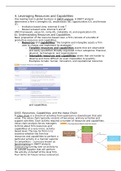
A value chain is a stream of activities from upstream to downstream that add
value. The value chain typically consists of two areas: primary activities and
support activities. Each activity requires a number of resources and capabilities.
Value chain analysis forces managers
to think about firm resources and
capabilities at a very micro, activity-
based level. The key for firms is to
examine whether the firm has
resources and capabilities to perform a
particular activity in a manner superior
to competitors – a process known as
benchmarking in SWOT analysis.
Outsourcing turning over an activity to
an outside supplier that will perform
the activity on behalf of the local firm.
Four terms (in-house versus outsource):
One leading tool in global business is SWOT analysis. A SWOT analysis
determines a firm’s strengths (S), weaknesses (W), opportunities (O), and threats
(T).
- Institution based view: external O and T
- Resource-based view: internal S and W
VRIO framework: value (V), rarity (R), imitability (I), and organization (O).
§1. Understanding Resources and Capabilities
Basic proposition of the resource-based view: a firm consists of a bundle of
productive resources and capabilities.
- Resources and capabilities “the tangible and intangible assets a firm
uses to choose and implement its strategies.”
o Tangible resources and capabilities assets that are observable
and easily quantified. Broadly organized in four categories: financial,
physical, technological, and organizational.
o Intangible resources and capabilities assets that are harder to
observe and more difficult (or even impossible) to quantify.
Examples include: human, innovation, and reputational resources
and capabilities.
§2/§3. Resources, Capabilities, and the Value Chain
A value chain is a stream of activities from upstream to downstream that add
value. The value chain typically consists of two areas: primary activities and
support activities. Each activity requires a number of resources and capabilities.
Value chain analysis forces managers
to think about firm resources and
capabilities at a very micro, activity-
based level. The key for firms is to
examine whether the firm has
resources and capabilities to perform a
particular activity in a manner superior
to competitors – a process known as
benchmarking in SWOT analysis.
Outsourcing turning over an activity to
an outside supplier that will perform
the activity on behalf of the local firm.
Four terms (in-house versus outsource):