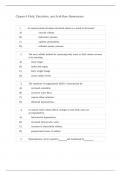
Chapter 6 Fluid, Electrolyte, and Acid-Base Homeostasis
1. An injured patient develops interstitial edema as a result of decreased:
A) vascular volume.
B) hydrostatic pressure.
C) capillary permeability.
D) colloidal osmotic pressure.
2. The most reliable method for measuring body water or fluid volume increase
is by assessing:
A) tissue turgor.
B) intake and output.
C) body weight change.
D) serum sodium levels.
3. The syndrome of inappropriate ADH is characterized by:
A) increased osmolality.
B) excessive water thirst.
C) copious dilute urination.
D) dilutional hyponatremia.
4. In isotonic fluid volume deficit, changes in total body water are
accompanied by:
A) intravascular hypotonicity.
B) increased intravascular water.
C) increases in intracellular sodium.
D) proportionate losses of sodium.
5. Hyponatremia can be caused by and manifested by .
, A) hypovolemia; dehydration
B) third spacing; hypertonicity
C) water retention; hypotonicity
D) aldosterone excess; low ADH
6. One of the major causes of hyperkalemia is , which alters
potassium elimination.
A) renal dysfunction
B) aldosterone excess
C) metabolic alkalosis
D) plasma albumin deficit
7. Hypoparathyroidism causes hypocalcemia by:
A) increasing serum magnesium.
B) increasing phosphate excretion.
C) blocking bone release of calcium.
D) blocking action of intestinal vitamin D.
8. Magnesium is important for the overall function of the body because of its
direct role in:
A) cell membrane permeability.
B) somatic cell growth control.
C) sodium and tonicity regulation.
D) DNA replication and transcription.
9. A patient has acidosis that is suspected to be respiratory in etiology. Which
of the following is the major cause of acute primary respiratory acidosis?
A) Decreased CO2 retention
B) Increased metabolic acids
1. An injured patient develops interstitial edema as a result of decreased:
A) vascular volume.
B) hydrostatic pressure.
C) capillary permeability.
D) colloidal osmotic pressure.
2. The most reliable method for measuring body water or fluid volume increase
is by assessing:
A) tissue turgor.
B) intake and output.
C) body weight change.
D) serum sodium levels.
3. The syndrome of inappropriate ADH is characterized by:
A) increased osmolality.
B) excessive water thirst.
C) copious dilute urination.
D) dilutional hyponatremia.
4. In isotonic fluid volume deficit, changes in total body water are
accompanied by:
A) intravascular hypotonicity.
B) increased intravascular water.
C) increases in intracellular sodium.
D) proportionate losses of sodium.
5. Hyponatremia can be caused by and manifested by .
, A) hypovolemia; dehydration
B) third spacing; hypertonicity
C) water retention; hypotonicity
D) aldosterone excess; low ADH
6. One of the major causes of hyperkalemia is , which alters
potassium elimination.
A) renal dysfunction
B) aldosterone excess
C) metabolic alkalosis
D) plasma albumin deficit
7. Hypoparathyroidism causes hypocalcemia by:
A) increasing serum magnesium.
B) increasing phosphate excretion.
C) blocking bone release of calcium.
D) blocking action of intestinal vitamin D.
8. Magnesium is important for the overall function of the body because of its
direct role in:
A) cell membrane permeability.
B) somatic cell growth control.
C) sodium and tonicity regulation.
D) DNA replication and transcription.
9. A patient has acidosis that is suspected to be respiratory in etiology. Which
of the following is the major cause of acute primary respiratory acidosis?
A) Decreased CO2 retention
B) Increased metabolic acids