BIOL 211 Concepts of Zoology
Exam 1 Study Guide
Chapter 1
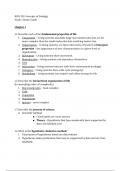
1.1 Describe each of the fundamental properties of life
1. Uniqueness - Living systems assemble large macromolecules that are far
more complex than the small molecules that nonliving matter has.
2. Organization - In living systems, we find a hierarchy of levels (1.2) Emergent
properties - the appearance of new characteristics at a given level of
organization.
3. Movement - Living systems show movement.
4. Reproduction - Living systems can reproduce themselves
5. DNA
6. Interaction - Living systems interact with their environment (ecology)
7. Ontogeny - Living systems have a life cycle (ontogeny)
8. Metabolism - Living systems can acquire and utilize energy for life
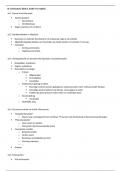
1.2 Describe the hierarchical organization of life
(In ascending order of complexity)
1. Macromolecules - least complex
2. Cells
3. Organisms
4. Populations
5. Species - most complex
1.3 Describe the process of science
● Scientific Method
■ Conclusions are never proven
■ Theory - Hypothesis that has consistently been supported by
data; not falsified (yet)
1.4 What is the hypothetic-deductive method?
1. Generation of hypotheses based on observations
2. Hypotheses make predictions that may be supported by data and are thus
falsifiable
, 1.5 With regard to Darwin’s theory of evolution, define the following:
● Perpetual change → The living world is neither constant nor
perpetually cycling, but is always changing
● Common Descent → All forms of life descended from a common
ancestor through a branching of lineages
● Phylogeny → Life’s history has the structure of a branching
evolutionary tree
● Multiplication of Species → The evolutionary process produces new
species by splitting and transforming older ones
● Gradualism → The large differences in anatomical traits that
characterize diverse species originate through the accumulation of
many small incremental changes over very long periods of time
○ Not necessarily long periods of time
● Natural selection → A creative process that generates novel forms
from the small individual variations that occur among organisms
within a population
○ There is variation in populations
○ Variation is heritable
○ Some adaptations are more successful than others
● Adaptation → The expected result of a process that accumulates the
most favorable variants occurring in a population throughout long
periods of evolutionary time
1.6 How does neo-Darwinism differ from Darwinism?
★ Darwinism lacked a successful theory of heredity (he assumed it was
blending). In 1900, Mendel established the principle of particulate
inheritance, which is that hereditary factors could be discrete and non
blending and that a new genetic variant therefore could persist unaltered
from one generation to the next.
★ Neo-Darwinism is the outgrowth of Darwin’s Theory of Evolution (D’sToE)
and Mendel’s Chromosomal Theory of Inheritance (M’sCToI)
Chapter 2
2.1 Describe the 6 properties of water that are essential for life
1. High specific heat capacity
Exam 1 Study Guide
Chapter 1
1.1 Describe each of the fundamental properties of life
1. Uniqueness - Living systems assemble large macromolecules that are far
more complex than the small molecules that nonliving matter has.
2. Organization - In living systems, we find a hierarchy of levels (1.2) Emergent
properties - the appearance of new characteristics at a given level of
organization.
3. Movement - Living systems show movement.
4. Reproduction - Living systems can reproduce themselves
5. DNA
6. Interaction - Living systems interact with their environment (ecology)
7. Ontogeny - Living systems have a life cycle (ontogeny)
8. Metabolism - Living systems can acquire and utilize energy for life
1.2 Describe the hierarchical organization of life
(In ascending order of complexity)
1. Macromolecules - least complex
2. Cells
3. Organisms
4. Populations
5. Species - most complex
1.3 Describe the process of science
● Scientific Method
■ Conclusions are never proven
■ Theory - Hypothesis that has consistently been supported by
data; not falsified (yet)
1.4 What is the hypothetic-deductive method?
1. Generation of hypotheses based on observations
2. Hypotheses make predictions that may be supported by data and are thus
falsifiable
, 1.5 With regard to Darwin’s theory of evolution, define the following:
● Perpetual change → The living world is neither constant nor
perpetually cycling, but is always changing
● Common Descent → All forms of life descended from a common
ancestor through a branching of lineages
● Phylogeny → Life’s history has the structure of a branching
evolutionary tree
● Multiplication of Species → The evolutionary process produces new
species by splitting and transforming older ones
● Gradualism → The large differences in anatomical traits that
characterize diverse species originate through the accumulation of
many small incremental changes over very long periods of time
○ Not necessarily long periods of time
● Natural selection → A creative process that generates novel forms
from the small individual variations that occur among organisms
within a population
○ There is variation in populations
○ Variation is heritable
○ Some adaptations are more successful than others
● Adaptation → The expected result of a process that accumulates the
most favorable variants occurring in a population throughout long
periods of evolutionary time
1.6 How does neo-Darwinism differ from Darwinism?
★ Darwinism lacked a successful theory of heredity (he assumed it was
blending). In 1900, Mendel established the principle of particulate
inheritance, which is that hereditary factors could be discrete and non
blending and that a new genetic variant therefore could persist unaltered
from one generation to the next.
★ Neo-Darwinism is the outgrowth of Darwin’s Theory of Evolution (D’sToE)
and Mendel’s Chromosomal Theory of Inheritance (M’sCToI)
Chapter 2
2.1 Describe the 6 properties of water that are essential for life
1. High specific heat capacity