
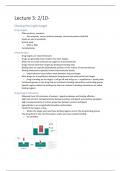
Lecture 3: 2/10-
Chosing the (right) target
Drug targets
- O#en proteins, receptors
o Also enzymes, carrier proteins (pumps), structural proteins (tubulin)
- Lipids are also a possibility
- Nucleic acids
o DNA or RNA
- Carbohydrates
Characteris*cs
- Drug targets are macromolecules
- Drugs are generally much smaller than their targets
- O#en we use small molecules to target the macromolecules
- Drugs interact with their targets by binding to binding sites
- Binding sites are typically hydrophobic pockets on the surface of macromolecules
- Binding interacEons typically involve intermolecular bonds
o Intermolecular bound o#en made between drug and target
- Most drugs are in equilibrium between being bound and unbound to their target
o Drug is binding on the target -> will go off and will go on -> equilibrium = steady state
- FuncEonal groups on the drug that are involved in binding interacEons are binding groups
- Specific regions within the binding site that are involved in binding interacEons are called
binding regions
Drug-target interac.on
- Obtained from 3-D structures of protein - ligand complexes and binding affiniEes
- High level of steric complementarity between protein and ligand: lock-and-key paradigm.
- High complementarity of surface properEes between protein and ligand
- Ligand binds in an energeEcally favorable conformaEon
- Pocket of the target, a drug
o Within the target you have these binding regions and on the drug binding groups
- The drug doesn’t stay into the pocket, unless you have covalent binding
o On-off effect
,Conven.onal strategies to find new drug target
- Forward approach: focus on the pathophysiology
o HIV virus: one of the targets is the reverse transcriptase HIV protease
o Proteins involved in the pathophysiology are the target
- Backward approach: analysis of mechanism of acEon of exisEng therapeuEc
o Benzodiazepines
The scope of (new) drug targets
- Largest group are the G-protein coupled receptors
- Also the enzymes are a large group
- EsEmated that in our genome we have 600-1500 druggable targets that we can explore
Background
- Genomic approach becomes more important and also the use of the right preclinical species to
predict the outcome in human beings
New strategies for drug target iden.fica.on
- Drug effect
o Expression level of your gene: see of the gene product is expressed
§ Higher/lower expression -> will not mean that this will be translated to proteins
and that the protein will be acEve
o Regulatory factors: leading to the translaEon and hopefully it leads to a funcEonal
protein
o Compensatory mechanisms
- One gene -> it will lead to one protein and one drug target
- You can have several splice variants, mulEmeric receptors…. => quite complicated when you
think at drug target idenEficaEon
Gene categorie
- Disease genes: mutaEons associated with parEcular disease
o Single gene: gene products are not drug-targetable
§ cysEc fibrosis, hemophilia, phenylketonuria,
, § For cysEc fibrosis: o#en one gene involved in the final outcome
o MulEple gene: gene products may be drug-targetable
§ tyrosine kinase, secretase, …
• Tyrosine kinase inhibitors-> used for cancer treatment (for several types)
o Not selecEve -> bind to other receptors -> side effects
- Disease modifying genes: mutaEons regulatory genes -> over- or underexpression of normal
non-mutated genes
o Gene expression profiling: microarrays, serial analysis of gene expression (SAGE)
o Gene knock-out screening: transgenic mice, C. elegans, Danio
§ Early days: mices -> now: zebrafish
§ Homozygous knock out vs hetero
• Heterozygous model: have a lower expression level of a certain gene -> use
this as a potenEal model to assess your target
o Bv. Diabetes models: very difficult to asses the safety of certain drug in
healthy individuals -> you will get hypoglycaemia -> adverse effects
§ Problem with complete transgenic models, the homozygous
models: effect is too high, too high levels of glucose
§ Balans = heterozygous: you have levels that are higher than in
healthy individual, but not too high
o Transgenic, heterozygous model to asses to potenEal effects of the drug
of the offspring. When you are pregnant and you have diabetes then
this is dangerous, because the glucose levels are not normal -> effect on
offspring => levels need to be controlled.
- Drugable genes: gene product with drug-recogniEon binding site
New strategies for drug target valida.on
- Pharmacological validaEon (combined with ‘lead’ discovery in HTS seengs)
o Use of ‘prototype’ inhibitors of the putaEve target
o Use of specific anEbodies to putaEve target protein
o HTS : high throughput screening
§ Companies want this in the early phases in drug discovery
§ In a very short Emeframe you get the data you want
• Certain in vitro models: could be HTS if you can put them in 96 well plates and
you can use a automaEcally system to analyse it -> you can analyse in a very
fast way
§ Lot of data in a short Emeframe
§ Is used a lot, can be done with all sort of markers
• Fluor compound binds to the compound and it binds to the receptors -> you
will get the signal
o If it don’t bind you don’t see it
- GeneEc validaEon -> selecEve suppression of expression of specific genes
§ More advanced molecules
§ AnEsense oligonucleoEdes
• SyntheEc oligonucleoEdes
• AnEsense sequences by geneEc engineering
• Short chain nucleoEdes to bind to a certain region
• Several workings mechanisms (depending on the design)
o Binding to mRNA -> block further translaEonal
Chosing the (right) target
Drug targets
- O#en proteins, receptors
o Also enzymes, carrier proteins (pumps), structural proteins (tubulin)
- Lipids are also a possibility
- Nucleic acids
o DNA or RNA
- Carbohydrates
Characteris*cs
- Drug targets are macromolecules
- Drugs are generally much smaller than their targets
- O#en we use small molecules to target the macromolecules
- Drugs interact with their targets by binding to binding sites
- Binding sites are typically hydrophobic pockets on the surface of macromolecules
- Binding interacEons typically involve intermolecular bonds
o Intermolecular bound o#en made between drug and target
- Most drugs are in equilibrium between being bound and unbound to their target
o Drug is binding on the target -> will go off and will go on -> equilibrium = steady state
- FuncEonal groups on the drug that are involved in binding interacEons are binding groups
- Specific regions within the binding site that are involved in binding interacEons are called
binding regions
Drug-target interac.on
- Obtained from 3-D structures of protein - ligand complexes and binding affiniEes
- High level of steric complementarity between protein and ligand: lock-and-key paradigm.
- High complementarity of surface properEes between protein and ligand
- Ligand binds in an energeEcally favorable conformaEon
- Pocket of the target, a drug
o Within the target you have these binding regions and on the drug binding groups
- The drug doesn’t stay into the pocket, unless you have covalent binding
o On-off effect
,Conven.onal strategies to find new drug target
- Forward approach: focus on the pathophysiology
o HIV virus: one of the targets is the reverse transcriptase HIV protease
o Proteins involved in the pathophysiology are the target
- Backward approach: analysis of mechanism of acEon of exisEng therapeuEc
o Benzodiazepines
The scope of (new) drug targets
- Largest group are the G-protein coupled receptors
- Also the enzymes are a large group
- EsEmated that in our genome we have 600-1500 druggable targets that we can explore
Background
- Genomic approach becomes more important and also the use of the right preclinical species to
predict the outcome in human beings
New strategies for drug target iden.fica.on
- Drug effect
o Expression level of your gene: see of the gene product is expressed
§ Higher/lower expression -> will not mean that this will be translated to proteins
and that the protein will be acEve
o Regulatory factors: leading to the translaEon and hopefully it leads to a funcEonal
protein
o Compensatory mechanisms
- One gene -> it will lead to one protein and one drug target
- You can have several splice variants, mulEmeric receptors…. => quite complicated when you
think at drug target idenEficaEon
Gene categorie
- Disease genes: mutaEons associated with parEcular disease
o Single gene: gene products are not drug-targetable
§ cysEc fibrosis, hemophilia, phenylketonuria,
, § For cysEc fibrosis: o#en one gene involved in the final outcome
o MulEple gene: gene products may be drug-targetable
§ tyrosine kinase, secretase, …
• Tyrosine kinase inhibitors-> used for cancer treatment (for several types)
o Not selecEve -> bind to other receptors -> side effects
- Disease modifying genes: mutaEons regulatory genes -> over- or underexpression of normal
non-mutated genes
o Gene expression profiling: microarrays, serial analysis of gene expression (SAGE)
o Gene knock-out screening: transgenic mice, C. elegans, Danio
§ Early days: mices -> now: zebrafish
§ Homozygous knock out vs hetero
• Heterozygous model: have a lower expression level of a certain gene -> use
this as a potenEal model to assess your target
o Bv. Diabetes models: very difficult to asses the safety of certain drug in
healthy individuals -> you will get hypoglycaemia -> adverse effects
§ Problem with complete transgenic models, the homozygous
models: effect is too high, too high levels of glucose
§ Balans = heterozygous: you have levels that are higher than in
healthy individual, but not too high
o Transgenic, heterozygous model to asses to potenEal effects of the drug
of the offspring. When you are pregnant and you have diabetes then
this is dangerous, because the glucose levels are not normal -> effect on
offspring => levels need to be controlled.
- Drugable genes: gene product with drug-recogniEon binding site
New strategies for drug target valida.on
- Pharmacological validaEon (combined with ‘lead’ discovery in HTS seengs)
o Use of ‘prototype’ inhibitors of the putaEve target
o Use of specific anEbodies to putaEve target protein
o HTS : high throughput screening
§ Companies want this in the early phases in drug discovery
§ In a very short Emeframe you get the data you want
• Certain in vitro models: could be HTS if you can put them in 96 well plates and
you can use a automaEcally system to analyse it -> you can analyse in a very
fast way
§ Lot of data in a short Emeframe
§ Is used a lot, can be done with all sort of markers
• Fluor compound binds to the compound and it binds to the receptors -> you
will get the signal
o If it don’t bind you don’t see it
- GeneEc validaEon -> selecEve suppression of expression of specific genes
§ More advanced molecules
§ AnEsense oligonucleoEdes
• SyntheEc oligonucleoEdes
• AnEsense sequences by geneEc engineering
• Short chain nucleoEdes to bind to a certain region
• Several workings mechanisms (depending on the design)
o Binding to mRNA -> block further translaEonal


