

Class 9: Frontotemporal dementia
Demen%a
- FTD belongs to the class of Demen3a
- What is typically demen3a: memory loss, Alzheimer and old people
- But there is a lot more under the umbrella of demen3a
- Inability to perform daily ac3vi3es
- Progressive
- We will focus on FTD
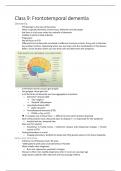
- Different forms of demen3a correlated to different structures in brain. Every part in the brain
has another func3on. Depending where you lose brain cells the manifesta3on of the disease
differs. So the loca3on where you lose brain cells will determines the symptoms.
- In FTD brain shrinks and you get atrophy
- You get gaps, 3ssue gets lost
- In all the forms of demen3a you have aggrega3on of proteins
o Alzheimer’s disease (AD)
§ ‘Tau’ tangles +
§ ‘Amyloid’ (Ab) plaques
o Lewy-body disease (LBD)
§ alpha-synuclein
o Frontotemporal demen3a (FTD)
§ TDP43 or Tau or FUS
è It is always one of these three -> difficult to know which proteins disposed
- Each of the proteins have a favourite place to disposed -> is responsible for the symptoms
o Amyloid and tau: temporal lobe
- Now scan for amyloid
o Some3mes in frontal cortex -> Alzheimer disease with behaviorial changes -> frontal
variant of FTD
- Finding biomarkers is crucial
o Imaging biomarkers, biofluids (in blood and CFS), gene3c panels in the future hopefully
Early-onset demen/a
- Arbitrary cut-off disease onset< 65 years
- ~1800 pa3ents with early-onset demen3a in Flanders
- Oben ini3ally other diagnoses:
o Burn-out, depression, psychiatric changes
- Disease is oben more rapidly progressive when it occurs at a younger age
- Large impact: pa3ents oben s3ll work and have (young) children
, - Early versus late-onset demen3a
o FTD is a common form in early-onset disease
o In late-onset mainly Alzheimer
Frontatemperal demen%a (FTD)
- First described in 1892 by Arnold Pick
- Alois Alzheimer first described the pathology in 1911
- Inclusions were called Pick bodies
- Clinical disease “Pick’s disease”
- Current name is Frontotemporal demen3a
- Clinical presenta3ons:
o Behavioral variant FTD
o Language variant(s) of FTD
o FTD with amyotrophic lateral sclerosis (ALS)
o FTD with parkinsonism
§ Some symptoms of Parkinson’s disease
- Pathological presenta3ons
o Tau, TDP or FUS
§ Eve within the group you have variability
§ Rare form is FUS
- Compulsion loss of sense of danger
- Loss of sense of disgust – loss of sense of safety
- Cannot judge emo3ons
- Prevalence 15-22 per 100,000 individuals
- Average age at onset 60 years (30s to 80s)
- Pa3ents may act in inappropriate ways, show a lack of judgement or disinhibi3on, neglect to
maintain personal hygiene or do something compulsive or repe33ve.
- Pa3ents show lack of insight
- Pa3ents may have language problems
- Parkinsonism and muscle weakness in some pa3ents
- 40-50% of FTD pa3ents have a posi3ve family history7
Frontotemporal lobar degenera%on (FTLD)
- The type with tau pathology
- Very severe in frontal lobe
- Large aggregates of tau
Frontotemporal demen/a and Parkinsonism linked to Chromosome 17 (FTDP-17)
- Consensus mee3ng in Ann Arbor in 1996
- Families with autosomal dominant inheritance of FTD with gene3c linkage to chromosome 17
- Tau pathology in most cases
Linkage analysis in chromosome 17 families
- Overview of the families that they studied
- They did linkage analysis
- You look for a part is that is shared between affected individuals and not present in the healthy
ones
- Assump3on that all the families have the same gene that is mutated then you would think that
the candidate is located in the grey wone -> MAPT gene
Demen%a
- FTD belongs to the class of Demen3a
- What is typically demen3a: memory loss, Alzheimer and old people
- But there is a lot more under the umbrella of demen3a
- Inability to perform daily ac3vi3es
- Progressive
- We will focus on FTD
- Different forms of demen3a correlated to different structures in brain. Every part in the brain
has another func3on. Depending where you lose brain cells the manifesta3on of the disease
differs. So the loca3on where you lose brain cells will determines the symptoms.
- In FTD brain shrinks and you get atrophy
- You get gaps, 3ssue gets lost
- In all the forms of demen3a you have aggrega3on of proteins
o Alzheimer’s disease (AD)
§ ‘Tau’ tangles +
§ ‘Amyloid’ (Ab) plaques
o Lewy-body disease (LBD)
§ alpha-synuclein
o Frontotemporal demen3a (FTD)
§ TDP43 or Tau or FUS
è It is always one of these three -> difficult to know which proteins disposed
- Each of the proteins have a favourite place to disposed -> is responsible for the symptoms
o Amyloid and tau: temporal lobe
- Now scan for amyloid
o Some3mes in frontal cortex -> Alzheimer disease with behaviorial changes -> frontal
variant of FTD
- Finding biomarkers is crucial
o Imaging biomarkers, biofluids (in blood and CFS), gene3c panels in the future hopefully
Early-onset demen/a
- Arbitrary cut-off disease onset< 65 years
- ~1800 pa3ents with early-onset demen3a in Flanders
- Oben ini3ally other diagnoses:
o Burn-out, depression, psychiatric changes
- Disease is oben more rapidly progressive when it occurs at a younger age
- Large impact: pa3ents oben s3ll work and have (young) children
, - Early versus late-onset demen3a
o FTD is a common form in early-onset disease
o In late-onset mainly Alzheimer
Frontatemperal demen%a (FTD)
- First described in 1892 by Arnold Pick
- Alois Alzheimer first described the pathology in 1911
- Inclusions were called Pick bodies
- Clinical disease “Pick’s disease”
- Current name is Frontotemporal demen3a
- Clinical presenta3ons:
o Behavioral variant FTD
o Language variant(s) of FTD
o FTD with amyotrophic lateral sclerosis (ALS)
o FTD with parkinsonism
§ Some symptoms of Parkinson’s disease
- Pathological presenta3ons
o Tau, TDP or FUS
§ Eve within the group you have variability
§ Rare form is FUS
- Compulsion loss of sense of danger
- Loss of sense of disgust – loss of sense of safety
- Cannot judge emo3ons
- Prevalence 15-22 per 100,000 individuals
- Average age at onset 60 years (30s to 80s)
- Pa3ents may act in inappropriate ways, show a lack of judgement or disinhibi3on, neglect to
maintain personal hygiene or do something compulsive or repe33ve.
- Pa3ents show lack of insight
- Pa3ents may have language problems
- Parkinsonism and muscle weakness in some pa3ents
- 40-50% of FTD pa3ents have a posi3ve family history7
Frontotemporal lobar degenera%on (FTLD)
- The type with tau pathology
- Very severe in frontal lobe
- Large aggregates of tau
Frontotemporal demen/a and Parkinsonism linked to Chromosome 17 (FTDP-17)
- Consensus mee3ng in Ann Arbor in 1996
- Families with autosomal dominant inheritance of FTD with gene3c linkage to chromosome 17
- Tau pathology in most cases
Linkage analysis in chromosome 17 families
- Overview of the families that they studied
- They did linkage analysis
- You look for a part is that is shared between affected individuals and not present in the healthy
ones
- Assump3on that all the families have the same gene that is mutated then you would think that
the candidate is located in the grey wone -> MAPT gene


