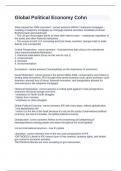
Global Political Economy Cohn
What caused the 2008 recession? correct answers MAINLY Subprime mortgages -
reselling of subprime mortgages as mortgage-backed securities worldwide (Lehman
Brothers bank goes bankrupt)
- The US gov encourages banks to lower their interest rates -- inadequate regulation of
the banks and other financial institutions
- The excess in both U.S. borrowing and East Asian countries' savings leads to trade
deficits (US overspends)
Critical Perspectives correct answers - 4 perspectives that criticize the mainstream
ones (neomercantalism/liberalism)
1. historical materialism (focus on this one for chp 1)
2. constructivism
3. feminism
4. environmentalism
Economism correct answers Overemphasis on the importance of economics
Great Moderation correct answers the period 1980s-2006, central banks were better at
limiting deep recessions, FED thought they tamed business cycle; given business, cycle
downturn seemed less of threat, financial innovation, and deregulation allowed for
overextensions like subprime mortgages
Historical Materialism correct answers A critical point against 2 main perspectives;
examines structural change over time.
* emphasis on North-South struggles
* Stems from marxism
* emphasis on class struggles
Global Political Economy correct answers IPE with extra steps; reflects globalization
* see globalization def
* notice it is the title of the book because it's not just the study of international political
economy, but now it's broader, the global political economy
Globalization correct answers Refers to the broadening and deepening of
interdependence among people and states throughout the world (global)
not just international anymore - now it's global
Liberalism correct answers One of the two main perspectives of IPE
*ORTHODOX Liberal in IPE means favor of free markets, property rights, and limited
gov control in economic activities
*KEYNESIAN liberals are more accepting of gov intervention.
, *Liberal view the world with optimism and as a positive-sum game
*note the two types of liberals both agree on free markets/property rights but have diff
opinions on gov control
Neomercantilism correct answers One of the two main perspectives of IPE
Examines how states develop economic policies to increase their wealth and position in
Internationa; relations system
Positive-sum-game correct answers All states can benefit in IPE even if the benefit is
not equal; optimistic perspectives that is held by liberalism
*liberals believe international relations institutions can promote cooperation
Realism correct answers International relations perspective; focuses on military-
security aspects of power
*note this is a perspective under the field of international relations and not under IPE;
focus on the 2 main ones for IPE
Subprime Mortgage Effect correct answers An increase in demand for houses led to a
building boom, paired with the great moderation
- led to reduced housing prices mid-2006 + mortgages were coming for renewal at
higher interest rates
= subprime borrowers defaulted on loans because borrowers owed more and couldn't
sell their homes because the value had drastically decreased
- led to the 2008 housing crisis
Subprime Mortgages correct answers home loan issued to borrowers with low credit
scores or low income - high risk
What is IPE correct answers International Political Economy - an interdisciplinary
academic discipline that analyzes economics, politics and international relations.
Break the name down
- International (involves multiple states)
- Politics (public (state) /private actors)
- Economic (markets determined by supply and demand)
Zero-sum game in IPE correct answers One state's gain is another state's loss
*Neomercantalists view IPE as a zero-sum-game
*Neomercantalists focus on relative gains
*RELATIVE gains: A state's gains in relation to the gains of other states
*In IPE, States try to manipulate the market to capture relative gains
Gross Domestic Product (GDP) correct answers The total value of goods and services
produced within a country's borders during a given year. Counts income in terms of
where it is earned rather than who owns the factors of production.
What caused the 2008 recession? correct answers MAINLY Subprime mortgages -
reselling of subprime mortgages as mortgage-backed securities worldwide (Lehman
Brothers bank goes bankrupt)
- The US gov encourages banks to lower their interest rates -- inadequate regulation of
the banks and other financial institutions
- The excess in both U.S. borrowing and East Asian countries' savings leads to trade
deficits (US overspends)
Critical Perspectives correct answers - 4 perspectives that criticize the mainstream
ones (neomercantalism/liberalism)
1. historical materialism (focus on this one for chp 1)
2. constructivism
3. feminism
4. environmentalism
Economism correct answers Overemphasis on the importance of economics
Great Moderation correct answers the period 1980s-2006, central banks were better at
limiting deep recessions, FED thought they tamed business cycle; given business, cycle
downturn seemed less of threat, financial innovation, and deregulation allowed for
overextensions like subprime mortgages
Historical Materialism correct answers A critical point against 2 main perspectives;
examines structural change over time.
* emphasis on North-South struggles
* Stems from marxism
* emphasis on class struggles
Global Political Economy correct answers IPE with extra steps; reflects globalization
* see globalization def
* notice it is the title of the book because it's not just the study of international political
economy, but now it's broader, the global political economy
Globalization correct answers Refers to the broadening and deepening of
interdependence among people and states throughout the world (global)
not just international anymore - now it's global
Liberalism correct answers One of the two main perspectives of IPE
*ORTHODOX Liberal in IPE means favor of free markets, property rights, and limited
gov control in economic activities
*KEYNESIAN liberals are more accepting of gov intervention.
, *Liberal view the world with optimism and as a positive-sum game
*note the two types of liberals both agree on free markets/property rights but have diff
opinions on gov control
Neomercantilism correct answers One of the two main perspectives of IPE
Examines how states develop economic policies to increase their wealth and position in
Internationa; relations system
Positive-sum-game correct answers All states can benefit in IPE even if the benefit is
not equal; optimistic perspectives that is held by liberalism
*liberals believe international relations institutions can promote cooperation
Realism correct answers International relations perspective; focuses on military-
security aspects of power
*note this is a perspective under the field of international relations and not under IPE;
focus on the 2 main ones for IPE
Subprime Mortgage Effect correct answers An increase in demand for houses led to a
building boom, paired with the great moderation
- led to reduced housing prices mid-2006 + mortgages were coming for renewal at
higher interest rates
= subprime borrowers defaulted on loans because borrowers owed more and couldn't
sell their homes because the value had drastically decreased
- led to the 2008 housing crisis
Subprime Mortgages correct answers home loan issued to borrowers with low credit
scores or low income - high risk
What is IPE correct answers International Political Economy - an interdisciplinary
academic discipline that analyzes economics, politics and international relations.
Break the name down
- International (involves multiple states)
- Politics (public (state) /private actors)
- Economic (markets determined by supply and demand)
Zero-sum game in IPE correct answers One state's gain is another state's loss
*Neomercantalists view IPE as a zero-sum-game
*Neomercantalists focus on relative gains
*RELATIVE gains: A state's gains in relation to the gains of other states
*In IPE, States try to manipulate the market to capture relative gains
Gross Domestic Product (GDP) correct answers The total value of goods and services
produced within a country's borders during a given year. Counts income in terms of
where it is earned rather than who owns the factors of production.