Lecture 1: The role of CIO in organizations
Case summary
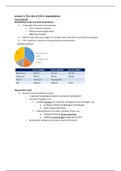
Introduction to the case (IVK Corporation)
• A loan-base financial service business
o 2.2m customer inquiries
o 530k processed application
o 180k loans funded
• Market share: the percentage of a market’s total sales that is earned by a company.
• IVK’s condition: a period of slowing business performance.
Organization chart
• Board of Directors (Board or BoD):
o “a group of individuals elected to represent shareholders”.
o A board’s mandate is to
▪ establish policies for corporate management and oversight, e.g.,
• no illegal activities (Volkswagen’s Dieselgate).
• equal opportunity policy.
▪ making decisions on major company issues, e.g.,
• hiring and firing of senior executives.
• ratifying annual budget suggested by CEO.
o Every public company must have a board of directors.
, • Chief Executive Officer (CEO):
o “the highest-ranking executive in a company, whose primary responsibilities include
▪ being the public face of the company.
▪ making major corporate decisions,
▪ managing the overall operations and resources of a company,
▪ acting as the main point of communication between the board and
corporate operations, and
▪ a CEO is usually elected by the board”.
• Chief Operation Officer (COO):
o missing in the chart
o considered to be second in the chain of command.
o mainly focuses on executing the company’s business plans, while the CEO is more
concerned with long-term goals and the broader company outlook.
o tasked with overseeing the day-to-day administrative and operational functions of a
business.
• Chief Financial Officer (CFO):
o head of financial management
o responsible for managing the financial actions of a company, e.g., tracking cash flow,
creating financial reports.
• Chief Information Officer (CIO):
o head of information technology
o the highest level IT executive or manager in a firm or business unit (even if the term
CIO may not always be used).
o salaries ranged from $150k to $250k in 2014.
• The focus of our course is the CIO.
CH1 summary
• Carl Williams, the new CEO, appointed Jim Barton, the head of loan operations, as the new
CIO.
• Why does not Barton like the job?
o Barton has no background in IT.
, o He does not know what the role of CIO is.
• Why did the new CEO select Barton? Who can be a good CIO?
o “you have a lot of ideas on how IT should be run”
▪ “you’ve been one of his (former CIO’s) most outspoken critics”
o “IT is a problem area. You are a highly regarded fixer”.
• What is the problem with IVK’s IT department?
o IT people do not understand the business.
o IT management is not about management (profit, risk, return, process, and people).
o IT uses technical jargon in its communication with other departments.
• Important notes:
o “Unlike Davies (former CIO), you’ll report directly to me”
▪ “the company will go through a big change and a huge part of the change will
be IT”
Role of CIO
IT-business alignment (also reviewing the pre-requisite knowledge for this course).
The main role of CIO
CIOs are in charge of aligning the components connected with the red lines.
, Business strategy
Porter: differentiation and cost leadership
Miles & Snow: defenders, prospectors, analysers, and reactors
Business strategy
• Strategy:
o a plan of action designed to achieve a long-term overall aim.
• Business strategy:
o Corporate strategy
▪ e.g., Samsung
o Strategic Business Unit (SBU) strategy
▪ e.g., Samsung Mobile Phones
o Functional strategy
▪ Marketing, finance, R&D, manufacturing, human resource, logistics.
Strategic positioning
• Porter argues that there are two generic strategies.
• Generic strategies are the extremes of a continuum, and firms compete across the entire
spectrum.
Typology of firms based on strategy
• Miles and Snow argue that there are three generic strategies.
Case summary
Introduction to the case (IVK Corporation)
• A loan-base financial service business
o 2.2m customer inquiries
o 530k processed application
o 180k loans funded
• Market share: the percentage of a market’s total sales that is earned by a company.
• IVK’s condition: a period of slowing business performance.
Organization chart
• Board of Directors (Board or BoD):
o “a group of individuals elected to represent shareholders”.
o A board’s mandate is to
▪ establish policies for corporate management and oversight, e.g.,
• no illegal activities (Volkswagen’s Dieselgate).
• equal opportunity policy.
▪ making decisions on major company issues, e.g.,
• hiring and firing of senior executives.
• ratifying annual budget suggested by CEO.
o Every public company must have a board of directors.
, • Chief Executive Officer (CEO):
o “the highest-ranking executive in a company, whose primary responsibilities include
▪ being the public face of the company.
▪ making major corporate decisions,
▪ managing the overall operations and resources of a company,
▪ acting as the main point of communication between the board and
corporate operations, and
▪ a CEO is usually elected by the board”.
• Chief Operation Officer (COO):
o missing in the chart
o considered to be second in the chain of command.
o mainly focuses on executing the company’s business plans, while the CEO is more
concerned with long-term goals and the broader company outlook.
o tasked with overseeing the day-to-day administrative and operational functions of a
business.
• Chief Financial Officer (CFO):
o head of financial management
o responsible for managing the financial actions of a company, e.g., tracking cash flow,
creating financial reports.
• Chief Information Officer (CIO):
o head of information technology
o the highest level IT executive or manager in a firm or business unit (even if the term
CIO may not always be used).
o salaries ranged from $150k to $250k in 2014.
• The focus of our course is the CIO.
CH1 summary
• Carl Williams, the new CEO, appointed Jim Barton, the head of loan operations, as the new
CIO.
• Why does not Barton like the job?
o Barton has no background in IT.
, o He does not know what the role of CIO is.
• Why did the new CEO select Barton? Who can be a good CIO?
o “you have a lot of ideas on how IT should be run”
▪ “you’ve been one of his (former CIO’s) most outspoken critics”
o “IT is a problem area. You are a highly regarded fixer”.
• What is the problem with IVK’s IT department?
o IT people do not understand the business.
o IT management is not about management (profit, risk, return, process, and people).
o IT uses technical jargon in its communication with other departments.
• Important notes:
o “Unlike Davies (former CIO), you’ll report directly to me”
▪ “the company will go through a big change and a huge part of the change will
be IT”
Role of CIO
IT-business alignment (also reviewing the pre-requisite knowledge for this course).
The main role of CIO
CIOs are in charge of aligning the components connected with the red lines.
, Business strategy
Porter: differentiation and cost leadership
Miles & Snow: defenders, prospectors, analysers, and reactors
Business strategy
• Strategy:
o a plan of action designed to achieve a long-term overall aim.
• Business strategy:
o Corporate strategy
▪ e.g., Samsung
o Strategic Business Unit (SBU) strategy
▪ e.g., Samsung Mobile Phones
o Functional strategy
▪ Marketing, finance, R&D, manufacturing, human resource, logistics.
Strategic positioning
• Porter argues that there are two generic strategies.
• Generic strategies are the extremes of a continuum, and firms compete across the entire
spectrum.
Typology of firms based on strategy
• Miles and Snow argue that there are three generic strategies.