
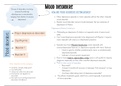
Group of disorders involving
severe & enduring How are mood disorders distinguished?
disturbances in emotionality
ranging from elation to severe o Either depressive episode or manic episode without the other= Unipolar
depression mood disorder
o Bipolar mood disorder= person travels between the two extremes of
depression & Mania
Depression-Mania Continuum
o Misleading as depression & elation not opposite ends of same mood
Mood disorders
state
o Don’t need depressive episode to be diagnosed with Bipolar I: requires
manic episode with anxious or depressed symptoms
o Episode may have manic episode with
anxious/depressed features, or depressive episode with manic features
Have to specify whether predominantly manic or predominantly
depressed episode
Indicator of more severe impairment
o Rare to have : person will qualify for bipolar
diagnosis, especially as they often manifest depressive episodes
Other disorders in this category: o *NB to note course of episodes:
Recurrent?
→ At least 2 months full recovery in between (“full remission”) or less
→
→
(Remission)
→ Are there alternating manic & depressive episodes?
o This affects treatments goals: relief from current episode, & prevention
→ of future episodes
, Depressive disorders
Diagnostic Criteria: Include specifiers in diagnosis as
they’re helpful in determining best
treatment & most likely course of
disease
8 specifiers to describe depressive disorder:
, o
o o
-
o -
o
Onset & duration of depression:
o
o Risk of developing major depression: low until teens- then begins to steadily rise
o Mean age of onset: 30 yrs. o
o 10% of people who develop it are 55 or older
o Depression & suicide steadily increasing
o Length of episodes varies: ranging from 2 weeks to several years
o Typical duration of 1st episode: 2-9 months if untreated
o Probability or remission within a year is 90%
o Episodes don’t always clear up: leave residual symptoms o
- likelihood of another is much higher- awareness of this is *nb to treatment planning
o Depressive disorder when symptoms begin: age of onset early 20yrs.
o Onset before 21yrs (or much earlier) characterized by:
1. Greater chronicity (longer)
2. Relatively poor prognosis (response to treatment)
3. Stronger likelihood of running in the family
o Dysthymia may last 20-30 yrs or more
- median duration: approx. 5 yrs in adults & 4 yrs. In children
o patients with persistent depressive disorder with less severe depressive symptoms more likely
to attempt suicide
o common for major depressive episode & dysthymia to co-occur
o *NB to consider chronicity & persistence when diagnosing depressive disorders
severe & enduring How are mood disorders distinguished?
disturbances in emotionality
ranging from elation to severe o Either depressive episode or manic episode without the other= Unipolar
depression mood disorder
o Bipolar mood disorder= person travels between the two extremes of
depression & Mania
Depression-Mania Continuum
o Misleading as depression & elation not opposite ends of same mood
Mood disorders
state
o Don’t need depressive episode to be diagnosed with Bipolar I: requires
manic episode with anxious or depressed symptoms
o Episode may have manic episode with
anxious/depressed features, or depressive episode with manic features
Have to specify whether predominantly manic or predominantly
depressed episode
Indicator of more severe impairment
o Rare to have : person will qualify for bipolar
diagnosis, especially as they often manifest depressive episodes
Other disorders in this category: o *NB to note course of episodes:
Recurrent?
→ At least 2 months full recovery in between (“full remission”) or less
→
→
(Remission)
→ Are there alternating manic & depressive episodes?
o This affects treatments goals: relief from current episode, & prevention
→ of future episodes
, Depressive disorders
Diagnostic Criteria: Include specifiers in diagnosis as
they’re helpful in determining best
treatment & most likely course of
disease
8 specifiers to describe depressive disorder:
, o
o o
-
o -
o
Onset & duration of depression:
o
o Risk of developing major depression: low until teens- then begins to steadily rise
o Mean age of onset: 30 yrs. o
o 10% of people who develop it are 55 or older
o Depression & suicide steadily increasing
o Length of episodes varies: ranging from 2 weeks to several years
o Typical duration of 1st episode: 2-9 months if untreated
o Probability or remission within a year is 90%
o Episodes don’t always clear up: leave residual symptoms o
- likelihood of another is much higher- awareness of this is *nb to treatment planning
o Depressive disorder when symptoms begin: age of onset early 20yrs.
o Onset before 21yrs (or much earlier) characterized by:
1. Greater chronicity (longer)
2. Relatively poor prognosis (response to treatment)
3. Stronger likelihood of running in the family
o Dysthymia may last 20-30 yrs or more
- median duration: approx. 5 yrs in adults & 4 yrs. In children
o patients with persistent depressive disorder with less severe depressive symptoms more likely
to attempt suicide
o common for major depressive episode & dysthymia to co-occur
o *NB to consider chronicity & persistence when diagnosing depressive disorders



