

Humanistic Approach
Free will
- All the approaches so far are deterministic (we do not have control over our own
behaviour)
- Humanistic approach suggests humans are self-determining and have free will
- Reject scientific models of human behaviour and focus on a person-centred approach.
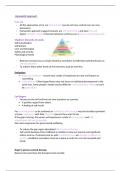
Maslow’s hierarchy of needs
Self-actualisation
Self Esteem
Love and belonging
Safety and security
Physiological needs
- Believes everyone has an innate tendency and desire to fulfil their potential known as
self-actualisation
- To achieve these other levels of the hierarchy must be met first.
Evaluation
Impact on business – ensure basic needs of employees are met and impact on
counselling
Cultural bias – China/Japan/Korea may not focus on individual development in the
same way. Some people’s needs may be different – low population validity so can’t
be generalised
Carl Rogers
- Focuses on the self and how we view ourselves as a person.
A positive regard from others
A feeling of self-worth
For personal growth to be achieved an individual’s self-concept must be broadly equivalent
or have congruence with their ideal self (person they want to be)
If the gap is too big, the person will experience a state of incongruence and self-
actualisation will not be possible.
We need congruence for good mental wellbeing.
- To reduce the gap rogers developed client centred therapy
- Self-worth develops from childhood in relation to how our parents and significant
others treat us. if parents treat us with conditional love, we develop conditions of
worth > conditions we believe must be in place in order for us to be accepted and
loved.
Roger’s person-centred therapy
Based on key premises the therapist must provide:
, Unconditional positive regard for the client
Empathy
- Aims to deal with ways in which people perceive themselves consciously, increase self-
worth, reduce level of incongruence, and help the person become a more fully
functioning person.
Evaluation
- Not scientific – untestable concepts
- Not reductionist – this approach is very holistic and therefore may have more validity
in explaining human behaviour
- Uses qualitative methods of study
- Produces a large amount of info, rich in detail although hard to analyse as its subjective
not scientific
EVALUATION
Not reductionist
- Rejects attempts to break up behaviour and experiences into smaller components.
- Explains human and animal learning in terms of simple stimulus response connections.
- Advocates holism – subjective experience can only be understood by considering the
whole person.
- This approach may have more validity that its alternatives by considering meaningful
human behaviour within its real-world context.
Counterpoint
- Relatively few concepts that can be broken down to single variables and measured
- Means humanistic psychology in general is short on empirical evidence to support its
claims.
Optimistic approach
- Optimistic, been praised for bringing the person back into psychology and promoting a
positive image of human condition.
- Sees all people as basically good, free to work towards the achievement of their
potential and in control of their lives.
- Offers a refreshing and optimistic alternative to other approaches that suggest a lack of
control over external factors
Western cultural bias
- Many ideas central to this approach such as individual freedom, autonomy and
personal growth are associated with individualist cultures.
- Collectivist cultures emphasise the needs of the group, community, and
interdependence.
- These cultures may not easily identify with ideals and values of humanistic psychology
(self-actualisation)
Free will
- All the approaches so far are deterministic (we do not have control over our own
behaviour)
- Humanistic approach suggests humans are self-determining and have free will
- Reject scientific models of human behaviour and focus on a person-centred approach.
Maslow’s hierarchy of needs
Self-actualisation
Self Esteem
Love and belonging
Safety and security
Physiological needs
- Believes everyone has an innate tendency and desire to fulfil their potential known as
self-actualisation
- To achieve these other levels of the hierarchy must be met first.
Evaluation
Impact on business – ensure basic needs of employees are met and impact on
counselling
Cultural bias – China/Japan/Korea may not focus on individual development in the
same way. Some people’s needs may be different – low population validity so can’t
be generalised
Carl Rogers
- Focuses on the self and how we view ourselves as a person.
A positive regard from others
A feeling of self-worth
For personal growth to be achieved an individual’s self-concept must be broadly equivalent
or have congruence with their ideal self (person they want to be)
If the gap is too big, the person will experience a state of incongruence and self-
actualisation will not be possible.
We need congruence for good mental wellbeing.
- To reduce the gap rogers developed client centred therapy
- Self-worth develops from childhood in relation to how our parents and significant
others treat us. if parents treat us with conditional love, we develop conditions of
worth > conditions we believe must be in place in order for us to be accepted and
loved.
Roger’s person-centred therapy
Based on key premises the therapist must provide:
, Unconditional positive regard for the client
Empathy
- Aims to deal with ways in which people perceive themselves consciously, increase self-
worth, reduce level of incongruence, and help the person become a more fully
functioning person.
Evaluation
- Not scientific – untestable concepts
- Not reductionist – this approach is very holistic and therefore may have more validity
in explaining human behaviour
- Uses qualitative methods of study
- Produces a large amount of info, rich in detail although hard to analyse as its subjective
not scientific
EVALUATION
Not reductionist
- Rejects attempts to break up behaviour and experiences into smaller components.
- Explains human and animal learning in terms of simple stimulus response connections.
- Advocates holism – subjective experience can only be understood by considering the
whole person.
- This approach may have more validity that its alternatives by considering meaningful
human behaviour within its real-world context.
Counterpoint
- Relatively few concepts that can be broken down to single variables and measured
- Means humanistic psychology in general is short on empirical evidence to support its
claims.
Optimistic approach
- Optimistic, been praised for bringing the person back into psychology and promoting a
positive image of human condition.
- Sees all people as basically good, free to work towards the achievement of their
potential and in control of their lives.
- Offers a refreshing and optimistic alternative to other approaches that suggest a lack of
control over external factors
Western cultural bias
- Many ideas central to this approach such as individual freedom, autonomy and
personal growth are associated with individualist cultures.
- Collectivist cultures emphasise the needs of the group, community, and
interdependence.
- These cultures may not easily identify with ideals and values of humanistic psychology
(self-actualisation)


