

BCA 1st Sem ( Programming In C)
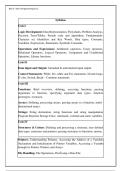
Syllabus
Unit-I
Logic Development: Data Representation, Flowcharts, Problem Analysis,
Decision Trees/Tables, Pseudo code and algorithms. Fundamentals:
Character set, Identifiers and Key Words, Data types, Constants,
Variables, Expressions, Statements, Symbolic Constants.
Operations and Expressions: Arithmetic operators, Unary operators,
Relational Operators, Logical Operators, Assignment and Conditional
Operators, Library functions.
Unit-II
Data Input and Output: formatted & unformatted input output.
Control Statements: While, Do–while and For statements, Nested loops,
If–else, Switch, Break – Continue statements.
Unit-III
Functions: Brief overview, defining, accessing functions, passing
arguments to function, specifying argument data types, function
prototypes, recursion.
Arrays: Defining, processing arrays, passing arrays to a function, multi–
dimensional arrays.
Strings: String declaration, string functions and string manipulation
Program Structure Storage Class: Automatic, external and static variables.
Unit-IV
Structures & Unions: Defining and processing a structure, user defined
data types, structures and pointers, passing structures to functions, unions.
Pointers: Understanding Pointers, Accessing the Address of a Variable,
Declaration and Initialization of Pointer Variables, Accessing a Variable
through its Pointer, Pointers and Arrays
1
File Handling: File Operations, Processing a Data File
, BCA 1st Sem ( Programming In C)
INDEX
S. No Contents Page No
1 Logic Development 5-34
2 Operations and Expressions 34-47
3 Data Input and Output 49-53
4 Control Statements 54-71
5 Functions 73-87
6 Arrays 88-99
7 Strings 100-112
8 Structures & Unions 114-123
9 Pointers 123-126
10 File Handling 126-133
2
,BCA 1st Sem ( Programming In C)
UNIT –I
3
, BCA 1st Sem ( Programming In C)
Data Representation
•Data refers to the symbols that represent people, events, things, and ideas. Data
can be a name, a number, the colors in a photograph, or the notes in a musical
composition.
•Data Representation refers to the form in which data is stored, processed, and
transmitted.
Number systems are the technique to represent numbers in the computer system
architecture, every value that you are saving or getting into/from computer
memory has a defined number system.
Computer architecture supports following number systems.
Binary number system
Octal number system
Decimal number system
Hexadecimal (hex) number system
1) Binary Number System
A Binary number system has only two digits that are 0 and 1. Every number
(value) represents with 0 and 1 in this number system. The base of binary number
system is 2, because it has only two digits.
4
Syllabus
Unit-I
Logic Development: Data Representation, Flowcharts, Problem Analysis,
Decision Trees/Tables, Pseudo code and algorithms. Fundamentals:
Character set, Identifiers and Key Words, Data types, Constants,
Variables, Expressions, Statements, Symbolic Constants.
Operations and Expressions: Arithmetic operators, Unary operators,
Relational Operators, Logical Operators, Assignment and Conditional
Operators, Library functions.
Unit-II
Data Input and Output: formatted & unformatted input output.
Control Statements: While, Do–while and For statements, Nested loops,
If–else, Switch, Break – Continue statements.
Unit-III
Functions: Brief overview, defining, accessing functions, passing
arguments to function, specifying argument data types, function
prototypes, recursion.
Arrays: Defining, processing arrays, passing arrays to a function, multi–
dimensional arrays.
Strings: String declaration, string functions and string manipulation
Program Structure Storage Class: Automatic, external and static variables.
Unit-IV
Structures & Unions: Defining and processing a structure, user defined
data types, structures and pointers, passing structures to functions, unions.
Pointers: Understanding Pointers, Accessing the Address of a Variable,
Declaration and Initialization of Pointer Variables, Accessing a Variable
through its Pointer, Pointers and Arrays
1
File Handling: File Operations, Processing a Data File
, BCA 1st Sem ( Programming In C)
INDEX
S. No Contents Page No
1 Logic Development 5-34
2 Operations and Expressions 34-47
3 Data Input and Output 49-53
4 Control Statements 54-71
5 Functions 73-87
6 Arrays 88-99
7 Strings 100-112
8 Structures & Unions 114-123
9 Pointers 123-126
10 File Handling 126-133
2
,BCA 1st Sem ( Programming In C)
UNIT –I
3
, BCA 1st Sem ( Programming In C)
Data Representation
•Data refers to the symbols that represent people, events, things, and ideas. Data
can be a name, a number, the colors in a photograph, or the notes in a musical
composition.
•Data Representation refers to the form in which data is stored, processed, and
transmitted.
Number systems are the technique to represent numbers in the computer system
architecture, every value that you are saving or getting into/from computer
memory has a defined number system.
Computer architecture supports following number systems.
Binary number system
Octal number system
Decimal number system
Hexadecimal (hex) number system
1) Binary Number System
A Binary number system has only two digits that are 0 and 1. Every number
(value) represents with 0 and 1 in this number system. The base of binary number
system is 2, because it has only two digits.
4


