

SAMENVATTING TRANSPORT ECONOMICS
H0: INTRODUCTION
1.Derived demand
- Transport is a derived demand, means that nobody transport goods just for fun, but with a
purpose.
- Derived demand means that there must be a reason to transport goods from A to B.
o That’s why just building infrastructure is a bad idea, because you can build a very
beautiful airport but if no one wants to go there than isn’t good.
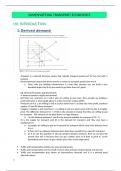
- Dg: demand for goods, ging downwards
- A: balance between supply and demand
- But there are customers at C and K who are willing to pay more, they actually are making a
profit with price A, the triangle above A is the consumer surplus (WTP)
- Producers at B or L are willing to sell at a price lower than A, so they also have profit, producer
surplus. CS and PS allows transport.
- Imagine a supplier L and customer K, L is willing to sell at a lower price and K to pay at a higher
price. The difference between K-L = M this is the amount of money that they are willing to pay
for transport . This amount can be big if there is a huge distance.
o So the distance between C and B is the amount available for transport (C-B = T).
- St is the supply for transport and Dt is the demand for transport and they also have a
equilibruim M.
o so people are willing to pay an M amount for transport which covers the distance from
K to L.
o If there isn’t any distance between them than there wouldn’t be a need for transport.
o So if we ask the question of why do people transport products, than we can give the
answer that this is because they can get a better price in B than in point A. at the
destination point they can get a better price than at the origin point.
Traffic and transportation hardly ever arise spontaneously
Traffic and transportation are the result of some other primary need for goods and services
Traffic and transportation thus shows an intermediary character and it is a derived need
(derived nature)
1
, Graphical analysis: the derived nature of transport demand
o Starting situation: a commodity is supplied in Antwerp and demanded for in Ghent, and
the commodity thus needs to be transported
o Step 1: consider a quantity x (less than Y)
o Step 2: determine the delivery price OB
o Step 3: determine the willingness to pay OC
o Step 4: OC – OB gives the basics of calculating the MAXIMUM cost of transportation
o Step 5: derive Dt
Step 6: assume St (upward sloping curve and based on marginal costs)
Step 7: determine E (new quantity equilibrium taking into account
transportation costs)
2.The traffic and transportation system
The difference between traffic and transportation
Traffic consists of 2 components:
1. Means of transport: mobile capital goods like vehicles, trains, vessels,
aeroplanes, etc.
2. Infrastructure: fixed capital goods
1. and 2. are PERMANENT COMPONENTS and result into a so-called
traffic performance
o Example: the new tram (Flexity 2) has a traffic performance of 48
fixed and 24 folding seats plus space for 330 standing passengers
- Traffic: the moving of vehicles.
- Traffic at itself isn’t intersting because there is no added value in the traffic itself.
- We measure traffic performance by measuring the capacity
Transportation takes into account the two permanent components of traffic plus the VARIABLE
COMPONENT LOAD
Transportation exists of
1. Means of transport
2. Infrastructure
3. Load
Example: the new tram (Flexity 2) has an (average) transportation performance of 2,000
passengers on line 1 in Ghent on Monday evening (note: this is just an example)
Transportation is much more interesting because we have something to transport, so you create added
value by transporting things from A to B. Here its about measuring the amounts of goods transported.
CONCUSION:
Traffic: capacity
Transportation: amount of goods
2
, 3. Transportation subsystems
3.1 classification by the type of load
A. Passenger transport
Private transport: government doesn’t give sanctions and the owner decides who gets to
use it
o F.ex.: school busses if you need to go in the same direction you can’t just hop on
it, because it’s privately owned
Public transport: government-imposed regulations
B. Freight transport
Bulk cargo: commodities that are transported in large quantities and without packaging
o Dry bulk goods: non-liquid commodities (e.g. iron ore, coal and grain)
o Liquid bulk commodities: e.g. crude oil, petroleum products, chemicals
General cargo: goods that are consigned per item or package
o Handled piece by piece
o Break-bulk: goods in small packaging, i.e. bags and boxes, that are loaded and
unloaded on pallets by means of shipboard cranes (e.g. flour, sugar,
fruit)
o Neo-bulk: various goods that are shipped and handled as a single item
(e.g. steel products, heavy machinery)
o Roll-on / roll-off: trucks and passenger cars that are driven onto and
off ships via ramps
o Containers
3.2 classification by the type of load
A. Passenger transport
Important criteria: price, comfort, accessibility and speed
The relationship between accessibility and speed is often inverse
o Private cars have an almost unlimited accessibility (both in time and space)
compared to trains and trams (because of the grid-like infrastructures)
o However, considering traffic congestion, what about the speed of transportation?
Use of space by different modes in passenger transport?
3
, B. Freight transport
Modal choice = f(type of goods, transportation distance)
6 transport modes: Road, Rail, Air, Sea, IWW, Pipeline
The value of the goods which results also in the speed and the distance decide whether whe are
going to take the train, plane,…
3.3 scheduled and non-scheduled transport
Scheduled transportation: public transport and scheduled airline flight
o Especially in sea shipping it will be scheduled. But if you want to transport very special
things than you cannot do scheduled transportation, than you will need to order a ship.
Non-scheduled transportation: not operating according to a fixed schedule
o taxi, own car,..
o E.g. inland navigation and maritime transportation: “tramp shipping”
o E.g. air transport: “chartering”
3.4 Own account vs. Third party service
Own account: some companies do this but is very expensive, most of the companies are using third
party service providers.
4. Measuring transport and transportation
performance
Question: Which units are used in the transportation sector in order to express “mobility”?
First method: quantity transported
From an infrastructure or government point of view you are more interested in traffic. But from
a transportation performane point of view you are more interested in passengers.
4
H0: INTRODUCTION
1.Derived demand
- Transport is a derived demand, means that nobody transport goods just for fun, but with a
purpose.
- Derived demand means that there must be a reason to transport goods from A to B.
o That’s why just building infrastructure is a bad idea, because you can build a very
beautiful airport but if no one wants to go there than isn’t good.
- Dg: demand for goods, ging downwards
- A: balance between supply and demand
- But there are customers at C and K who are willing to pay more, they actually are making a
profit with price A, the triangle above A is the consumer surplus (WTP)
- Producers at B or L are willing to sell at a price lower than A, so they also have profit, producer
surplus. CS and PS allows transport.
- Imagine a supplier L and customer K, L is willing to sell at a lower price and K to pay at a higher
price. The difference between K-L = M this is the amount of money that they are willing to pay
for transport . This amount can be big if there is a huge distance.
o So the distance between C and B is the amount available for transport (C-B = T).
- St is the supply for transport and Dt is the demand for transport and they also have a
equilibruim M.
o so people are willing to pay an M amount for transport which covers the distance from
K to L.
o If there isn’t any distance between them than there wouldn’t be a need for transport.
o So if we ask the question of why do people transport products, than we can give the
answer that this is because they can get a better price in B than in point A. at the
destination point they can get a better price than at the origin point.
Traffic and transportation hardly ever arise spontaneously
Traffic and transportation are the result of some other primary need for goods and services
Traffic and transportation thus shows an intermediary character and it is a derived need
(derived nature)
1
, Graphical analysis: the derived nature of transport demand
o Starting situation: a commodity is supplied in Antwerp and demanded for in Ghent, and
the commodity thus needs to be transported
o Step 1: consider a quantity x (less than Y)
o Step 2: determine the delivery price OB
o Step 3: determine the willingness to pay OC
o Step 4: OC – OB gives the basics of calculating the MAXIMUM cost of transportation
o Step 5: derive Dt
Step 6: assume St (upward sloping curve and based on marginal costs)
Step 7: determine E (new quantity equilibrium taking into account
transportation costs)
2.The traffic and transportation system
The difference between traffic and transportation
Traffic consists of 2 components:
1. Means of transport: mobile capital goods like vehicles, trains, vessels,
aeroplanes, etc.
2. Infrastructure: fixed capital goods
1. and 2. are PERMANENT COMPONENTS and result into a so-called
traffic performance
o Example: the new tram (Flexity 2) has a traffic performance of 48
fixed and 24 folding seats plus space for 330 standing passengers
- Traffic: the moving of vehicles.
- Traffic at itself isn’t intersting because there is no added value in the traffic itself.
- We measure traffic performance by measuring the capacity
Transportation takes into account the two permanent components of traffic plus the VARIABLE
COMPONENT LOAD
Transportation exists of
1. Means of transport
2. Infrastructure
3. Load
Example: the new tram (Flexity 2) has an (average) transportation performance of 2,000
passengers on line 1 in Ghent on Monday evening (note: this is just an example)
Transportation is much more interesting because we have something to transport, so you create added
value by transporting things from A to B. Here its about measuring the amounts of goods transported.
CONCUSION:
Traffic: capacity
Transportation: amount of goods
2
, 3. Transportation subsystems
3.1 classification by the type of load
A. Passenger transport
Private transport: government doesn’t give sanctions and the owner decides who gets to
use it
o F.ex.: school busses if you need to go in the same direction you can’t just hop on
it, because it’s privately owned
Public transport: government-imposed regulations
B. Freight transport
Bulk cargo: commodities that are transported in large quantities and without packaging
o Dry bulk goods: non-liquid commodities (e.g. iron ore, coal and grain)
o Liquid bulk commodities: e.g. crude oil, petroleum products, chemicals
General cargo: goods that are consigned per item or package
o Handled piece by piece
o Break-bulk: goods in small packaging, i.e. bags and boxes, that are loaded and
unloaded on pallets by means of shipboard cranes (e.g. flour, sugar,
fruit)
o Neo-bulk: various goods that are shipped and handled as a single item
(e.g. steel products, heavy machinery)
o Roll-on / roll-off: trucks and passenger cars that are driven onto and
off ships via ramps
o Containers
3.2 classification by the type of load
A. Passenger transport
Important criteria: price, comfort, accessibility and speed
The relationship between accessibility and speed is often inverse
o Private cars have an almost unlimited accessibility (both in time and space)
compared to trains and trams (because of the grid-like infrastructures)
o However, considering traffic congestion, what about the speed of transportation?
Use of space by different modes in passenger transport?
3
, B. Freight transport
Modal choice = f(type of goods, transportation distance)
6 transport modes: Road, Rail, Air, Sea, IWW, Pipeline
The value of the goods which results also in the speed and the distance decide whether whe are
going to take the train, plane,…
3.3 scheduled and non-scheduled transport
Scheduled transportation: public transport and scheduled airline flight
o Especially in sea shipping it will be scheduled. But if you want to transport very special
things than you cannot do scheduled transportation, than you will need to order a ship.
Non-scheduled transportation: not operating according to a fixed schedule
o taxi, own car,..
o E.g. inland navigation and maritime transportation: “tramp shipping”
o E.g. air transport: “chartering”
3.4 Own account vs. Third party service
Own account: some companies do this but is very expensive, most of the companies are using third
party service providers.
4. Measuring transport and transportation
performance
Question: Which units are used in the transportation sector in order to express “mobility”?
First method: quantity transported
From an infrastructure or government point of view you are more interested in traffic. But from
a transportation performane point of view you are more interested in passengers.
4



