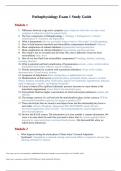
Pathophysiology Exam 1 Study Guide
Module 1
1. Difference between a sign and a symptom sign is objective (what the care taker sees)
symptom is subjective (what the patient feels)
3. The four components of Pathophysiology 1. Etiology 2. Pathogenesis 3. Clinical
manifestation 4. Treatment and implication
4. What is homeostasis the way our bodies bring us back to “the center” its self-regulating
5. How is fluid between interstitial and intracellular compartments distributed? Osmosis
6. Main complication of sodium imbalance hyponatremia and hypernatremia
7. Main complication of calcium imbalance hypocalcemia and hypocalcemia
8. How fluid is lost or excreted from the body (Yes, this is difference from loss from
extracellular) urine, feces
9. How do we lose fluid from extracellular compartment? Vomiting, diarrhea, urinating,
sweating, diuretics
10. What is potential and fatal complication of hyponatremia seizures, coma, cerebral edema
diminished deep tendon reflexes, muscle weakness,
11. Priority assessment for a patient with a potassium imbalance. Focus on the cardiac,
neuromuscular, GI and urinary systems
12. Symptoms of dehydration thirst, feeling dizzy or lightheaded, dry mouth
13. Manifestations of fluid excess peripheral edema, periorbital edema, anasarca, cerebral
edema, dyspnea, bounding pulse, tachycardia, jugular vein distension, hypertension, polyuria,
rapid weight gain, crackles, and bulging fontanelles
14. Cause of edema (The capillary hydrostatic pressure increases to cause edema in the
interstitial compartment) excess fluid in the interstitial space
15. Extracellular fluid has higher concentration of which electrolytes/substances sodium and
chloride
16. The energy currency of a cell and role the mitochondrion plays in this currency ATP the
mitochondria breakdown glucose for energy to produce ATP
17. Three electrolytes that are stored in and impact bone and the relationship they have to
each other calcium, Phosphate, Magnesium RELATIONSHIP: raised calcium =
decreased magnesium, raised calcium = decreased phosphorus, raised magnesium =
decreased phosphorus
18. Review the RAAS system. The information is in your module 1 content information. We
cover it in more detail in mod 6 but you need to know that the system regulates blood
pressure by vasoconstriction to increase blood pressure. We discussed this when we
talked about aldosterone.
Module 2
1. What happens during the alarm phase of Hans Selye’s General Adaptation
Syndrome? Epinephrine is released causing a decreased ability to respond to stressor, then
reducing resistance to stressor.
This study source was downloaded by 100000888857454 from CourseHero.com on 09-02-2024 14:57:16 GMT -05:00
https://www.coursehero.com/file/114552298/Exam-1-Study-Guide-Fall-2021docx/
Module 1
1. Difference between a sign and a symptom sign is objective (what the care taker sees)
symptom is subjective (what the patient feels)
3. The four components of Pathophysiology 1. Etiology 2. Pathogenesis 3. Clinical
manifestation 4. Treatment and implication
4. What is homeostasis the way our bodies bring us back to “the center” its self-regulating
5. How is fluid between interstitial and intracellular compartments distributed? Osmosis
6. Main complication of sodium imbalance hyponatremia and hypernatremia
7. Main complication of calcium imbalance hypocalcemia and hypocalcemia
8. How fluid is lost or excreted from the body (Yes, this is difference from loss from
extracellular) urine, feces
9. How do we lose fluid from extracellular compartment? Vomiting, diarrhea, urinating,
sweating, diuretics
10. What is potential and fatal complication of hyponatremia seizures, coma, cerebral edema
diminished deep tendon reflexes, muscle weakness,
11. Priority assessment for a patient with a potassium imbalance. Focus on the cardiac,
neuromuscular, GI and urinary systems
12. Symptoms of dehydration thirst, feeling dizzy or lightheaded, dry mouth
13. Manifestations of fluid excess peripheral edema, periorbital edema, anasarca, cerebral
edema, dyspnea, bounding pulse, tachycardia, jugular vein distension, hypertension, polyuria,
rapid weight gain, crackles, and bulging fontanelles
14. Cause of edema (The capillary hydrostatic pressure increases to cause edema in the
interstitial compartment) excess fluid in the interstitial space
15. Extracellular fluid has higher concentration of which electrolytes/substances sodium and
chloride
16. The energy currency of a cell and role the mitochondrion plays in this currency ATP the
mitochondria breakdown glucose for energy to produce ATP
17. Three electrolytes that are stored in and impact bone and the relationship they have to
each other calcium, Phosphate, Magnesium RELATIONSHIP: raised calcium =
decreased magnesium, raised calcium = decreased phosphorus, raised magnesium =
decreased phosphorus
18. Review the RAAS system. The information is in your module 1 content information. We
cover it in more detail in mod 6 but you need to know that the system regulates blood
pressure by vasoconstriction to increase blood pressure. We discussed this when we
talked about aldosterone.
Module 2
1. What happens during the alarm phase of Hans Selye’s General Adaptation
Syndrome? Epinephrine is released causing a decreased ability to respond to stressor, then
reducing resistance to stressor.
This study source was downloaded by 100000888857454 from CourseHero.com on 09-02-2024 14:57:16 GMT -05:00
https://www.coursehero.com/file/114552298/Exam-1-Study-Guide-Fall-2021docx/