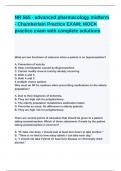
NR 565 - advanced pharmacology midterm
- Chamberlain Practice EXAM; MOCK
practice exam with complete solutions
What are two functions of naloxone when a patient is on buprenorphine?
A. Prevention of toxicity
B. Stop c\onstipation caused by Buprenorphine
C. Cannot readily reverse toxicity already occurring
D. Both A and C
D. Both A and C
3 multiple choice options
Why must an NP be cautious when prescribing medications to the elderly
population?
A. Due to their diagnosis of dementia.
B. They are high risk for polypharmacy.
C. The elderly population metabolizes medication faster.
D. Prescribe as usual. No difference in elderly patients.
B. They are high risk for polypharmacy.
There are several points of education that should be given to a patient
taking acetaminophen. Which of these statements if made by the patient
taking acetaminophen is incorrect?
A. "If I take one dose, I should wait at least four hours to take another."
B. "There is no limit to how many tablets I can take each day."
C. "I should not take Tylenol if I have liver disease or chronically drink
alcohol."
, D. "I can take 325-650mg for mild pain, and 500-1000mg for moderate pain."
B. "There is no limit to how many tablets you can take each day."
What is the point of a prescription drug monitoring program (PDMP)?
A. Help identify patients who may be at risk for overdose
B. Make prescribing faster for providers
C. Educate patients about overdose
D. Provide correct dosing and pricing information for providers
A. Help identify patients who may be at risk for overdose
The purpose of black box warnings is to make providers aware of
A. ways to reduce and prevent harm, such as pregnant women avoiding
teratogenic drugs.
B. potential common side effects, such as nausea, vomiting, or upset
stomach.
C. potential severe side effects, such as fetal harm, suicidality, or near-fatal
dysrhythmias.
D. Both A and C
D. Both A and C
Patients with renal and hepatic insufficiency can experience all of the
following effects from medications except:
A. Greater peak effects
B. Longer duration of action
C. Increased risk for respiratory depression
D. Increased dosages of medications
E. Increased risk of overdose
D. Increased dosages of medications
Which of the following is not a guiding principle for prescribers when
considering opioid medications?
A. Prescribe opioids only when non-pharmacologic and non-opioid
treatments have been ineffective.
B. Use the lowest effective dose for the shortest duration.
C. Assess the patient's risk of overdose.
D. Avoid referring patients to pain specialists for pain management.
D. Avoid referring patients to pain specialists for pain management.
- Chamberlain Practice EXAM; MOCK
practice exam with complete solutions
What are two functions of naloxone when a patient is on buprenorphine?
A. Prevention of toxicity
B. Stop c\onstipation caused by Buprenorphine
C. Cannot readily reverse toxicity already occurring
D. Both A and C
D. Both A and C
3 multiple choice options
Why must an NP be cautious when prescribing medications to the elderly
population?
A. Due to their diagnosis of dementia.
B. They are high risk for polypharmacy.
C. The elderly population metabolizes medication faster.
D. Prescribe as usual. No difference in elderly patients.
B. They are high risk for polypharmacy.
There are several points of education that should be given to a patient
taking acetaminophen. Which of these statements if made by the patient
taking acetaminophen is incorrect?
A. "If I take one dose, I should wait at least four hours to take another."
B. "There is no limit to how many tablets I can take each day."
C. "I should not take Tylenol if I have liver disease or chronically drink
alcohol."
, D. "I can take 325-650mg for mild pain, and 500-1000mg for moderate pain."
B. "There is no limit to how many tablets you can take each day."
What is the point of a prescription drug monitoring program (PDMP)?
A. Help identify patients who may be at risk for overdose
B. Make prescribing faster for providers
C. Educate patients about overdose
D. Provide correct dosing and pricing information for providers
A. Help identify patients who may be at risk for overdose
The purpose of black box warnings is to make providers aware of
A. ways to reduce and prevent harm, such as pregnant women avoiding
teratogenic drugs.
B. potential common side effects, such as nausea, vomiting, or upset
stomach.
C. potential severe side effects, such as fetal harm, suicidality, or near-fatal
dysrhythmias.
D. Both A and C
D. Both A and C
Patients with renal and hepatic insufficiency can experience all of the
following effects from medications except:
A. Greater peak effects
B. Longer duration of action
C. Increased risk for respiratory depression
D. Increased dosages of medications
E. Increased risk of overdose
D. Increased dosages of medications
Which of the following is not a guiding principle for prescribers when
considering opioid medications?
A. Prescribe opioids only when non-pharmacologic and non-opioid
treatments have been ineffective.
B. Use the lowest effective dose for the shortest duration.
C. Assess the patient's risk of overdose.
D. Avoid referring patients to pain specialists for pain management.
D. Avoid referring patients to pain specialists for pain management.