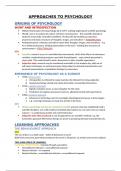
APPROACHES TO PSYCHOLOGY
ORIGINS OF PSYCHOLOGY
WUNT AND INTROSPECTION
William Wundt opens first psychology lab in 1879, marking beginning of scientific psychology
Wundt’s aim is to analyse the nature of human consciousness – first scientific attempt to
study the mind under controlled conditions. He does this by breaking up conscious
awareness into basic structures of thoughts, images, and sensations = INTROSPECTION
Participants given a stimulus and told to report their thoughts, images, and sensations – e.g.
for a ticking metronome. Dividing observations in this way + isolating the structures of
consciousness = STRUCTURALISM
AO3
Scientific: research occurs in controlled lab environments, which limit effects of extraneous
variables, standardised procedures used with all participants – same stimuli presented in
same order. This made Wundt’s work a forerunner to later scientific approaches
Subjective data: research may be considered unscientific in the modern day, with use of
self-report techniques on mental processes being subject to demand characteristics and
personal interpretations of qualitative findings by researchers
EMERGENCE OF PSYCHOLOGY AS A SCIENCE
1900s: behaviourists
o Introspection is criticised by many (namely John Watson) for being subjective
o Argued psychology should only study observable, measurable phenomena
1950s: cognitive approach
o Digital revolution serves as new metaphor for the mind
o Predictions of cognitive processes (memory, attention) tested with experiments
1980s: biological approach
o Advances in technology used to investigate physiological processes as they happen
o e.g. scanning techniques to study live activity in the brain
AO3
Modern psychology can also be considered scientific and over time has established itself a
scientific discipline: use of lab studies/controlled observations etc, has same aims as natural
sciences – to understand, predict and control behaviour
Subjective data often produced as not all approaches use scientific methods, e.g. the
humanistic approach AND human beings are prone to producing demand characteristics etc.
LEARNING APPROACHES
THE BEHAVIOURIST APPROACH
AO1:
‘We are all born as a blank state' - belief all behaviour is learnt
Belief basic processes governing learning are the same in all species, so animals used as test subjects
TWO MAIN FORMS OF LEARNING:
CLASSICAL CONDITIONING = learning through association
Unconditioned stimulus = unconditioned response
Neutral stimulus = no response
Neutral stimulus + unconditioned stimulus = unconditioned response
, Conditioned stimulus = conditioned response
Demonstrated by Pavlov’s dogs
OPERANT CONDITIONING = learning through consequence
POSITIVE REINFORCEMENT: increases likelihood of the behaviour being repeated by using
pleasant consequences when it occurs
NEGATIVE REINFORCEMENT: increases likelihood of the behaviour being repeated by using
taking away negatives when it happens
PUNISHMENT: decreases likelihood of a behaviour being repeated by using unpleasant
consequences when it occurs
Demonstrated by Skinner’s rats
AO3
Reliable data produced – focus on measuring observable behaviours in controlled lab
settings. Behaviours broken into in basic stimulus-response units (+ stimulus manipulated to
observe response), which minimises extraneous variables and allows cause and effect
relationships to be established
Counterpoint: behaviourists have oversimplified learning. Unlike other approaches e.g. SLT
and cognitive, the behaviourist approach draws no attention to the role of mental processes
in learning, e.g. the influence of human thought/attention. Learning may be more complex
than shown through observable behaviour alone
Environmental determinism: suggests all behaviour is the result of past conditioning,
ignoring any influence of free will – Skinner said himself free will is ‘an illusion’. This is an
extremist view can pose dangers e.g. in justice system
Useful application: principles of classical conditioning used to develop systematic
desensitisation – works by eliminating the learned anxious response (CR) associated with a
phobic stimulus (CS) and replace it with relaxation so patient is relieved of their conditioned
response. Effective for a range of phobias e.g. arachnophobia
SOCIAL LEARNING THEORY
AO1:
BANDURA: we learn by identifying with role models + imitating their behaviour – modelling.
Role models generally possess similar characteristics to the observer or are attractive/high
status. They don’t have to be physically present – important influence of media
Learning can occur directly, or indirectly through vicarious reinforcement – by observing
consequences of others behaviour. Imitation occurs if observer sees behaviour reinforced
rather than punished
For social learning to take place, mediational processes must be maintained:
o ATTENTION: need to attend to model's behaviour
o RETENTION: how well the behaviour is remembered
o MOTOR REPRODUCTION: physical capability of observer to reproduce behaviour
o MOTIVATION: receiving positive reinforcement for the modelled behaviour
Bandura et al: Children who watched aggressive behaviour towards a bobo doll imitated the
aggressive behaviour, and those shown calm behaviour imitated this . Children more likely to imitate
models if the models were seen to be rewarded, or those of the same sex as them.
AO3:
Bandura is a contrived study with little external validity. Children may not have encountered
a bobo doll before + believed the behaviour observed was how they were expected to use it,
rather than identifying with this behaviour – demand characteristics. The study doesn’t
necessarily tell us how children learn aggression in everyday life
Explains offending behaviour and gender development: both have role of vicarious
reinforcement
ORIGINS OF PSYCHOLOGY
WUNT AND INTROSPECTION
William Wundt opens first psychology lab in 1879, marking beginning of scientific psychology
Wundt’s aim is to analyse the nature of human consciousness – first scientific attempt to
study the mind under controlled conditions. He does this by breaking up conscious
awareness into basic structures of thoughts, images, and sensations = INTROSPECTION
Participants given a stimulus and told to report their thoughts, images, and sensations – e.g.
for a ticking metronome. Dividing observations in this way + isolating the structures of
consciousness = STRUCTURALISM
AO3
Scientific: research occurs in controlled lab environments, which limit effects of extraneous
variables, standardised procedures used with all participants – same stimuli presented in
same order. This made Wundt’s work a forerunner to later scientific approaches
Subjective data: research may be considered unscientific in the modern day, with use of
self-report techniques on mental processes being subject to demand characteristics and
personal interpretations of qualitative findings by researchers
EMERGENCE OF PSYCHOLOGY AS A SCIENCE
1900s: behaviourists
o Introspection is criticised by many (namely John Watson) for being subjective
o Argued psychology should only study observable, measurable phenomena
1950s: cognitive approach
o Digital revolution serves as new metaphor for the mind
o Predictions of cognitive processes (memory, attention) tested with experiments
1980s: biological approach
o Advances in technology used to investigate physiological processes as they happen
o e.g. scanning techniques to study live activity in the brain
AO3
Modern psychology can also be considered scientific and over time has established itself a
scientific discipline: use of lab studies/controlled observations etc, has same aims as natural
sciences – to understand, predict and control behaviour
Subjective data often produced as not all approaches use scientific methods, e.g. the
humanistic approach AND human beings are prone to producing demand characteristics etc.
LEARNING APPROACHES
THE BEHAVIOURIST APPROACH
AO1:
‘We are all born as a blank state' - belief all behaviour is learnt
Belief basic processes governing learning are the same in all species, so animals used as test subjects
TWO MAIN FORMS OF LEARNING:
CLASSICAL CONDITIONING = learning through association
Unconditioned stimulus = unconditioned response
Neutral stimulus = no response
Neutral stimulus + unconditioned stimulus = unconditioned response
, Conditioned stimulus = conditioned response
Demonstrated by Pavlov’s dogs
OPERANT CONDITIONING = learning through consequence
POSITIVE REINFORCEMENT: increases likelihood of the behaviour being repeated by using
pleasant consequences when it occurs
NEGATIVE REINFORCEMENT: increases likelihood of the behaviour being repeated by using
taking away negatives when it happens
PUNISHMENT: decreases likelihood of a behaviour being repeated by using unpleasant
consequences when it occurs
Demonstrated by Skinner’s rats
AO3
Reliable data produced – focus on measuring observable behaviours in controlled lab
settings. Behaviours broken into in basic stimulus-response units (+ stimulus manipulated to
observe response), which minimises extraneous variables and allows cause and effect
relationships to be established
Counterpoint: behaviourists have oversimplified learning. Unlike other approaches e.g. SLT
and cognitive, the behaviourist approach draws no attention to the role of mental processes
in learning, e.g. the influence of human thought/attention. Learning may be more complex
than shown through observable behaviour alone
Environmental determinism: suggests all behaviour is the result of past conditioning,
ignoring any influence of free will – Skinner said himself free will is ‘an illusion’. This is an
extremist view can pose dangers e.g. in justice system
Useful application: principles of classical conditioning used to develop systematic
desensitisation – works by eliminating the learned anxious response (CR) associated with a
phobic stimulus (CS) and replace it with relaxation so patient is relieved of their conditioned
response. Effective for a range of phobias e.g. arachnophobia
SOCIAL LEARNING THEORY
AO1:
BANDURA: we learn by identifying with role models + imitating their behaviour – modelling.
Role models generally possess similar characteristics to the observer or are attractive/high
status. They don’t have to be physically present – important influence of media
Learning can occur directly, or indirectly through vicarious reinforcement – by observing
consequences of others behaviour. Imitation occurs if observer sees behaviour reinforced
rather than punished
For social learning to take place, mediational processes must be maintained:
o ATTENTION: need to attend to model's behaviour
o RETENTION: how well the behaviour is remembered
o MOTOR REPRODUCTION: physical capability of observer to reproduce behaviour
o MOTIVATION: receiving positive reinforcement for the modelled behaviour
Bandura et al: Children who watched aggressive behaviour towards a bobo doll imitated the
aggressive behaviour, and those shown calm behaviour imitated this . Children more likely to imitate
models if the models were seen to be rewarded, or those of the same sex as them.
AO3:
Bandura is a contrived study with little external validity. Children may not have encountered
a bobo doll before + believed the behaviour observed was how they were expected to use it,
rather than identifying with this behaviour – demand characteristics. The study doesn’t
necessarily tell us how children learn aggression in everyday life
Explains offending behaviour and gender development: both have role of vicarious
reinforcement