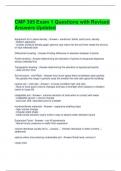
CMP 305 Exam 1 Questions with Revised
Answers Updated
Equipment for in place density - Answer-- sandcone: bottle, sand cone, density
- balloon apparatus
- nuclear moisture density gage: gamma rays inject into the soil then reads the amount
of rays reflected back
Differential Leveling - Answer-Finding difference in elevation between 2 points
Profile leveling - Answer-determining the elevation of points at measured distances
along a selected line
Topographic leveling - Answer-determining the elevation of spaced grid points
- uses contour lines
Soil structure - void Ratio - Answer-how much space there is between each particle
- the greater the range in particle sizes the smaller the void ratio (good for building)
coarse soil - void ratio - Answer-- in loose condition high void ratio
- likely to have quick volume changes and loss of strength when subject to vibration
(when in loose fill)
collapsible soil - Answer-- volume reduction of soils when in contact with water
- collapsible gravel = volume change
- sand can shift, saturated sand is unstable
montmorillonite materials - Answer-- expansive swelling clays
- high volume change
- irregular plate shape
- weak bonds between layers make it easy to absorb water between layers
Expansive Force - Answer-- can lift pavements
- lateral forces: pressure on walls from expansion
volume decrease usually do to... causes... - Answer-decrease in water content....
settlement
options when encountering undesirable soil - Answer-Small area: remove it
Large area:
, - remove it$$
- chemical stabilization: lime slurry mix
- piles/ caissons
Bentonite clay - Answer-good for well drilling
Soil trafficablility - Answer-ability of soil to support the weight of vehicles under repeated
traffic
Soil load ability - Answer-measure of difficulty in excavating and loading soil
- high load ability: loose granular soils
- low load ability: compacted soils
units for soil weight - Answer-- lbs/ per cubic foot
- lbs/cy
- tons/cy
Soil volume characteristics: Bank - Answer-- Material in its natural state
- units: BCY, bank cubic yard
Types of Leveling - Answer-- Differential Level
- Profile
- Topographic
Accuracy of differential leveling depends on...
and common mistake - Answer-- centering of bubble
- keeping the rod vertical
- equal sight distances for the BS and FS
- length of sight: be practical
-common mistake: reading wrong foot mark
Types of Levels - Answer-construction level
self compensating
construction level - Answer-- dumpy 10-20x
- simple
- straight line measurements
self compensating - Answer-- easier to use
- what we use in lab
Transit and theodolites - Answer-- both work in the horizontal and vertical plane
- rotate angles
- vertical measurements
- transit is more traditional, few automated features
- theodolite can read angles ver y accurately of up to 1 sec of an arc
Answers Updated
Equipment for in place density - Answer-- sandcone: bottle, sand cone, density
- balloon apparatus
- nuclear moisture density gage: gamma rays inject into the soil then reads the amount
of rays reflected back
Differential Leveling - Answer-Finding difference in elevation between 2 points
Profile leveling - Answer-determining the elevation of points at measured distances
along a selected line
Topographic leveling - Answer-determining the elevation of spaced grid points
- uses contour lines
Soil structure - void Ratio - Answer-how much space there is between each particle
- the greater the range in particle sizes the smaller the void ratio (good for building)
coarse soil - void ratio - Answer-- in loose condition high void ratio
- likely to have quick volume changes and loss of strength when subject to vibration
(when in loose fill)
collapsible soil - Answer-- volume reduction of soils when in contact with water
- collapsible gravel = volume change
- sand can shift, saturated sand is unstable
montmorillonite materials - Answer-- expansive swelling clays
- high volume change
- irregular plate shape
- weak bonds between layers make it easy to absorb water between layers
Expansive Force - Answer-- can lift pavements
- lateral forces: pressure on walls from expansion
volume decrease usually do to... causes... - Answer-decrease in water content....
settlement
options when encountering undesirable soil - Answer-Small area: remove it
Large area:
, - remove it$$
- chemical stabilization: lime slurry mix
- piles/ caissons
Bentonite clay - Answer-good for well drilling
Soil trafficablility - Answer-ability of soil to support the weight of vehicles under repeated
traffic
Soil load ability - Answer-measure of difficulty in excavating and loading soil
- high load ability: loose granular soils
- low load ability: compacted soils
units for soil weight - Answer-- lbs/ per cubic foot
- lbs/cy
- tons/cy
Soil volume characteristics: Bank - Answer-- Material in its natural state
- units: BCY, bank cubic yard
Types of Leveling - Answer-- Differential Level
- Profile
- Topographic
Accuracy of differential leveling depends on...
and common mistake - Answer-- centering of bubble
- keeping the rod vertical
- equal sight distances for the BS and FS
- length of sight: be practical
-common mistake: reading wrong foot mark
Types of Levels - Answer-construction level
self compensating
construction level - Answer-- dumpy 10-20x
- simple
- straight line measurements
self compensating - Answer-- easier to use
- what we use in lab
Transit and theodolites - Answer-- both work in the horizontal and vertical plane
- rotate angles
- vertical measurements
- transit is more traditional, few automated features
- theodolite can read angles ver y accurately of up to 1 sec of an arc