100% satisfaction guarantee Immediately available after payment Both online and in PDF No strings attached 4.2 TrustPilot
logo-home
Exam (elaborations)

Quiz 3 for BSC 1005 Questions And Answers Rated A+ New Update Assured Satisfaction

Rating
-
Sold
-
Pages
4
Grade
A+
Uploaded on
01-09-2024
Written in
2024/2025

Proteins can be labeled with radioactivity in order to trace their pathway through a living cell. Choose the one list from below that represents the correct pathway of an antibody protein produced by an immune system B cell. The pathway would start where they are made inside the cell to the point where they exit the cell to enter the lymphatic or circulatory system. - ribosomes > rough ER > vesicles > Golgi apparatus > vesicles > cell membrane (Protein production always starts with a ribosome. Then the rough ER will "finish" and fold and package them, and send them via vesicles to the Golgi apparatus. There they are further modified so they can be shipped, via vesicles again, to destinations either inside the cell they were made, or outside of the cell membrane to foreign destinations, as in this case with the antibodies.) What is assumed to be the advantage of the long, folded inner membrane of the mitochondria? What do the folds of the inner membrane do to make the mitochondrion more efficient? - increased surface area for cell respiration reactions. (It is thought that the folded inner membrane increases the surface area, which is the surface area of the mitochondria on which ATP is actually created via the Electron Transport Chain.) Viruses are members of which one of the three Domains of living organisms? - - Archea - Bacteria - Eukarya - None Answer: NoNE: Viruses are not considered to be living organisms, and therefore are not classified with other living organisms into any of the three Domains that we put all other living things. The cellular cytoskeleton of eukaryotes contains which of these types of protein fibers? - If it isn't microtubules, intermediate filaments, and microfilaments (actin filaments), then it's wrong. Those 3 are the three types of protein fibers. Which structures within a cell are responsible for making (or more accurately, recharging) the ATP molecules used for cellular energy? - mitochondria ; The mitochondria are the cellular power plants.The Cell Theory of Schleiden and Schwann was very important in establishing that... - all living things are composed of at least one living cell. Every living cell on the planet is enclosed by a - lipid bilayer cell membrane. What is it that viruses cannot or will not do that causes them to be defined as a separate group of organisms, and not as true, living cells? - They cannot replicate themselves or reproduce without being inside a living cell. (Virus particles do not have the machinery for replication or reproduction. That is why they must invade living cells. The virus particles are using the replication machinery of the living cells to do the work that the virus cannot do. Viruses do use RNA and DNA just like cells. They do assemble proteins just like cells. And they do have structure to their particles (although they do not have a lipid bilayer cell membrane like all other living cells).) Based on the results of your iodine and methylene blue staining in the cell lab, would you say that plant cell walls are permeable or impermeable to water and other solutes (molecules dissolved in water)? - permeable ; The best evidence for permeability of the cell wall is the iodine being able to stain the starch granules inside the potato cells. But you also were able to see the iodine get inside the onion cell and stain the nucleus yellow/gold. Cilia, flagella, and pseudopodia are all involved in... - movement or motion of the cell in its normal environment. Lysosomes are compared to what type of human-manufactured device? - Garbage disposal What is one cell type in the human body that does not contain any mitochondria? - red blood cell (Mature red blood cells do not contain any mitochondria. In fact, red blood cells don't really have any of the major organelles, including a nucleus.) Why, from a functional or performance standpoint, are most individual cells very, very, small (whether prokaryotic or eukaryotic)? - the surface area to volume ratio has to be high enough for diffusion and osmosis to be able to occur. (Cells have to stay small enough so that diffusion and osmosis can still occur at a rate that allows the cell to function properly. If the cell gets too big, the interior of the cell will be too far away from the exterior (the cell membrane) and the rate of diffusion or osmosis cannot change to make up for that distance, so the cell won't be able to get materials in and out at proper speeds.)What are two important pieces of evidence that support the endosymbiotic theory, which says that chloroplasts and mitochondria were once free-living bacteria? - Both organelles contain their own DNA, and both are surrounded by their own lipid bilayer membrane. (There is quite a bit of supporting evidence, but the two listed here are the fact that both chloroplasts and mitochondria are surrounded by their own lipid bilayer, separate from the actual cell in which they reside; and that both chloroplasts and mitochondria contain their own DNA, separate from the DNA in the nucleus of the cell in which they reside. These and other facts have supported the theory that those two organelles started life as freeliving bacteria, and were co-opted by a eukaryotic cell at some point, and eventually evolved into a full time resident.) Which of these organelles would typically be found in large numbers within the cells of the human liver? - smooth ER (The human liver is a detoxification plant, and the liver cells are full of smooth ER to aid in removing toxins that enter the bloodstream and are delivered to the liver cells. Alcoholics typically have liver cells that are packed full of smooth ER, trying desperately to process the constant stream of alcohol (a poison to your cells) present in the blood.)

Show more Read less
Institution
BSC 1005
Course
BSC 1005


Whoops! We can’t load your doc right now. Try again or contact support.

Written for

Institution
BSC 1005
Course
BSC 1005

Document information

Uploaded on
September 1, 2024
Number of pages
4
Written in
2024/2025
Type
Exam (elaborations)
Contains
Questions & answers

Subjects

Content preview

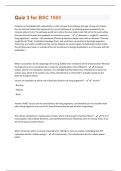
Quiz 3 for BSC 1005
Proteins can be labeled with radioactivity in order to trace their pathway through a living cell. Choose
the one list from below that represents the correct pathway of an antibody protein produced by an
immune system B cell. The pathway would start where they are made inside the cell to the point where
they exit the cell to enter the lymphatic or circulatory system. - ribosomes > rough ER > vesicles >
Golgi apparatus > vesicles > cell membrane (Protein production always starts with a ribosome. Then the
rough ER will "finish" and fold and package them, and send them via vesicles to the Golgi apparatus.
There they are further modified so they can be shipped, via vesicles again, to destinations either inside
the cell they were made, or outside of the cell membrane to foreign destinations, as in this case with the
antibodies.)


What is assumed to be the advantage of the long, folded inner membrane of the mitochondria? What do
the folds of the inner membrane do to make the mitochondrion more efficient? - increased
surface area for cell respiration reactions. (It is thought that the folded inner membrane increases the
surface area, which is the surface area of the mitochondria on which ATP is actually created via the
Electron Transport Chain.)

Viruses are members of which one of the three Domains of living organisms? - - Archea

- Bacteria

- Eukarya

- None


Answer: NoNE: Viruses are not considered to be living organisms, and therefore are not classified with
other living organisms into any of the three Domains that we put all other living things.


The cellular cytoskeleton of eukaryotes contains which of these types of protein fibers? - If it isn't
microtubules, intermediate filaments, and microfilaments (actin filaments), then it's wrong. Those 3 are
the three types of protein fibers.


Which structures within a cell are responsible for making (or more accurately, recharging) the ATP
molecules used for cellular energy? - mitochondria ; The mitochondria are the cellular power
plants.

Get to know the seller

Seller avatar
Reputation scores are based on the amount of documents a seller has sold for a fee and the reviews they have received for those documents. There are three levels: Bronze, Silver and Gold. The better the reputation, the more your can rely on the quality of the sellers work.
PatrickKaylian Delaware State University
View profile
Follow You need to be logged in order to follow users or courses
Sold
1820
Member since
2 year
Number of followers
1044
Documents
22126
Last sold
3 days ago

3.8

317 reviews

5
147
4
60
3
54
2
16
1
40

Recently viewed by you

Why students choose Stuvia

Created by fellow students, verified by reviews

Quality you can trust: written by students who passed their tests and reviewed by others who've used these notes.

Didn't get what you expected? Choose another document

No worries! You can instantly pick a different document that better fits what you're looking for.

Pay as you like, start learning right away

No subscription, no commitments. Pay the way you're used to via credit card and download your PDF document instantly.

Student with book image

“Bought, downloaded, and aced it. It really can be that simple.”

Alisha Student

Frequently asked questions