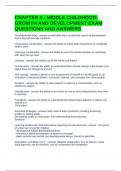
CHAPTER 4 - MIDDLE CHILDHOOD:
GROWTH AND DEVELOPMENT EXAM
QUESTIONS AND ANSWERS
Developmental delay - answer-a noticeable lag in a particular aspect of development
that is beyond average variations
Visual-motor coordination - answer-the ability to match body movements to coordinate
what is seen
Hand-eye coordination - answer-the ability to move the hands precisely to coordinate
with what the eye sees
Dexterity - answer-the skillful use of the hands and fingers
Conservation - answer-the ability to understand that a simple change in the shape of an
object does not change its amount
Self-concept - answer-a person's own assessment of himself or herself based on an
evaluation of personal abilities, successes, failures, and concepts from other people
Seriation - answer-the ability to place objects in order by a characteristic, such as
smallest to largest
Classification - answer-the ability to sort items by one or more characteristics they have
in common
Transitivity - answer-the ability to understand that relationships between 2 objects can
extend to a
Third object
Executive strategies - answer-skills used to solve problems, including assessing
problems, setting goals,
Developing a plan to meet goals, and implementing and evaluation
Solutions
Learning initiative are important before beginning schools because - answer-- first years
of school are crucial for children
- development follows predictable patterns
- information about development is based on averages
- slight variation are normal, but developmental delays should be identified
Description of children 5 to 7: - answer-talkative, imaginative, love to explore, crave
adult approval, can be sensitive, can be cooperative yet competitive
, Physical growth and development (5 to 7) - answer-- growth in height and weight slows
during this period
- bodies look longer and leaner
- baby teeth are replaced by permanent teeth
Gross motor skills (5 to 7) - answer-- better developed than fine-motor skills
- physical skills make them feel independent
- full of energy to run, jump, skip, hop
- activities improve balance and coordination
- fearlessness may result in accidents
Fine motor skills (5 to 7) - answer-- hand eye coordination and dexterity improves
- writing skill are a combination of cognitive and physical development
- cutting, coloring, building, and playing electronic games all develop fine-motor skills
- self care depends on fine-motor development
Cognitive development (5 to 7) - answer-- children are eager to learn, excited about
starting school, and curious and excited for independence
- they also have limited attention span and learn better through experience
Thinking skills (5 to 7) - answer-- at age 5 children are unable to understand
conservation
- they begin to understand around age 7
- children begin to understand sequence of steps and mix of words, logic, and humor
- imagination is still vivid and allows them to express anxiety and conflict
Language and reading (5 to 7) - answer-- children identify letters as symbols
- being to recognize the sounds they make
- start with letter combinations, then word combinations
- by the end of 2nd grade, many are competent readers
- children with difficulties at this stage need extra help
Social-emotional development (5 to 7) - answer-- children develop feelings of
competence by learning new skills
- self confidence grows
- they can feel interior to other children
Peer relationships (5 to 7) - answer-- peers become more important
- choice of friends may often change
- form closer one on one and group relationships
- girls usually play with girls, boys usually play with boys
Family relationships (5 to 7) - answer-- children want to please their parents
- they respond well to expectations and rules
- sibling relationships may vary from helpful to arguments
GROWTH AND DEVELOPMENT EXAM
QUESTIONS AND ANSWERS
Developmental delay - answer-a noticeable lag in a particular aspect of development
that is beyond average variations
Visual-motor coordination - answer-the ability to match body movements to coordinate
what is seen
Hand-eye coordination - answer-the ability to move the hands precisely to coordinate
with what the eye sees
Dexterity - answer-the skillful use of the hands and fingers
Conservation - answer-the ability to understand that a simple change in the shape of an
object does not change its amount
Self-concept - answer-a person's own assessment of himself or herself based on an
evaluation of personal abilities, successes, failures, and concepts from other people
Seriation - answer-the ability to place objects in order by a characteristic, such as
smallest to largest
Classification - answer-the ability to sort items by one or more characteristics they have
in common
Transitivity - answer-the ability to understand that relationships between 2 objects can
extend to a
Third object
Executive strategies - answer-skills used to solve problems, including assessing
problems, setting goals,
Developing a plan to meet goals, and implementing and evaluation
Solutions
Learning initiative are important before beginning schools because - answer-- first years
of school are crucial for children
- development follows predictable patterns
- information about development is based on averages
- slight variation are normal, but developmental delays should be identified
Description of children 5 to 7: - answer-talkative, imaginative, love to explore, crave
adult approval, can be sensitive, can be cooperative yet competitive
, Physical growth and development (5 to 7) - answer-- growth in height and weight slows
during this period
- bodies look longer and leaner
- baby teeth are replaced by permanent teeth
Gross motor skills (5 to 7) - answer-- better developed than fine-motor skills
- physical skills make them feel independent
- full of energy to run, jump, skip, hop
- activities improve balance and coordination
- fearlessness may result in accidents
Fine motor skills (5 to 7) - answer-- hand eye coordination and dexterity improves
- writing skill are a combination of cognitive and physical development
- cutting, coloring, building, and playing electronic games all develop fine-motor skills
- self care depends on fine-motor development
Cognitive development (5 to 7) - answer-- children are eager to learn, excited about
starting school, and curious and excited for independence
- they also have limited attention span and learn better through experience
Thinking skills (5 to 7) - answer-- at age 5 children are unable to understand
conservation
- they begin to understand around age 7
- children begin to understand sequence of steps and mix of words, logic, and humor
- imagination is still vivid and allows them to express anxiety and conflict
Language and reading (5 to 7) - answer-- children identify letters as symbols
- being to recognize the sounds they make
- start with letter combinations, then word combinations
- by the end of 2nd grade, many are competent readers
- children with difficulties at this stage need extra help
Social-emotional development (5 to 7) - answer-- children develop feelings of
competence by learning new skills
- self confidence grows
- they can feel interior to other children
Peer relationships (5 to 7) - answer-- peers become more important
- choice of friends may often change
- form closer one on one and group relationships
- girls usually play with girls, boys usually play with boys
Family relationships (5 to 7) - answer-- children want to please their parents
- they respond well to expectations and rules
- sibling relationships may vary from helpful to arguments